Hello! Welcome to the second lesson in our final module on Advanced Case Studies in Exciton Physics.
In our last lesson, we explored the fascinating world of Rydberg excitons in Cu₂O. We saw how this material acts as a near-perfect solid-state analogue of the hydrogen atom, supporting fragile, "giant" excitons with diameters on the micron scale. The key was a rigid lattice and weak interactions, leading to a beautifully clean and predictable energy spectrum.
Today, we pivot to a starkly different class of materials: halide perovskites. These materials are renowned for their exceptional performance in solar cells and LEDs, yet their excitonic properties are far from simple. Our goal is to explain the origin of large exciton binding energies in halide perovskites and the role of strong polaronic effects. You will see that the robustness and large binding energy of excitons in these materials stem from a complex and powerful interaction between the charge carriers and the crystal lattice itself.
1. The Halide Perovskite Puzzle
Organic-inorganic lead halide perovskites (OILHPs), with a chemical formula like APbX₃ (e.g., MAPbI₃, where MA = methylammonium), have taken the materials science world by storm. They combine excellent optical absorption with long carrier diffusion lengths, a combination that is ideal for photovoltaics.
However, a fundamental property—the exciton binding energy ()—has been a subject of intense debate. Reported values for a material like MAPbI₃ span a wide range from a few meV to over 50 meV. While this is much larger than in conventional semiconductors like GaAs ( meV), it's not nearly as large as in typical organic materials with tightly-bound Frenkel excitons (hundreds of meV).
This ambiguity presents a puzzle for the simple Wannier-Mott model we have often used. Recall the formula for the exciton binding energy:
where is the reduced effective mass, eV, and is the effective relative dielectric constant.
The core of the puzzle lies in choosing . Halide perovskites are ionic crystals, and they exhibit two very different dielectric constants:
- High-frequency dielectric constant, : This describes the screening from only the electronic clouds. It's relatively small (e.g., ).
- Static dielectric constant, : This includes screening from both the electrons and the displacement of ions in the lattice. Because perovskite lattices are "soft" and ionic, is very large (e.g., ).
Using would predict a very large binding energy, while using would predict a very small one. The experimental values lie somewhere in between. This tells us that the simple Wannier model is insufficient; the screening is more complex. To understand why, we need to consider how charge carriers interact with the soft, ionic lattice of a perovskite.
Exciton binding energies and polaron interplay...
To get a sense of the debate and the basic parameters involved, please read the introduction and the section on the Wannier-Mott model in this review article.
Please read Section 1 ('Introduction') and the first paragraph of Section 2 ('Techniques for determining exciton binding energies'). Focus on how OILHPs bridge the gap between traditional inorganic and organic semiconductors, the range of reported binding energies, and the problem associated with the dielectric constant in the Wannier-Mott model.
2. The Polaron: A Charge Carrier in a "Molasses" of Lattice Vibrations
The key to the perovskite puzzle is the polaron. Given your background in QFT, you can think of a polaron as the condensed matter analogue of a "dressed" particle. In QED, an electron is surrounded by a cloud of virtual photons. In a polar crystal, a charge carrier (electron or hole) is surrounded by a cloud of lattice vibrations (phonons) that it drags along with it.
This "dressing" occurs because the charge carrier's electric field polarizes the ionic lattice. In the soft, ionic lattice of a perovskite, this effect is particularly strong. The composite quasiparticle—the charge plus its induced lattice distortion—is the polaron.
Diagram of a negative Fröhlich polaron
Artist's view of a negative Fröhlich polaron. The electron (large sphere) moves through the ionic lattice, causing the surrounding positive ions to be pulled closer and negative ions to be pushed away. This lattice distortion cloud moves with the electron, effectively increasing its inertia (mass) and screening its charge.
The dominant mechanism for this in ionic crystals is the Fröhlich interaction, which describes the long-range Coulombic coupling between an electron and longitudinal optical (LO) phonons. The strength of this interaction is captured by the dimensionless Fröhlich coupling constant, :
where is the band effective mass of the carrier and is the characteristic LO phonon energy.
This equation neatly summarizes the physics:
- A large difference between and (i.e., strong ionic polarizability) increases .
- A low phonon energy (a "soft" lattice) increases .
- A larger band mass increases .
For halide perovskites, is typically in the range of 1-4, which signifies an intermediate-to-strong coupling regime. For comparison, in GaAs, , which is a very weak coupling.
The consequences of this strong coupling are profound:
- Mass Renormalization: The carrier becomes "heavier" because it has to drag the lattice distortion with it. In the weak coupling limit, the polaron mass is .
- Screening: The lattice distortion cloud screens the carrier's charge.
Test your understanding!
Consider two hypothetical ionic semiconductors, A and B, with the same effective mass and LO phonon energy. Semiconductor A has and . Semiconductor B has and . Which material would you expect to exhibit stronger polaronic effects? Justify your answer using the Fröhlich coupling constant.
Show answer
We need to compare the term for both materials.
- For A:
- For B:
Since all other factors in the formula for are the same, Semiconductor B will have a larger Fröhlich coupling constant (). Therefore, Semiconductor B will exhibit stronger polaronic effects due to its greater ionic polarizability (larger difference between and ).
3. The Excitonic Polaron and the Screening Dilemma
Now, let's build an exciton from two polarons: an electron-polaron and a hole-polaron. This object is called an excitonic polaron. The central question returns: how do these two dressed particles screen each other's Coulomb attraction?
The answer depends on the interplay between two characteristic length scales:
- Exciton Bohr radius, : The average separation between the electron and hole.
- Polaron radius, : The spatial extent of the lattice distortion cloud around a single carrier, given by .
The screening behavior changes depending on their relative size:
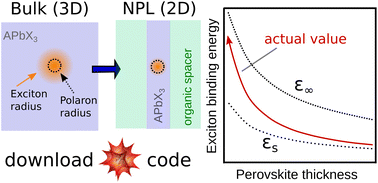
- Weak Coupling (): The electron and hole are far apart. They move slowly, and the lattice has ample time to fully respond to their presence. The screening is static, described by . This leads to a small binding energy.
- Strong Coupling (): The electron and hole are very close. They orbit each other so quickly that the heavy ions of the lattice cannot keep up. The screening is purely electronic, described by . This leads to a large binding energy.
- Intermediate Coupling (): This is the situation in halide perovskites. The lattice response is partial and dynamic. The screening is neither fully static nor purely electronic. The effective potential is complex and distance-dependent, transitioning from -like at long distances to -like at short distances.
This intermediate regime is precisely why the simple Wannier model fails. More sophisticated models are needed that can handle the electron-hole correlation and the coupling to phonons on an equal footing. One of the most successful frameworks for this is the Pollmann-Büttner-Kane (PBK) model.
Theoretical approaches to Fröhlich excitonic polarons in ...
The Pollmann-Büttner-Kane (PBK) model provides a powerful variational framework to solve the excitonic polaron problem. Please read the following section from the paper 'Theoretical approaches to Fröhlich excitonic polarons...' to understand the core concepts of this model.
Please read Section IV, 'POLLMAN-BÜTTNER-KANE MODEL FOR EXCITONIC POLARONS', up to the end of subsection A. Focus on: The structure of the exciton-phonon Hamiltonian (Eq. 36). The concept of the reduced free polaron radius eR_{pol} = R_{pol}/a_B (Eq. 38) as the key parameter determining the coupling regime. The general idea of the variational approach (Eqs. 42-45), where the goal is to find a wavefunction that minimizes the total energy of the exciton-polaron system. You don't need to follow every mathematical step, but grasp the physical picture of the method.
The PBK model essentially calculates the energy of the system by considering an effective potential that includes both the direct Coulomb attraction (screened by ) and a lattice-mediated potential that arises from the interaction of the two polaron clouds. Minimizing the total energy self-consistently yields the exciton binding energy and an effective Bohr radius. This method correctly predicts that for the intermediate coupling regime of perovskites, the binding energy is significantly enhanced compared to the weak-coupling limit.
4. Application to Halide Perovskites: The Final Pieces
The PBK model provides the right framework. When applied to halide perovskites, two additional features are critical for quantitative accuracy.
Multi-Phonon Modes
The simple Fröhlich model assumes a single LO phonon frequency. However, the vibrational spectra of perovskites are complex, featuring multiple polar optical modes that can couple to charge carriers. A realistic model must account for all these contributions. The PBK model can be extended to a multimode version (MPBK) by summing the contributions from each phonon branch.
Temperature Dependence and Anharmonicity
You may have noticed in your own research that perovskite properties are highly sensitive to temperature. This is because the soft lattice is highly anharmonic, meaning the vibrations are not perfect simple harmonic oscillations. At higher temperatures, this dynamic disorder significantly alters the phonon frequencies and the effective dielectric screening. This explains why exciton binding energies in perovskites often show a noticeable temperature dependence, a feature that is not easily captured by 0K theories like the standard PBK model but can be addressed by more advanced computational methods.
The following reading describes how the PBK model is extended to handle multiple phonon modes and applies it to real perovskite materials like MAPbI₃, MAPbBr₃, and CsPbCl₃, comparing the calculations to experimental data.
Theoretical approaches to Fröhlich excitonic polarons in ...
Let's see how these theoretical tools are applied to real materials. This section of the same paper discusses the extension of the model to include multiple phonon modes, a crucial step for accurately describing perovskites.
Please read Section VII, 'EXTENDING THE STANDARD EMPIRICAL APPROACH...'. Pay special attention to: The motivation for including multiple polar modes (paragraph 1). The approach of summing over mode contributions (Eqs. 87 and 88). The main conclusions from Tables VI, VII, and VIII: a single-mode approximation can be tuned to match experiments, but a multi-mode approach provides a more physical description by using measured phonon frequencies.
By incorporating these effects, theoretical models can reproduce the experimentally observed exciton binding energies in the range of 15-60 meV. The picture that emerges is one of an excitonic polaron: a correlated electron-hole pair, where each particle is dressed by a significant lattice polarization, leading to a reduction in the dielectric screening and a corresponding enhancement of their binding energy.
Conclusion
Today we have untangled the puzzle of the large exciton binding energy in halide perovskites. In stark contrast to the fragile, hydrogen-like excitons in Cu₂O, perovskite excitons are robust quasiparticles deeply intertwined with their lattice environment.
Key Takeaways:
- The large exciton binding energies in halide perovskites ( meV) are a result of inefficient dielectric screening of the electron-hole Coulomb attraction.
- This inefficiency arises from strong Fröhlich coupling between charge carriers and LO phonons in the soft, ionic perovskite lattice, leading to the formation of polarons.
- The system is in an intermediate coupling regime where the exciton Bohr radius is comparable to the polaron radius ().
- Sophisticated models like the multi-mode Pollmann-Büttner-Kane (MPBK) framework are required to accurately describe this "excitonic polaron" and correctly predict its binding energy.
Preview of the Next Lesson
We have now explored two fascinating and contrasting case studies: the "atomic" excitons in Cu₂O and the "polaronic" excitons in perovskites. In our next lesson, we will introduce another fundamental interaction that shapes exciton properties. We will explain the impact of the Rashba-Dresselhaus effect on the fine structure and spin dynamics of excitons in non-centrosymmetric crystals. This will add a rich layer of spin-orbit physics to our understanding of the exciton Hamiltonian.