Hello! Welcome to our final case study in this module.
In our last lesson, we explored the fascinating world of excitons confined within a single, atomically thin layer of a transition metal dichalcogenide (TMDC). We saw how this extreme 2D confinement leads to incredibly robust excitons and unique valley-dependent physics. You'll recall that we ended with the idea of stacking these layers to build new materials, known as van der Waals heterostructures.
Today, we will investigate one of the most exciting frontiers in modern condensed matter physics, which arises directly from this stacking concept. Our learning outcome is to describe the formation and properties of moiré excitons in twisted bilayer heterostructures. We will see how introducing a simple twist between two layers creates a large-scale periodic landscape—a moiré pattern—that acts as an artificial lattice for excitons, leading to a new class of engineered quantum states.
1. The Moiré Superlattice: An Emergent Landscape
When two periodic lattices are overlaid with a small rotational misalignment (a "twist angle," ) or a slight lattice mismatch, a new, larger-scale interference pattern emerges. This is the moiré pattern. In the context of stacked 2D materials, this creates a moiré superlattice.
For two identical hexagonal lattices with lattice constant , a small twist angle produces a moiré superlattice with a much larger period, , given by:
For a typical TMDC lattice constant of nm and a twist angle of ( radians), the moiré period is nm. This is orders of magnitude larger than the atomic lattice constant.
The Origin of the Moiré Potential
Why does this geometric pattern matter for excitons? The key is that the local atomic arrangement—and therefore the local electronic properties—varies periodically across the moiré supercell.
As you can see in the image below, different regions of the moiré pattern have different atomic stacking configurations. For example, in a WSe₂/MoSe₂ heterostructure, some regions will have a metal atom from one layer directly above a chalcogen atom from the other, while other regions will have different alignments.
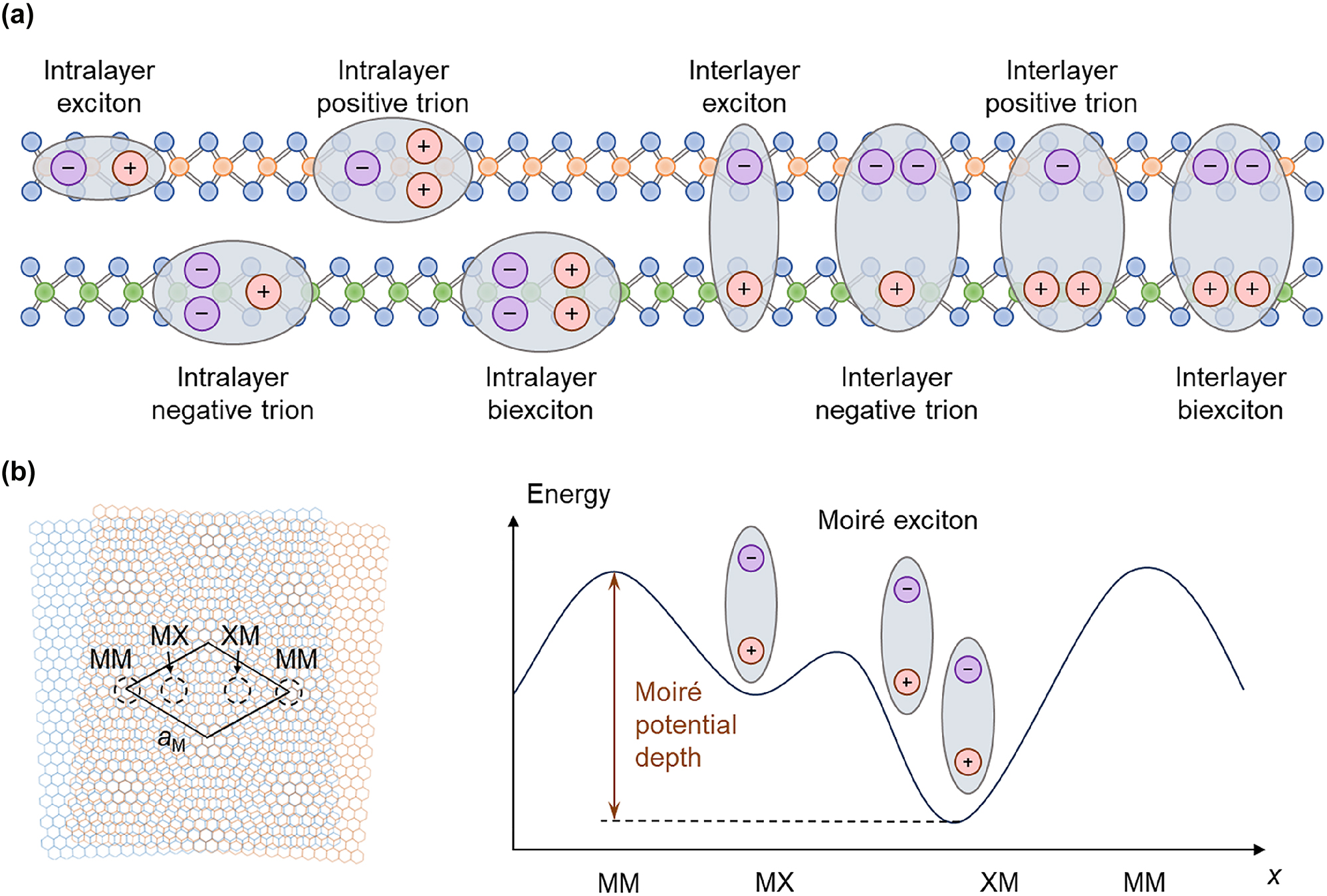
These different local stacking configurations have different:
- Interlayer Hybridization: The strength of the electronic coupling between the two layers changes.
- Band Alignments: The local bandgap energy varies.
- Lattice Reconstruction: The atoms may locally relax to find lower-energy stacking, inducing strain and creating piezoelectric potentials.
All these effects combine to create a smooth, periodic potential energy landscape for electrons and holes that mirrors the moiré pattern's geometry. This is the moiré potential. It effectively creates an array of nanoscale "quantum dots" for charge carriers.
The theoretical work by Magorrian et al. in "Multifaceted moiré superlattice physics in twisted WSe₂ bilayers" provides a detailed account of how these factors—piezoelectricity, interlayer hybridization, and atomic relaxation—compete and combine to form this potential landscape.
2. Properties of Moiré Excitons
If the moiré potential is deep enough, it can trap an exciton. An exciton localized within a minimum of the moiré potential is called a moiré exciton. Since these excitons are often formed from an electron in one layer and a hole in the other (an interlayer exciton), they possess a large out-of-plane electric dipole moment, making them sensitive to external electric fields.
The first definitive experimental observation of moiré excitons revealed several key properties that serve as their defining signatures.
Evidence for moiré excitons in van der Waals heterostructures
The 2019 Nature paper by Tran et al. provided the first clear experimental evidence for moiré excitons. It's a landmark study that beautifully connects theory and experiment. Let's read the key parts to understand how they observed and interpreted these new quasiparticles.
Please read the following sections from the paper: The second and third paragraphs of the introduction (starting 'In van der Waals materials...'). Focus on how the moiré superlattice creates a confinement potential for interlayer excitons. The section 'We first describe conceptually...' (p. 2) and study Figure 1. This is the core idea: the moiré pattern acts as an array of quantum dots with spatially varying optical selection rules. Read the paragraph starting 'Theoretically, multiple quantized resonances...' (p. 3, left column). This section connects the abstract idea to the alternating circular polarization they observe. Skim the theoretical description in the right column of p. 3, starting with 'Theoretically, multiple quantized resonances...'. Pay attention to Equation (1) and the description of the wavefunctions (s-wave, p-wave), which provides a simple model for the observed energy levels.
As you've just read, the key experimental signatures of moiré excitons are:
1. Multiple, Discrete Optical Resonances:
The moiré potential well is not just a single point; it's a 2D potential minimum. Just like a quantum harmonic oscillator or a particle in a box, this confinement potential hosts a set of quantized energy levels: a ground state and a series of excited states.
Experimentally, this manifests as a series of distinct, nearly equally-spaced peaks in the photoluminescence (PL) spectrum. Each peak corresponds to the recombination of a moiré exciton from one of these quantized levels.
2. Spatially Varying Optical Selection Rules:
This is a more subtle and powerful signature. In the previous lesson, we saw that the optical selection rules in a TMDC monolayer are fixed: light couples to the K+ valley, and to the K- valley.
In a moiré superlattice, the local crystal symmetry changes from point to point. This means the selection rules also become spatially dependent. For example, the high-symmetry point at the potential minimum might preferentially couple to light, while the region corresponding to the potential saddle point might couple to light.
An exciton's wavefunction is not a delta function; it has a spatial extent.
- The ground state (s-like wavefunction) is tightly localized at the potential minimum and inherits its selection rule (e.g., ).
- The first excited state (p-like wavefunction) has a node at the center and lobes that extend into regions with different local symmetry. This can cause it to couple to light with the opposite polarization (e.g., ).
This leads to the remarkable observation of alternating circular polarization for the successive peaks in the PL spectrum, providing strong evidence for the moiré exciton picture.

Test your understanding!
Imagine you are studying a twisted WSe₂/MoSe₂ heterostructure with a small twist angle. You observe three distinct interlayer exciton peaks in your low-temperature PL spectrum, which you label Peak 1 (lowest energy), Peak 2, and Peak 3 (highest energy). When you excite with light, you find that Peak 1 is strongly polarized, Peak 2 is polarized, and Peak 3 is polarized again.
How does the moiré exciton model explain this observation? What do these three peaks represent?
Show answer
This observation is a classic signature of moiré excitons.
- The three peaks represent the quantized energy levels of an exciton trapped in a moiré potential well. Peak 1 is the ground state, Peak 2 is the first excited state, and Peak 3 is the second excited state.
- The alternating polarization is explained by the spatial extent and symmetry of the wavefunctions for these states.
- The ground state (s-like) is localized at the potential minimum, which has a local symmetry that couples to light.
- The first excited state (p-like) has a node at the center and extends into regions with different symmetry, causing it to couple to light.
- The second excited state (which could be d-like or a higher s-like radial excitation) again has a different spatial symmetry, causing its net coupling to be polarized.
3. Tunability and Outlook
Perhaps the most powerful feature of moiré superlattices is their extraordinary tunability. By simply changing the twist angle, we can continuously vary the moiré period . This directly alters the confinement potential, changing the energy spacing between the moiré exciton states. A smaller angle creates a larger, smoother potential, while a larger angle creates a more compact, steeper potential.
Furthermore, these systems can be tuned with external fields:
- Electric fields can tune the energy of interlayer excitons via the Stark effect.
- Magnetic fields can be used to probe their properties, similar to atomic systems.
- Hydrostatic pressure or strain can modify the lattice constants and interlayer coupling, thus tuning the moiré potential itself.
This ability to engineer quantum states with such precision has opened the door to realizing exotic many-body phenomena, such as arrays of quantum emitters, strongly correlated electronic states (Wigner crystals), and even artificial Hubbard models, directly on a chip.
Conclusion
With moiré excitons, we move from observing phenomena in naturally occurring crystals to designing and building artificial quantum systems. The twisted bilayer platform transforms a simple semiconductor heterostructure into a programmable array of quantum dots for excitons.
Key Takeaways:
- Moiré Potential: A small twist angle between 2D material layers creates a long-wavelength moiré superlattice. Variations in atomic registry and interlayer coupling generate a periodic potential energy landscape for excitons.
- Moiré Excitons: These are excitons trapped within the minima of the moiré potential, behaving like quasiparticles in a periodic array of quantum dots.
- Key Signatures: Moiré excitons are identified by a series of discrete, quantized energy levels observed in optical spectra, often with alternating circular polarization due to spatially varying selection rules.
- Tunability: The properties of moiré excitons can be precisely controlled by adjusting the twist angle, applying electric fields, or inducing strain, making them a powerful platform for fundamental research and quantum device engineering.
Preview of the Next Lesson
This lesson concludes our journey through specific advanced case studies in exciton physics. We have seen how excitons behave in a vast range of environments, from the rigid lattice of Cu₂O to the soft polaronic cloud in perovskites, and now in the engineered quantum landscapes of moiré superlattices.
In our final lesson, we will take a step back and look at the bigger picture. The learning outcome will be to identify current open questions and future research directions in exciton physics. We will synthesize the concepts from the entire course to understand where the frontier of this exciting field is headed, particularly concerning many-body phenomena and applications in quantum technologies.