Hello! Welcome to our next lesson in the "Advanced Case Studies" module.
In our last few lessons, we've seen how the material environment—from the rigid lattice of Cu₂O to the soft polaronic one in perovskites—and fundamental symmetries shape exciton properties. We finished by exploring how spin-orbit coupling (SOC) in crystals lacking inversion symmetry gives rise to the Rashba and Dresselhaus effects, providing a momentum-dependent magnetic field that influences exciton fine structure and spin dynamics.
Today, we journey into the world of two-dimensional (2D) materials, where these concepts of symmetry and strong interactions are pushed to their extreme. We will focus on monolayer transition metal dichalcogenides (TMDCs), a class of materials that has revolutionized condensed matter physics. Our learning goal is to summarize the unique properties of excitons in 2D TMDCs, including their strong binding, valley-dependent physics, and modified selection rules. You will see how extreme quantum confinement and a unique crystal structure give rise to incredibly robust excitons and a new quantum degree of freedom: the "valley."
1. The 2D Semiconductor Landscape: Monolayer TMDCs
TMDCs are materials with the chemical formula MX₂, where M is a transition metal (like Mo, W) and X is a chalcogen (like S, Se). In their bulk form, they consist of stacked layers held together by weak van der Waals forces. This weakness allows them to be exfoliated down to a single atomic layer, just a few atoms thick.
A remarkable transformation occurs in this process. While bulk TMDCs are typically indirect bandgap semiconductors, many become direct bandgap semiconductors in the monolayer limit. Crucially, the minimum of the conduction band and the maximum of the valence band align at two distinct, degenerate points in the hexagonal Brillouin zone, labeled K+ and K-. These discrete points in momentum space are known as "valleys."
This emergence of a direct gap at specific valleys makes monolayer TMDCs highly efficient at interacting with light and sets the stage for their unique excitonic properties.
2. Exceptionally Robust Excitons
Perhaps the most striking feature of excitons in monolayer TMDCs is their enormous binding energy. While a typical exciton in bulk GaAs has a binding energy of about 5 meV, excitons in a TMDC monolayer like WSe₂ can have binding energies on the order of 0.3 to 0.5 eV. This is one to two orders of magnitude larger!
This immense stability, which allows excitons to exist even at room temperature, arises from two primary effects of the 2D geometry:
- Quantum Confinement: The electron and hole are physically confined to move within a plane only a few angstroms thick. This drastically reduces their average separation compared to a 3D system, strengthening their Coulomb attraction.
- Reduced Dielectric Screening: In a bulk material, the electric field lines between an electron and hole are screened by the surrounding dielectric medium. In a 2D monolayer, these field lines must pass through the surrounding environment (e.g., vacuum or a substrate), which typically has a much lower dielectric constant. This "un-screening" of the Coulomb force further enhances the electron-hole attraction.
Despite their very small Bohr radius (around 1 nm), these excitons are still well-described by the Wannier-Mott model, as the electron-hole separation still spans several lattice constants.
3. Valley-Dependent Physics and Chiral Selection Rules
The existence of the K+ and K- valleys, combined with the crystal's properties, introduces a new quantum number—the valley index—and a set of unique physical phenomena collectively known as "valleytronics."
The key ingredients are:
- Broken Inversion Symmetry: The crystal structure of a TMDC monolayer lacks a center of inversion.
- Strong Spin-Orbit Coupling: The heavy transition metal atoms lead to significant SOC.
As we saw in the last lesson, these two conditions are precisely what's needed to lift spin degeneracy. In TMDCs, this leads to a phenomenon called spin-valley locking. As shown in the image below, the spin orientation of the energy bands becomes rigidly tied to the valley index. For example, in the valence band, the spin-up state might be energetically favorable in the K+ valley, while the spin-down state is favored in the K- valley.
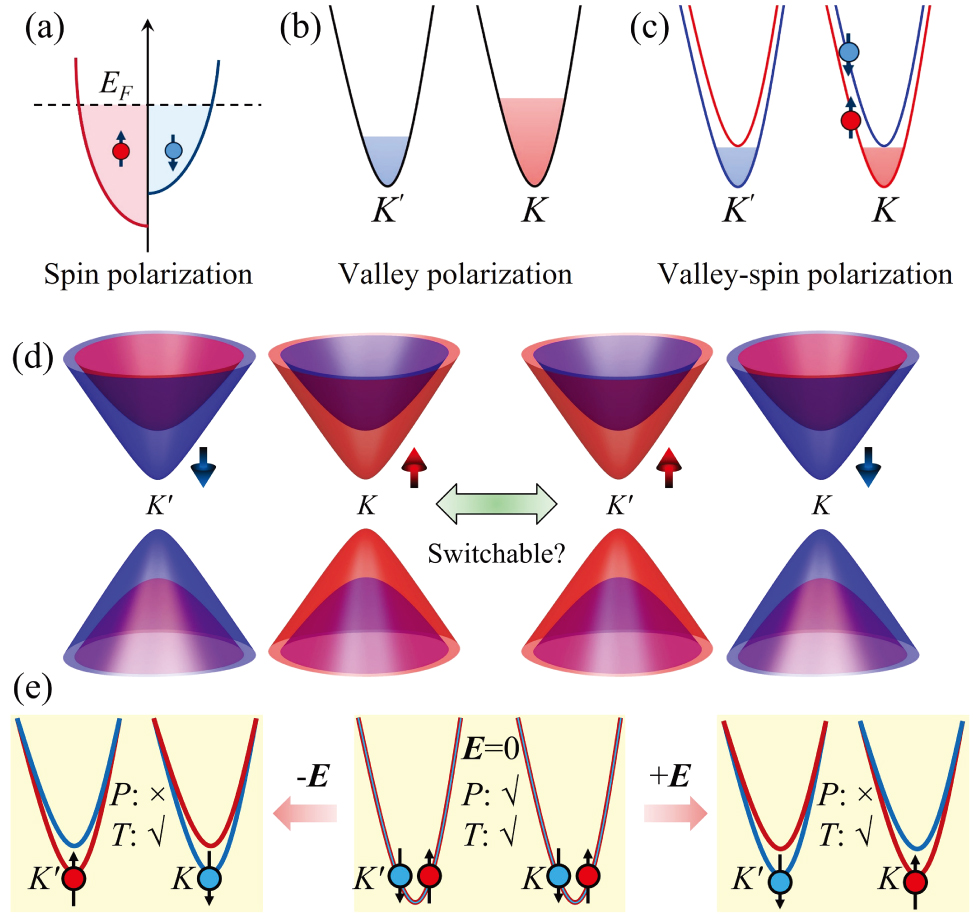
This spin-valley locking has a profound consequence for how light interacts with the material. Due to the conservation of total angular momentum during a photon absorption event, the selection rules are modified. A circularly polarized photon carries a spin angular momentum of . The absorption of a photon must conserve this angular momentum, which is transferred to the electron-hole pair.
The locked spin and valley quantum numbers dictate that only one combination is allowed for each helicity of light:
- Right-circularly polarized light () exclusively creates excitons in the K+ valley.
- Left-circularly polarized light () exclusively creates excitons in the K- valley.
These are often called chiral optical selection rules. They provide a direct optical handle to populate, or "initialize," a specific valley, forming the basis of valleytronics.
To explore these concepts in more detail, the following readings from two comprehensive review articles are highly recommended.
Excitons in atomically thin transition metal dichalcogenides
To understand the origin of these unique properties, let's start with this foundational review. It provides an excellent summary of the band structure, strong binding, and selection rules of excitons in TMDCs.
Please read the following parts of this review paper by Wang et al.: Start with the first paragraph under the title that begins 'Atomically thin materials...' to get an overview. Read the paragraph starting with 'In this review we mainly concentrate on...' (p. 2), which explains the direct bandgap at the K± points. Read the paragraph starting 'In a semiconductor, following absorption...' (p. 2), which introduces the strong binding energy. Read the paragraph in Section II.B starting 'One of the distinct properties of TMD monolayers...' (p. 9), which details the reasons for the strong Coulomb interaction. Read the first two paragraphs of Section II.C.1, 'Dark and bright excitons' (p. 13), which explain the chiral optical selection rules.
Light–valley interactions in 2D semiconductors
This second review focuses more on the 'valleytronics' aspect and the underlying physics of valley control. It offers a complementary perspective, particularly on the origin of the selection rules and the interaction with magnetic fields.
Please read these sections from the review by Mak et al. to solidify your understanding: The first three paragraphs of the article (p. 451) to appreciate the concept of the valley as an information carrier. The subsection 'Optical selection rules' (p. 453), which gives a clear explanation of the selection rules based on the conservation of orbital angular momentum. The subsection 'Valley magnetic response' (p. 454), to see how external magnetic fields interact with the valley degree of freedom.
Test your understanding!
You are performing a photoluminescence (PL) experiment on a WSe₂ monolayer at low temperature. You excite the sample with polarized light that is resonant with the main exciton transition.
- In which valley (K+ or K-) are excitons primarily created?
- What would you expect the polarization of the emitted PL to be?
- In a real experiment, the PL polarization is high but not 100%. What physical mechanism could lead to this depolarization? (Hint: Think about what could allow an exciton to switch valleys before it recombines.)
Show answer
- Following the chiral selection rules, light creates excitons in the K+ valley.
- If these excitons recombine radiatively before any other process occurs, they should emit polarized light to conserve angular momentum. Therefore, the emitted PL is expected to be polarized.
- The depolarization (emission of some light) implies that some excitons created in the K+ valley have scattered to the K- valley before recombining. A primary mechanism for this inter-valley scattering is the long-range electron-hole exchange interaction. This interaction can flip the exciton from one valley state to the other. Phonon scattering can also contribute. The ratio of the exciton lifetime to the valley scattering time determines the degree of polarization that is preserved.
Conclusion
Today we've seen how reducing the dimensionality of a semiconductor to a single atomic layer unlocks a host of new and fascinating physics. For excitons in TMDCs, this manifests in three key properties that set them apart from their bulk counterparts.
Key Takeaways:
- Strong Binding Energy: Extreme quantum confinement and reduced dielectric screening lead to exciton binding energies on the order of 0.5 eV, making them stable even at room temperature.
- Valley-Dependent Physics: The band structure features distinct K+ and K- valleys. Strong spin-orbit coupling locks the spin and valley degrees of freedom, creating a robust coupled quantum number.
- Chiral Selection Rules: Due to spin-valley locking and angular momentum conservation, circularly polarized light couples exclusively to specific valleys ( to K+, to K-). This provides a powerful tool for optical initialization and control of the valley state.
Preview of the Next Lesson
These unique properties of single-layer excitons are just the beginning. The true power of 2D materials lies in our ability to stack them like atomic-scale Lego bricks to create "van der Waals heterostructures." In our next lesson, we will explore one of the most exciting recent developments in this area: moiré excitons. We will see what happens when you stack two TMDC layers with a slight twist angle, creating a long-wavelength moiré pattern that can trap excitons and give rise to entirely new, engineered quantum phenomena.