Introduction
Welcome back. In our last lesson, we constructed a personalized Swasthawritta plan for a patient with essential hypertension. We delved into the Samprapti involving Pitta-Vata aggravation and Avarana, and designed a calming, cooling regimen. This process of analyzing the root cause to create a tailored intervention is the hallmark of advanced Ayurvedic practice.
Today, we address another major lifestyle disease, obesity, or Sthaulya. This condition is a quintessential Santarpanottha Vyadhi (a disease of over-nutrition and excess satiety) and a significant risk factor for numerous other metabolic disorders. Our goal is to create an integrated Swasthawritta plan for managing Obesity (Sthaulya), addressing Ahara, Vihara, and psychological factors. We will dissect the pathogenesis and build a robust, multi-faceted plan based on a clinical case, integrating classical principles with practical, evidence-based strategies.
1. Understanding Sthaulya: The Ayurvedic Pathogenesis
To effectively manage Sthaulya, we must first understand how Ayurveda conceptualizes its development. It's not simply about excess calories; it's a systemic breakdown in metabolic intelligence, primarily involving Kapha Dosha, Agni, and the Medovaha Srotas (channels carrying fatty tissue).
To begin, let's establish a strong conceptual foundation for obesity within the Ayurvedic framework.
Combining Swasthavṛtta and yoga in the management of ...
The paper 'Combining Swasthavṛtta and yoga in the management of...' offers a clear and deep explanation of metabolic syndrome and obesity. It lays out the core Ayurvedic concepts of Santarpanottha Vyādhi, the role of Agni, and the vitiation of Meda Dhātu.
Please read the introduction and the section 'Understanding Metabolic Syndrome in Contemporary and Ayurvedic Contexts'. Focus on how Ayurveda conceptualizes obesity (Sthaulya) as a disease of over-nutrition, the central role of 'manda agni' (low metabolic fire), 'āma utpatti' (toxin formation), and 'Medo dhātu dushti' (vitiation of adipose tissue).
As the reading explains, the pathogenesis (Samprapti) of Sthaulya is a sequential process. Let's break it down step-by-step.
The Samprapti of Sthaulya
The causative factors (Nidana) are grouped into dietary (Aharatmaka) and lifestyle (Viharatmaka) errors. These include:
- Dietary: Excessive consumption of Guru (heavy), Madhura (sweet), Snigdha (unctuous), and Sheeta (cold) foods. Adhyashana (eating before the previous meal is digested) is particularly damaging.
- Lifestyle: Avyayama (lack of exercise), Divaswapna (daytime sleep), and a generally sedentary life (Sayya asana sukhe ratah).
These factors initiate a pathological cascade:
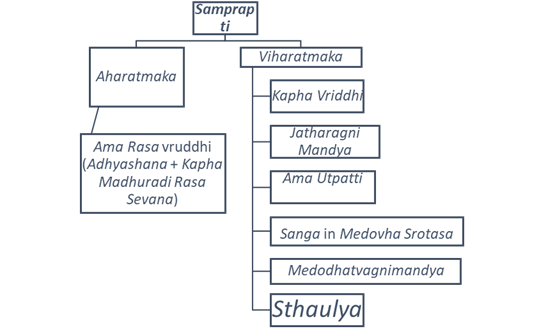
Let's trace the flow:
- Kapha Vriddhi: The causative factors primarily increase Kapha Dosha.
- Agni Mandya: The heavy, sluggish nature of vitiated Kapha suppresses the digestive and metabolic fire (Agni).
- Ama Utpatti: With a weak Agni, food is not properly digested, leading to the formation of Ama—a sticky, toxic substance that clogs the body's channels.
- Srotorodha: This Ama, combined with excess Kapha, obstructs the micro-channels (Srotas), particularly the Medovaha Srotas.
- Medo Dhatvagnimandya: The obstruction and Ama weaken the metabolic fire specific to the adipose tissue itself (Medo Dhatvagni).
- Medo Vriddhi: An impaired Medo Dhatvagni cannot properly form and nourish the subsequent tissues (Asthi Dhatu or bone). Instead, it produces an excess of unstable, immature adipose tissue, leading to Sthaulya.
This creates a vicious cycle. Charaka Samhita explains that the obstructed Vata becomes trapped in the Koshta (abdomen), further stimulating Agni pathologically (Athyagni), causing intense hunger. The person eats more, feeding the cycle of Ama formation and fat accumulation.
Our management plan, therefore, must aim to break this cycle at every level. The core principles are:
- Nidana Parivarjana (avoiding the causes)
- Kapha-Medohara (pacifying Kapha and reducing fat)
- Agni Deepana & Ama Pachana (strengthening fire and digesting toxins)
- Lekhana (scraping action to reduce excess tissue)
- Srotoshodhana (clearing the channels)
2. Case Study Application
Let's apply these principles to a real-world scenario. The following case is adapted from a published report and provides a detailed basis for our plan.
Integrated Ayurveda and Yoga Therapy in the ...
The case report 'Integrated Ayurveda and Yoga Therapy in the Management of Obesity' provides an excellent, detailed account of a patient with Sthaulya, including their history, Ayurvedic assessment, and a full treatment plan. We will use this as our model.
Please study the 'Case History' and the associated tables ('Systemic examination', 'Ayurvedic parameters'). Familiarize yourself with the patient's presenting complaints, nidanas (fried food, daytime sleep), prakruti, and the detailed Ayurvedic diagnosis.
Summary of the Case:
- Patient: 40-year-old male, goldsmith (sedentary work).
- Chief Complaints: Weight gain, polyphagia (Kshut atimatram), polydipsia (Pipasathiyogam), fatigue, dyspnoea on exertion.
- Nidanas: High intake of fried foods (Snigdha Ahara), eating before digestion (Adhyasana), lack of exercise (Avyayama), daytime sleep (Divaswapna).
- Ayurvedic Assessment:
- Prakruti: Kapha-Pitta
- Vikruti: Kapha Pradhana Tridosha Dushti
- Dushya: Meda Dhatu Vriddhi
- Agni: Vishamagni/Athyagni (erratic/pathologically high fire)
- Srotas: Rasavaha, Medovaha, Raktavaha with Sanga (obstruction) type vitiation.
- Diagnosis: Ati Sthoulya (Obesity)
3. Designing the Integrated Swasthawritta Plan
Based on our analysis of the Samprapti and the patient's specific presentation, we will now construct a comprehensive plan targeting Ahara, Vihara, and Manas.
A. Ahara: The Dietary Intervention Plan
Principle: The diet must be Kapha-Medohara (reducing Kapha and fat) and Lekhana (having a scraping quality), while also being Deepana (kindling Agni). It should not be about starvation, which would weaken Agni further, but about choosing the right foods at the right times.
The case study you reviewed provides an excellent, practical template.
Integrated Ayurveda and Yoga Therapy in the ...
Let's examine the detailed diet chart provided in the case study. It's a perfect example of applying classical dietary principles for Sthaulya in a structured, modern format.
Focus on 'Table-4 Diet chart'. Note the specific food choices (millets, green gram, buttermilk), the inclusion of medicated water (Asana sara toya), and the timing of meals. We will base our plan on this structure.
Here is the personalized dietary plan for the patient:
| Timing | Meal | Rationale & Specific Recommendations |
|---|---|---|
| 6 AM | Wake-up Drink | Lukewarm water with honey (Madhu). Honey is Lekhana (scraping) and Yogavahi (a catalyst), helping to clear Kapha and scrape Meda from the channels. It should never be heated. |
| 8 AM Breakfast | Light & High-Fiber | Grains: Focus on Ruksha (dry) grains like Barley (Yava), Millets (Ragi, Jowar), or old rice. Avoid heavy wheat. Protein: Green gram (Mudga) or Horse gram (Kulatha), both known for their Kapha-hara and Lekhana properties. |
| 11 AM | Mid-morning | A small portion of fruits with astringent/sour taste like Pomegranate (Dadima) or Indian Gooseberry (Amalaki). Avoid sweet fruits like bananas. |
| 1 PM Lunch | Main Meal (Moderate) | Small portion of red rice. Larger portions of vegetables with bitter and astringent tastes (Tikta, Kashaya rasa) like bitter gourd, ivy gourd (Patola). Include leafy greens. Buttermilk (Takra) spiced with cumin and ginger is an excellent digestant. |
| 5 PM | Evening Snack | Roasted grain flour (Saktu) mixed with buttermilk. Saktu is light and absorbent, preventing late-afternoon energy slumps without being heavy. |
| 7 PM Dinner | Lightest Meal | Vegetable soup or a very light porridge of fried broken wheat. Include steamed vegetables. This meal should be the smallest and taken at least 2-3 hours before sleep to allow for complete digestion. |
| General | Fluids & Spices | Sip warm water throughout the day. Use digestive spices like ginger, black pepper, cumin, and turmeric. Strictly avoid cold drinks, heavy dairy, refined sugar, and fried foods. |
B. Vihara: The Lifestyle and Activity Plan
Principle: The lifestyle must actively counter the sedentary, heavy qualities of Kapha. This involves introducing regular, stimulating activity (Vyayama) and establishing a disciplined daily routine (Dinacharya).
-
Dinacharya (Daily Routine):
- Wake Up: Before 6 AM, during Vata time, to bring lightness to the body.
- Udwarthana (Dry Powder Massage): As an initial intervention (like in the case study), daily massage with dry, coarse herbal powders like Kolakulathadi Churna is highly effective. It is intensely Kapha-hara, improves circulation, stimulates metabolism, and directly reduces subcutaneous fat.
- Avoid: Daytime sleep (Divaswapna) is strictly contraindicated as it is a prime cause of Kapha aggravation.
-
Vyayama (Exercise & Yoga):
A robust yoga protocol is essential. It provides a combination of cardiovascular activity, muscular engagement, and metabolic stimulation.
Combining Swasthavṛtta and yoga in the management of ...
To understand the rationale behind the yoga protocol, let's revisit the first paper. It explains how specific yogic practices target the pathophysiological mechanisms of metabolic disorders.
Review the section 'Yogic Interventions for Metabolic Regulation'. Pay attention to how asanas targeting the abdomen stimulate Agni, and how pranayama techniques regulate metabolism and the stress axis.
Based on the case study LINK and the principles from LINK, here is the recommended 1-hour daily yoga session:
- Warm-up (10 mins): Loosening exercises to prepare the joints.
- Pranayama (Kriya): Kapalbhati (Skull-shining breath). This is a powerful kriya that stimulates Agni, increases metabolic rate, and has a Lekhana effect. Start with 3 rounds of 20 strokes and gradually increase.
- Dynamic Asanas:
- Suryanamaskara (Sun Salutations): 10-12 rounds. A full-body workout that improves cardiovascular fitness and stimulates all bodily systems.
- Abdominal/Core Focus: Uthanapadasana (Raised Legs Pose), Noukasana (Boat Pose), Pavanamuktasana (Wind-Relieving Pose). These poses massage abdominal organs and strengthen the core.
- Twisting & Bending: Trikonasana (Triangle Pose), Katichakrasana (Waist-Rotating Pose), Paschimottanasana (Seated Forward Bend), Bhujangasana (Cobra Pose). These improve spinal flexibility and glandular function.
- Pranayama (Breath Regulation):
- Nadi Shuddhi (Alternate Nostril Breathing): Balances the nervous system and calms the mind.
- Suryabhedana (Right Nostril Breathing): This is a heating pranayama that stimulates the sympathetic nervous system and boosts metabolism. It is specific for countering the cold, sluggish nature of Kapha.
- Cool-down & Meditation (10 mins): Shavasana (Corpse Pose) for relaxation, followed by Om Chanting Meditation.
Test your understanding!
In the previous lesson for the Pitta-Vata hypertension patient, we strictly avoided heating pranayamas like Bhastrika and recommended Sheetali (cooling breath). Why is the prescription here for Kapalbhati and Suryabhedana?
Show answer
The choice of pranayama must be Dosha-specific and counter the nature of the imbalance. In hypertension, the system was over-stimulated and "hot" (Pitta aggravation), requiring cooling, calming practices. In Sthaulya, the system is sluggish, cold, and obstructed (Kapha aggravation and Manda Agni), requiring stimulating, heating practices like Kapalbhati and Suryabhedana to kindle Agni, clear obstruction, and boost metabolism.
C. Manasika: The Psychological Intervention Plan
Principle: The mind is a key player in obesity, influencing emotional eating, motivation, and stress levels. The goal is to cultivate Sattva (clarity, balance) and reduce Rajas (agitation) and Tamas (inertia).
Combining Swasthavṛtta and yoga in the management of ...
The mind-body connection in metabolic syndrome is profound. The 'Psychophysiological Interface...' paper provides a deep dive into how Swasthavritta and Yoga influence the autonomic nervous system, HPA axis, and behaviors like emotional eating.
Read the section 'Psychophysiological Interface of Swasthavṛtta and Yoga'. Focus on how these practices regulate the stress response (ANS and HPA axis), enhance interoception (awareness of internal bodily cues like hunger and satiety), and support behavioral transformation.
The psychological plan for our patient involves:
- Stress Management: The case patient has a Rajasika Manasika Prakruti and emotional stress. The prescribed Pranayama (Nadi Shuddhi) and daily meditation are not optional; they are critical for calming the mind and reducing stress-induced eating.
- Improving Interoception: Mindful eating is a key practice. The patient should be counselled to eat without distractions (TV, phone), chew food thoroughly, and pay close attention to the body's signals of hunger and fullness. This directly counters Adhyashana.
- Cultivating Motivation: The practice of Tapas (self-discipline) from Yogic philosophy, which aligns with Sadvritta, is essential. Setting small, achievable daily goals for diet and exercise builds self-efficacy and motivation. The structured plan itself provides the discipline needed to overcome Tamasic inertia.
- Emotional Regulation: Om Chanting and Bhramari pranayama (not explicitly in the case protocol but a useful addition) can be used to calm emotional turmoil and reduce the urge for comfort eating.
By integrating these three pillars, we create a powerful, synergistic plan that addresses obesity at its roots—metabolic, physical, and psychological. The results from the case study (LINK, Table 7 & 8), showing significant reduction in weight, BMI, and cholesterol, provide strong evidence for this holistic approach.
Conclusion
You have now developed a comprehensive, integrated Swasthawritta plan for managing obesity. This process required a deep understanding of the Ayurvedic Samprapti and the ability to translate those principles into a detailed, actionable protocol addressing diet, lifestyle, and mental well-being.
Key Takeaways:
- Sthaulya as a Systemic Failure: Obesity is not just excess weight but a disease of impaired Agni, Ama formation, and channel obstruction, primarily driven by Kapha Dosha.
- The Power of a Three-Pronged Attack: Effective management requires a synergistic approach that simultaneously corrects Ahara (diet), Vihara (lifestyle/activity), and Manas (psychological factors).
- Intervention Must Be Specific: The therapeutic strategy for Sthaulya (stimulating, heating, lightening) is fundamentally different from that for a Pitta-dominant condition like hypertension (calming, cooling, grounding).
- Swasthawritta as Potent Chikitsa: This case demonstrates that when applied rigorously, the principles of Swasthawritta are not merely preventive but serve as a primary and powerful form of treatment (Chikitsa) for complex lifestyle disorders.
Preview of the Next Lesson:
We will now take on an even more complex challenge. So far, we have focused on conditions where Swasthawritta is the primary therapy. In the next lesson, you will learn to "Formulate a Swasthawritta plan that complements a pre-existing Chikitsa protocol for a patient with an autoimmune disorder (e.g., Amavata)." This will require you to integrate lifestyle management with active, ongoing disease treatment, a critical skill in advanced clinical practice.