Introduction
Welcome back. In our last lesson, we learned how to interpret the statistical heart of a research paper—the p-values and confidence intervals—and how to distinguish between a result that is statistically significant and one that is clinically meaningful. This is a crucial skill. However, a statistically impressive result is meaningless if the study that produced it is fundamentally flawed.
This brings us to today's objective: to select and apply a structured critical appraisal tool (e.g., CASP checklist) to a research article on a Swasthawritta practice. Critical appraisal is the process of systematically examining research evidence to assess its validity, results, and relevance before using it to inform your clinical decisions. It is the core activity of evidence-based practice.
Think of it this way: last session, you learned to read the lab values. Today, you'll learn how to assess the quality of the lab that produced them. By the end of this lesson, you will be able to take a research paper on a Swasthawritta practice and use a formal checklist to methodically evaluate its strengths and weaknesses, helping you decide whether you can trust its conclusions.
1. What is Critical Appraisal?
Before we dive into a tool, let's clarify the concept. Critical appraisal isn't about being negative or finding fault. It is a balanced and systematic assessment of a study's quality. Every study, no matter how well-conducted, has limitations. Your job as a critical reader is to understand those limitations and judge whether they are serious enough to undermine the study's findings.
The primary enemy we are fighting in critical appraisal is bias. Bias is a systematic error in a study's design or conduct that leads to a distorted or incorrect estimate of an intervention's effect. For example:
- Selection Bias: If healthier patients are systematically allocated to the treatment group and sicker patients to the control group, the treatment will look more effective than it really is.
- Performance Bias: If patients know they are receiving a novel treatment, their expectations (the placebo effect) or behaviour might change, influencing the outcome.
- Detection Bias: If the person assessing the outcome (e.g., measuring joint swelling) knows which treatment the patient received, their measurement might be unconsciously influenced.
To help us systematically check for these and other issues, researchers have developed various critical appraisal tools. One of the most widely used sets of tools comes from the Critical Appraisal Skills Programme (CASP).
2. Selecting the Right Tool: The CASP Checklists
CASP provides a suite of checklists tailored to different research designs. Since different study designs answer different types of questions and have different potential flaws, you must use the correct checklist.
CASP Checklists - Critical Appraisal Skills Programme
The CASP website offers free, downloadable checklists for various study types. Take a moment to see the range of tools available. We will focus on one of these today.
Visit the website and look at the list of different checklists available, such as those for Systematic Reviews, Randomised Controlled Trials (RCTs), and Qualitative Studies. Notice how there is a specific tool for each major research design.
For evaluating Swasthawritta interventions (like a specific Vyayama protocol, a dietary regimen, or an herb), the Randomised Controlled Trial (RCT) is generally considered the strongest study design for establishing cause and effect. Therefore, we will focus on the CASP RCT Checklist in this lesson.
3. A Guided Tour of the CASP RCT Checklist
The CASP RCT checklist is structured around three fundamental questions, which we will explore in detail:
- Section A: Are the results of the study valid? (Internal Validity)
- Section B: What are the results? (Trustworthiness)
- Section C: Will the results help me locally? (Applicability/External Validity)
To guide us through these questions, we will watch an excellent video from Cochrane that walks through the CASP RCT checklist, applying it to a published trial. As you watch, notice how each question is designed to probe for a potential source of bias.
Section A: Is the Study Valid?
These first questions assess the study's design and methodology to check for major sources of bias that could invalidate the results. Let's begin the video walkthrough.
3. Randomised controlled trials
This first video segment introduces the CASP approach for RCTs and walks through the initial, most critical questions related to study validity. It covers PICO, randomization, and blinding.
Watch the following clips, which correspond to the first set of CASP questions: 01:19 - 03:06: Why RCTs are the 'gold standard' for reducing bias. 07:20 - 08:35: Question 1 (PICO) - Did the study address a clearly focused question? This is about defining the Population, Intervention, Comparator, and Outcomes. 10:01 - 11:01: Question 2 (Randomization) - Was the assignment of patients to treatments randomized, and was the allocation concealed? This checks for selection bias. 12:24 - 14:10: Question 4 (Blinding) - Were patients and clinicians kept 'blind' to the treatment? This checks for performance and detection bias.
This is what the checklist looks like in practice. The questions are simple prompts to guide your thinking.
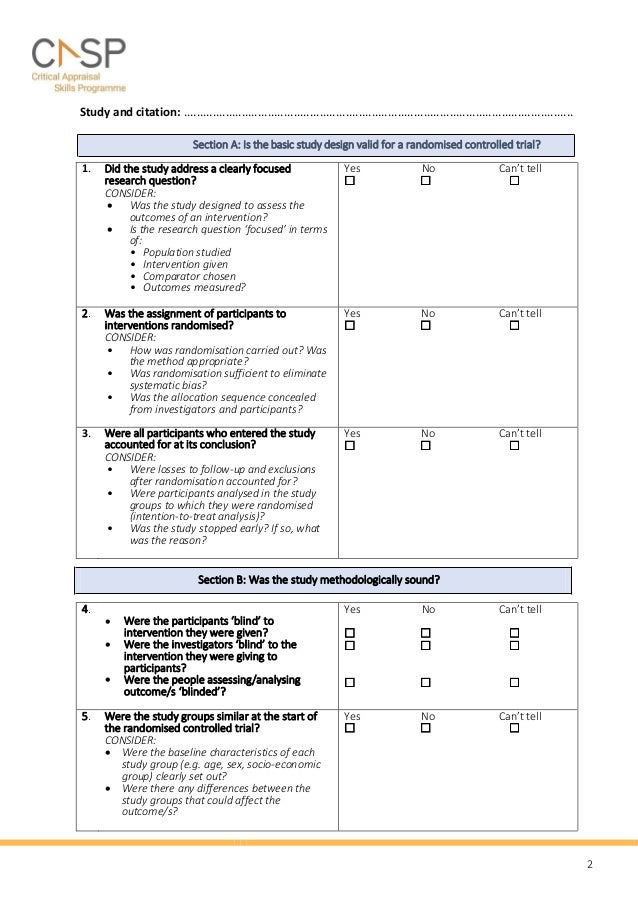
Let's continue with the remaining questions on validity.
3. Randomised controlled trials
This next segment covers how the study dealt with participants over time and whether the groups were treated equally.
Watch these clips: 11:01 - 12:24: Question 3 (Follow-up) - Were all patients who entered the trial accounted for? This explores attrition bias and the principle of Intention-to-Treat (ITT) analysis. 14:10 - 15:07: Question 5 (Baseline Comparability) - Were the groups similar at the start of the trial? This confirms if randomization was successful. 15:07 - 16:16: Question 6 (Equal Treatment) - Aside from the intervention, were the groups treated equally? This looks for co-interventions that could confound the results.
If you answer "No" or "Can't tell" to several of these initial questions, you should be very cautious about the study's results, regardless of how impressive the p-values are.
Section B: What are the results?
This section connects directly to our previous lesson. It asks about the magnitude and precision of the treatment effect.
3. Randomised controlled trials
Now, let's look at how to appraise the reporting of the results themselves. This part focuses on the effect size and confidence intervals.
Watch these two short clips: 16:16 - 17:26: Question 7 (Effect Size) - How large was the treatment effect? This is about understanding the main findings for the primary outcomes. 17:26 - 18:35: Question 8 (Precision) - How precise was the estimate of the effect? This is where you apply your knowledge of Confidence Intervals (CIs).
Section C: Will the results help me locally?
This final section is where you, as the clinician, take center stage. A study might be internally valid with precise results, but if the patients, setting, or intervention are too different from your own practice, the results may not be applicable.
3. Randomised controlled trials
The last set of questions concerns the external validity or applicability of the study's findings to your own clinical context.
Watch the final clips of the walkthrough: 18:35 - 19:52: Question 9 (Applicability) - Can the results be applied to your local population or patient? 19:52 - 21:01: Question 10 (Outcomes Considered) - Were all clinically important outcomes considered? 21:01 - 21:26: Question 11 (Benefit vs. Harm) - Are the benefits worth the harms and costs? This is the final judgment call.
4. Application: Appraising Evidence in a Swasthawritta Context
Now, let's apply this framework. The video used a psychotherapy trial, but the principles are universal. We will now look at a review article on Ayurvedic preventive healthcare that explicitly mentions using the CASP tool. This will show you how these concepts are being used in our field.
The Role of Ayurvedic Science in Preventive Healthcare
This paper, 'The Role of Ayurvedic Science in Preventive Healthcare', performs a systematic review of studies on Ayurvedic interventions. First, read the methodology section to see how the authors themselves used critical appraisal.
Read only the 'Methodology' section, specifically focusing on section '3.4 Reliability and Validity'. Note the sentence where the authors state they used the CASP checklist to assess the quality of the studies they included. This confirms the relevance of the tool in Ayurvedic research.
By stating they used the CASP checklist, the authors are signaling that they took steps to ensure the quality of the evidence they are presenting. Now, let's look at the evidence they summarized and practice asking CASP-style questions.
The Role of Ayurvedic Science in Preventive Healthcare
Now, let's look at the results of that review. You don't need to read the whole section, just the summary table of the studies they found.
Scroll down to 'Table 2. Summary of the 15 Studies Included in the Review'. Look at the entries listed as 'Clinical Trial'. We will use this summary information to practice asking critical appraisal questions.
Let's pick a trial from that table: Choudhary & Singh (2021) | Brahmi – Cognitive Function | 78% effectiveness; improved memory, reduced neuroinflammation.
Even with just this limited summary, we can use the CASP framework to ask critical questions:
- Q1 (PICO): The Intervention (Brahmi) and Outcome (Cognitive function) are listed. But who was the Population? Elderly patients? Healthy students? And what was the Comparator? Placebo? Another drug? No treatment? Without this, it's hard to judge the context.
- Q2/Q4 (Randomization/Blinding): The summary doesn't state if the trial was randomized or blinded. A non-randomized, unblinded trial would be at very high risk of bias. We cannot trust the result without this information.
- Q7 (Effect Size): The finding is "78% effectiveness". What does this number mean? Is it a relative risk reduction? The percentage of patients who improved by a certain amount? Without a clear definition and a confidence interval, this number is nearly impossible to interpret meaningfully.
- Q9 (Applicability): Was this study conducted on an Indian population? A Western population? The applicability of the findings to your patients depends heavily on this.
This exercise shows that even when a review paper summarizes findings, your critical appraisal mindset should be active. The CASP questions provide the structure for that thinking, helping you identify what information is missing and how confident you can be in a claim.
Test your understanding!
You find an abstract for a study on Pratimarsha Nasya with Anu Taila for preventing seasonal allergic rhinitis. It includes the following statements:
- "150 patients with a history of seasonal allergies were randomized to either a Nasya group or a no-treatment control group."
- "The study was single-blinded; the assessing physician was unaware of group allocation, but participants were not."
- "At the end of the 3-month study, 22 out of 75 participants (29%) in the control group had dropped out, compared to 5 out of 75 (7%) in the Nasya group."
Using the CASP RCT checklist questions as a guide, identify two potential sources of bias in this study and explain why they are a concern.
Show answer
Here are two major potential sources of bias:
- Performance Bias (related to Q4 - Blinding): The study was only single-blind. The participants knew they were in the Nasya group. This could create a strong placebo effect or change their health-related behaviours (e.g., they might be more proactive about avoiding allergens because they feel they are in an active treatment group). A "no-treatment" control is also problematic; a better design would use a placebo Nasya (e.g., with a carrier oil like sesame oil without the herbs) to keep participants blind.
- Attrition Bias (related to Q3 - Follow-up): There is a very high and unequal dropout rate. Far more people dropped out from the no-treatment control group (29%) than the Nasya group (7%). Why did they drop out? Perhaps those in the control group whose allergies were getting worse simply left the study in frustration. If so, the remaining control group patients would look healthier than they really are, making the Nasya intervention appear less effective than it truly is (or vice versa if people who felt better left). An intention-to-treat (ITT) analysis would be essential here.
Conclusion
Today, you've acquired a powerful and systematic method for evaluating clinical research. We've seen that reading a paper is not a passive act; it is an active process of interrogation, guided by a structured tool.
Key Takeaways:
- Critical appraisal is the systematic evaluation of research to assess its validity, results, and relevance.
- The CASP checklists are practical tools that guide this process for different study designs.
- When appraising an RCT, you must systematically question its internal validity (was it done right?), the trustworthiness of its results (what did it find?), and its external validity (can I use it?).
- Asking these questions helps you identify potential biases (like selection, performance, and attrition bias) that can render a study's conclusions unreliable.
Preview of the Next Lesson:
You are now equipped with a general tool for appraising an RCT. In our next lesson, "Evaluate the appropriateness of research methodology and identify potential sources of bias in Ayurvedic preventive care studies," we will take this a step further. We will focus on the unique methodological challenges that arise when studying Swasthawritta and other Ayurvedic interventions—such as the difficulty of creating a credible placebo for Abhyanga, standardizing a Dinacharya protocol, or choosing appropriate outcomes that capture the holistic effects of an intervention. We will apply the critical thinking skills you've developed today to these specific, complex scenarios.