Introduction
Welcome to our next lesson in the "Foundations of Research in Swasthawritta" module. In our previous session, we established a strong foundation by learning how to use the CASP checklist to systematically appraise a randomized controlled trial. You now have a general framework for questioning a study's validity, results, and relevance.
Today, we will sharpen that skill by focusing on the specific and often complex challenges that arise in our own field. Our learning outcome is to evaluate the appropriateness of research methodology and identify potential sources of bias in Ayurvedic preventive care studies.
While the principles of critical appraisal are universal, Ayurvedic research presents unique methodological hurdles. Interventions like Dinacharya or Ritucharya are holistic and individualized, not simple, single-variable pills. This makes designing high-quality research to test them a significant challenge. By the end of this lesson, you will be able to look at a study on a Swasthawritta practice and not only apply a general checklist but also pinpoint the specific methodological strengths and weaknesses that are unique to Ayurvedic science.
1. The Core Challenge: A Clash of Paradigms
The Randomized Controlled Trial (RCT) is often called the "gold standard" for establishing cause and effect. It thrives on testing a single, standardized intervention against a placebo in a tightly controlled environment. However, Ayurvedic practice is fundamentally different. It is multi-component (Ahara, Vihara, Aushadhi), individualized (based on Prakruti and Vikruti), and holistic.
Attempting to force a complex Ayurvedic intervention into a rigid, reductionist RCT framework can lead to studies that are not reflective of real-world practice.
Clinical Research in Ayurveda – Can Statistics as a ...
To understand this challenge in depth, please read the following excerpt from the paper 'Clinical Research in Ayurveda'. It masterfully contrasts the 'hierarchical method' of Western biomedical science with the complex, multi-component nature of Ayurvedic interventions.
Please read the section titled 'The Ayurvedic system of medicine...'. It begins after the first two paragraphs. Focus on understanding why the characteristics of Ayurvedic interventions (complexity, multiple components, individualization) make standard RCT designs difficult to implement and why this can introduce bias.
This reading highlights a crucial point: when evaluating Ayurvedic research, the most important first question is not "Is this an RCT?" but rather, "Is the chosen study design appropriate for the intervention and the research question?"
2. A Systematic Guide to Identifying Bias in Ayurvedic Research
In our last lesson, you were introduced to the concept of bias. Now, let's build a more detailed map of where bias can enter an Ayurvedic study. Bias is any systematic error that leads to a conclusion that is different from the truth. We can categorize these biases based on when they occur: before, during, or after the trial.
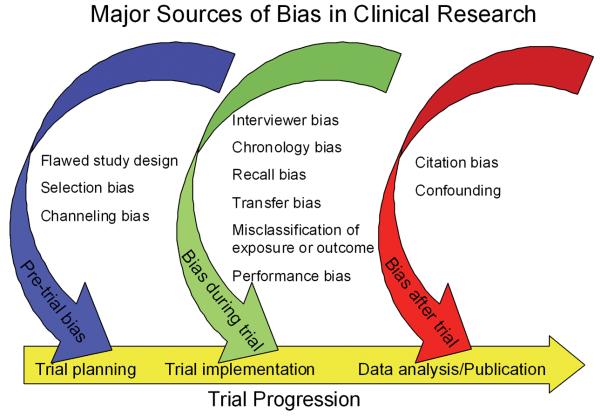
The article "Clinical Research in Ayurveda" provides an excellent, detailed breakdown of these biases.
Clinical Research in Ayurveda – Can Statistics as a ...
This next reading is the most critical for this lesson. It defines bias and provides a comprehensive table (Table 1) listing various types of bias, their meaning, and how to avoid them. This will be your reference guide.
Read the section 'Types of Biases' and carefully study 'Table 1: Types of Bias'. As you read, think about how each bias might manifest in a study on a Swasthawritta topic, such as Vyayama or a specific dietary regimen.
Let's discuss some of the most critical biases from that table in the context of Swasthawritta:
Pre-Trial Bias (Design and Planning Stage)
- Selection Bias: This occurs when the groups being compared are different from the start in a systematic way. In Ayurveda, this is a major risk in non-randomized studies. For instance, if a study on a Kapha-pacifying diet allows participants to self-select into the diet group, individuals who are already more health-conscious might be more likely to join, biasing the results.
- Channelling Bias: This is a form of selection bias where patients with certain characteristics (e.g., prognostic factors, disease severity) are systematically allocated to a particular treatment. In an Ayurvedic context, a clinician might subconsciously channel patients they believe will respond best (e.g., those with a clear Dosha imbalance matching the intervention) into the treatment arm, making the therapy appear more effective than it is.

During-Trial Bias (Implementation Stage)
- Performance Bias: This arises from systematic differences in the care provided to the groups, apart from the intervention itself. This is extremely difficult to avoid in Swasthawritta research. How do you "blind" a participant to the fact they are doing Abhyanga daily? Or following a specific diet? The knowledge of being in the "active" group can change behaviour and expectations (placebo effect), influencing the outcome.
- Recall Bias: Many Swasthawritta studies rely on participants reporting their own diet, exercise, and sleep patterns. People may not remember accurately, or their memory may be influenced by their health outcomes. For example, someone who feels better may recall their adherence to the regimen more positively.
- Interviewer Bias: The Vaidya or researcher assessing the outcome can be influenced if they know the patient's group allocation. Their interpretation of subjective improvements (e.g., in well-being, energy levels) or even objective signs (Nadi Pariksha) could be unconsciously biased.
After-Trial Bias (Analysis and Reporting Stage)
- Citation Bias (Publication Bias): Studies showing a positive effect for an Ayurvedic intervention are more likely to be published than those showing no effect. This creates a distorted view of the evidence base, making interventions seem more effective than they really are.
- Confounding: A confounder is a third factor that is associated with both the intervention and the outcome. In a study on a Medhya Rasayana, if the treatment group also happens to have a higher level of education (a confounder), it becomes impossible to separate the effect of the herb from the effect of education on cognitive function.
3. Case Study: Evaluating Methodology in Prakriti Assessment
A cornerstone of personalized preventive care in Ayurveda is the assessment of Prakruti. If we are to conduct research on individualized interventions, our method for determining Prakruti must itself be robust and valid. A flawed assessment tool can introduce significant bias into a study from the very beginning.
This critical review of Prakruti assessment tools provides a powerful real-world example of evaluating research methodology.
This review paper evaluates the scientific rigor of 64 different 'Prakriti Assessment Tools' (PATs). It serves as a perfect case study for our lesson's objective. Please read the following sections to understand the common methodological flaws found in this crucial area of Ayurvedic research.
Please read the following three parts: Background and Conclusion (in the abstract): This will give you a quick overview of the problem—most tools are not properly validated. Section 3.2, 'Tool evaluation based on the scale development and validation framework': Focus on Figure 5 and the accompanying text. Note how few tools meet the criteria for proper validation. Pay attention to terms like 'test-retest reliability' and 'content validity'. Section 4, 'Discussion': Read the first few paragraphs. The authors discuss critical gaps, such as the lack of a clear theoretical framework, problems with item generation, and bypassing key statistical steps like Exploratory Factor Analysis (EFA) before Confirmatory Factor Analysis (CFA).
This paper demonstrates that many tools used in Ayurvedic research may lack the methodological rigor required for producing trustworthy results. When you read a study that uses a Prakruti questionnaire, a key critical appraisal question should be: "Has this specific tool been validated? If not, how might that bias the study's findings?"
4. Choosing the Right Tool: Appropriate Methodologies for Ayurveda
Given the limitations of the classic RCT, researchers must consider alternative designs that may be more appropriate for studying complex Ayurvedic interventions. An "inappropriate" RCT that forces a holistic therapy into a reductionist box may be of lower quality than a well-designed observational study that respects the nature of the intervention.
Clinical Research in Ayurveda – Can Statistics as a ...
Let's return to the 'Clinical Research in Ayurveda' paper to explore some of these alternative, and often more appropriate, study designs.
Please read the section 'Statistical design methods'. Pay close attention to the descriptions of: Cluster trials Preference trials Observational studies Before and After Clinical Trials Focus on understanding the basic concept of each design and why it might be suitable for an Ayurvedic intervention.
The key takeaway is that there is a trade-off. While these alternative designs can offer greater real-world relevance (external validity), they often come with a higher risk of bias (lower internal validity). Therefore, when you encounter a study using one of these designs, you must be even more vigilant in looking for potential confounders and biases. Advanced statistical methods, such as stratification and propensity scores (mentioned in section 4 of the same paper), can help mitigate some of these biases, but they are not a perfect substitute for strong design.
Test your understanding!
You are reviewing a study protocol with the following design:
"To evaluate the effect of Yoga and a Sattvic diet on anxiety, we will recruit 200 participants from our hospital's outpatient department. One hundred participants will be assigned to a 12-week Yoga and diet program, while the other 100 will form a wait-list control group and receive the intervention after 12 weeks. The primary outcome will be the change in scores on the Hamilton Anxiety Rating Scale."
Based on what you've learned, identify three significant potential sources of bias in this design and explain why they are a concern.
Show answer
Here are three major potential sources of bias:
- Selection Bias: The protocol does not mention randomization. How are participants assigned to the intervention vs. the wait-list control? If clinicians are making the assignment, they might channel more motivated or less severe patients into the active group, making the intervention appear more effective.
- Performance Bias: The intervention is impossible to blind. Participants know they are doing Yoga and changing their diet. This knowledge can lead to a powerful placebo effect or other behavioural changes (e.g., improved sleep hygiene, more social interaction) that are not part of the intervention but still reduce anxiety. The wait-list control group does not account for this.
- Attrition Bias: Participants in the wait-list control group who experience worsening anxiety may be more likely to drop out of the study to seek other treatment, compared to the active group. If this happens, the control group at the end of the study will consist of only those with milder or more stable anxiety, which could falsely reduce the apparent effectiveness of the Yoga intervention.
Conclusion
You are now equipped to move beyond a generic critique of research and perform a nuanced evaluation specific to the field of Ayurveda. You understand not just what the common biases are, but why they are so prevalent and challenging in studies of preventive and holistic healthcare.
Key Takeaways:
- Standard RCTs are often a poor fit for testing complex, individualized Ayurvedic interventions. The "appropriateness" of the methodology is a key evaluation criterion.
- Bias can be systematically identified by considering the pre-trial, during-trial, and after-trial phases. In Ayurveda research, pay special attention to selection bias, performance bias (blinding issues), and confounding.
- The validity of assessment tools (e.g., for Prakruti) is a critical methodological point that must be evaluated, as a flawed tool can invalidate a study's results.
- Alternative designs like cluster trials, observational studies, and preference trials may be more appropriate for Ayurvedic research, but they require careful consideration of their own inherent biases.
Preview of the Next Lesson:
In this lesson, you have honed your ability to deconstruct a study's methodology. In our next session, we will shift from theory to practice by "analyzing contemporary research validating key Dinacharya practices, integrating perspectives from chronobiology." You will apply the critical skills you've developed today to real papers, evaluating whether their claims about practices like meal timing or sleep schedules are truly supported by their scientific methods.