Hello! In our last lesson, we constructed a comprehensive service blueprint for your new AI-augmented consultancy. This blueprint laid out the "how" of your service delivery, mapping the entire client journey from first contact to long-term partnership.
Today, we shift our focus from "how" to "who." A high-value, specialized service like the one you're building cannot and should not be for everyone. Its power lies in its precision. This lesson is dedicated to defining the Ideal Customer Profile (ICP) for your new offering. We'll move beyond a vague notion of a "good client" to a concrete, data-informed description of the perfect partner for your business. This process is the strategic filter that will help you attract clients who not only need your service but will value it, champion it, and pay a premium for the unique transformation you provide.
1. The Mindset Shift: Seeking a Different Caliber of Client
Before we dive into the mechanics of building an ICP, we need to establish the right mindset. Your pivot from a production-focused studio to a strategic consultancy requires a corresponding pivot in the type of client you engage. You are moving away from clients who see creative work as a commodity to be purchased by the hour, and toward partners who see strategy as an investment with a significant return.
The most successful consultants and agencies understand a fundamental distinction: some clients throw time at their problems, while others throw money. Clients who throw time tend to micromanage, lack budget, and drain your energy. Clients who throw money value their time above all else. They want to pay for an expert solution that makes their problem disappear efficiently and effectively. These are the clients you want.
To explore this crucial distinction, watch the beginning of this interview with Daniel Priestley, an author and entrepreneur who specializes in helping businesses attract high-value clients.
PROVEN Strategies to Attract High Ticket Clients and 10x Your Income w/ Daniel Priestley
Watch the initial segment of this video from "The Futur" channel, featuring Daniel Priestley.
Pay close attention to his definition of a "high-end client" and his explanation for why they are often less demanding, not more. He makes a critical point about solving problems for clients who want to throw money, not time, at their problems. This is the foundational mindset for defining your ICP.
As Priestley explains, the same service can have a vastly different value depending on the client. Your strategic service, which combines brand strategy with a powerful AI execution model, will be exponentially more valuable to a growing business that needs to scale its brand consistently than to a small shop that can manage with ad-hoc production. Your ICP will help you find the former.
2. What is an Ideal Customer Profile (ICP)?
An Ideal Customer Profile is a detailed, semi-fictional description of the company that is a perfect fit for your service. It’s not about a person (that’s a buyer persona, which we'll cover later), but about the organization itself—its size, industry, revenue, challenges, and goals.
For your B2B consultancy, the ICP is the north star for all your sales and marketing efforts. It ensures you're not wasting resources trying to appeal to everyone.
Many creatives resist this kind of focus, fearing they'll miss out on opportunities (a classic case of FOMO). However, a well-defined ICP doesn't mean you say "no" to all other work. It means you focus your proactive efforts on attracting the best work.
How to Create Your Ideal Client Profile (step by step)
The presenter in this video from Agency Mavericks gives an excellent overview of the ICP concept for a digital agency.
Watch the section where he directly addresses the fear of missing out and clarifies that an ICP is not a permanent, life-or-death decision. He then explains the different ways to define a target audience, which will be useful in a moment.
3. A Procedural Guide to Building Your ICP
Now for the "how-to." Building an ICP is a systematic process of research and synthesis. Given your decade of experience, you already have the most valuable raw material: your own client history.
Step-by-Step Guide: How to Identify Ideal Customer Profile ...
This guide from M1-Project provides a fantastic, procedural framework for creating an ICP. It's written for a B2B context and is highly actionable.
First, read the introductory sections to solidify your understanding of what an ICP is and why it's important. Focus on the definition and the practical benefits described under Why Businesses Need an ICP. Next, move to the core of the article. The section on Core Customer Attributes provides the exact categories of information you need to gather. Finally, review the step-by-step process, which begins with the most crucial step: identifying your best past clients.
Let's break down that process:
Step 1: Analyze Your Best (and Worst) Past Clients
Think back over your 10 years of running a creative studio. Make a list of your top 3-5 favorite clients and your bottom 3-5 least favorite clients.
- Best Clients: Who paid on time, respected your expertise, gave you creative freedom, and had projects that led to great portfolio pieces or measurable results? What did these clients' businesses have in common?
- Worst Clients: Who haggled over price, micromanaged the process, had unclear goals, and left you feeling drained? What were their common traits?
This initial analysis will immediately reveal patterns about the kinds of organizations you thrive with.
Step 2: Define and Document Key Attributes
Using the "Core Customer Attributes" from the M1-Project article as a guide, start documenting a profile based on your analysis. For your AI-augmented service, I suggest focusing on these attributes:
- Industry/Vertical: Are they in tech, e-commerce, professional services, healthcare?
- Company Size (Revenue & Team): A $500k/year business has different problems than a $10M/year business. A 5-person team operates differently from a 100-person company. Be specific.
- Maturity/Growth Stage: Are they a fast-growing scale-up, an established business looking to modernize, or a legacy brand?
- Challenges/Pain Points: This is critical. Your ideal client is likely struggling with brand inconsistency, slow content production, or the high cost of traditional agency retainers. They feel pressure to "do something with AI" but lack a clear strategy.
- Goals: What are they trying to achieve? Faster growth, market expansion, beating a competitor, increasing brand equity?
- Budget: They have an existing marketing budget and understand the concept of investing in infrastructure for future returns.
- Tech-Savviness: They are comfortable with technology and are likely already using a suite of SaaS tools (e.g., Hubspot, Salesforce, Figma).
This detailed framework is an excellent example of a completed ICP, connecting the company-level profile with the specific people you'll interact with.
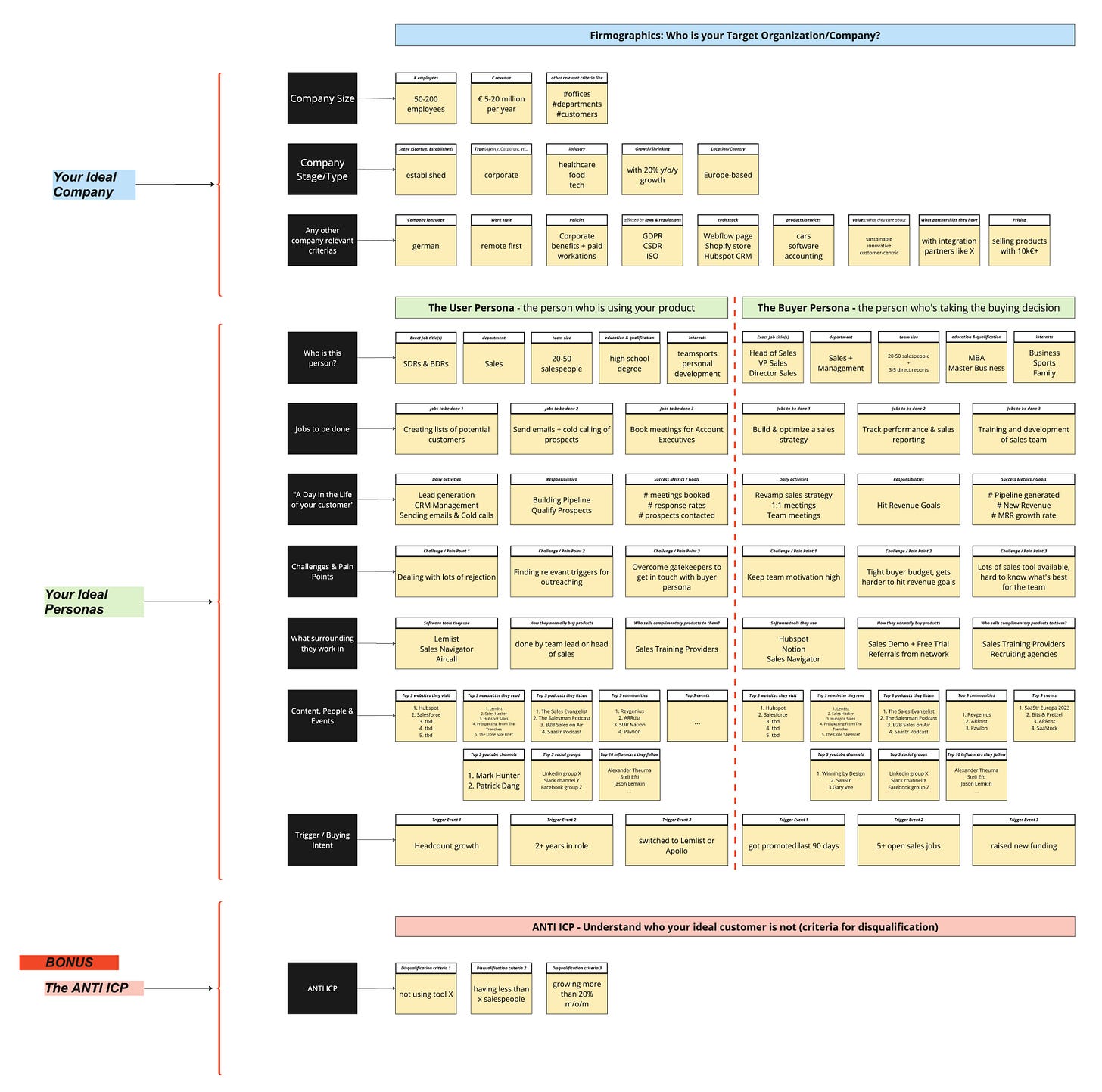
Step 3: Create a Scoring Matrix
Once you have a draft of your ICP, you can turn it into a practical tool. A scoring matrix helps you quickly qualify or disqualify new leads.

4. Using AI to Find Your ICP
It's fitting that for your AI-augmented consultancy, AI can also help you find your ideal clients. This isn't about replacing the strategic thinking you just did, but about enhancing and accelerating it.
How to Build an Ideal Customer Profile with AI | M1-Project
This second article from M1-Project builds on the first, focusing specifically on how AI can revolutionize the ICP creation process.
Read the section on how AI is revolutionizing profiling. Then, review the procedural steps, noting how they align with the manual process but add an AI-powered layer for data collection, segmentation, and refinement. Finally, the section on Common Mistakes is invaluable for avoiding common pitfalls.
In practical terms, you could use tools like LinkedIn Sales Navigator or other B2B databases to filter for companies that match your ICP criteria (e.g., "SaaS companies in Europe with 50-200 employees that recently hired a Head of Marketing"). This turns your ICP from a document into a powerful lead-generation machine.
Conclusion
Defining your Ideal Customer Profile is one of the most powerful strategic actions you can take for your new business. It's the act of choosing your clients with the same care that you choose your services.
Key Takeaways:
- Mindset is Key: Your goal is to attract clients who throw money, not time, at their problems. These high-value clients respect expertise and are focused on outcomes.
- ICP Defines the Company: An ICP describes the ideal organization (firmographics, challenges, goals), while a persona describes the people within it.
- It's a Process, Not a Guess: Build your ICP by analyzing your past successes, identifying common attributes, and documenting them in a structured way.
- From Document to Tool: Use your ICP to create a scoring matrix to qualify leads and guide your marketing efforts.
- Leverage AI: Use AI and data tools to find and target companies that match your ICP at scale.
You now have the framework to define precisely who you are looking for. This clarity is the foundation of a strong business. In our next lesson, we will use this newly defined ICP to develop service packages and a value-based pricing strategy that speaks directly to their needs and budget.