In our previous lesson, we examined the cross-sectional study design, which provides a valuable "snapshot" of a population at a single point in time. We learned that its primary strength is measuring prevalence, but its greatest weakness is the inability to determine whether an exposure preceded an outcome—the classic "chicken and egg" problem. To make stronger inferences about causality, we need a study design that can establish a clear temporal sequence.
This lesson introduces the cohort study, a powerful longitudinal design that directly addresses this limitation. By following groups of individuals (cohorts) over time, these studies allow us to observe the development of new outcomes and directly link them to prior exposures. Your goal is to describe the fundamental design of the two main types of cohort studies: prospective and retrospective.
The Core Principle of a Cohort Study
Before we differentiate between prospective and retrospective designs, let's establish what a cohort study is. At its heart, this design mimics the logical way we think about cause and effect: we start with a potential cause (an exposure) and watch to see if the effect (an outcome) occurs.
The process begins by identifying a group of individuals—the cohort—who are all free of the disease or outcome you wish to study. This cohort is then divided into subgroups based on their exposure to a potential risk factor. For example, a cohort might be separated into smokers and non-smokers. The researchers then follow these groups over time to see who develops the outcome of interest, such as lung cancer.
The following short video provides a clear overview of this fundamental concept.
Case Control, Retrospective Cohort & Prospective Cohort Studies
This clip from "Learn With MedNuggets" introduces the core logic of a cohort study, emphasizing that you begin by identifying groups based on their exposure to a risk factor.
Watch the segment from the introduction to cohort studies, which explains how participants are grouped by risk factor. Then, skip ahead to the summary, where the presenter ties this design to the concept of relative risk, a key measure we will explore in the next lesson.
The key idea is that we are tracking the development of new cases of a disease. This allows us to calculate the incidence of the disease in both the exposed and unexposed groups, a concept you learned about in our first module. Now, let's explore the two ways this can be done.
Prospective Cohort Studies: Looking Forward
The most intuitive type of cohort study is the prospective design. The term "prospective" means looking forward. In this design, researchers identify a cohort in the present, assess their exposure status, and then follow them into the future to record any newly developing outcomes.
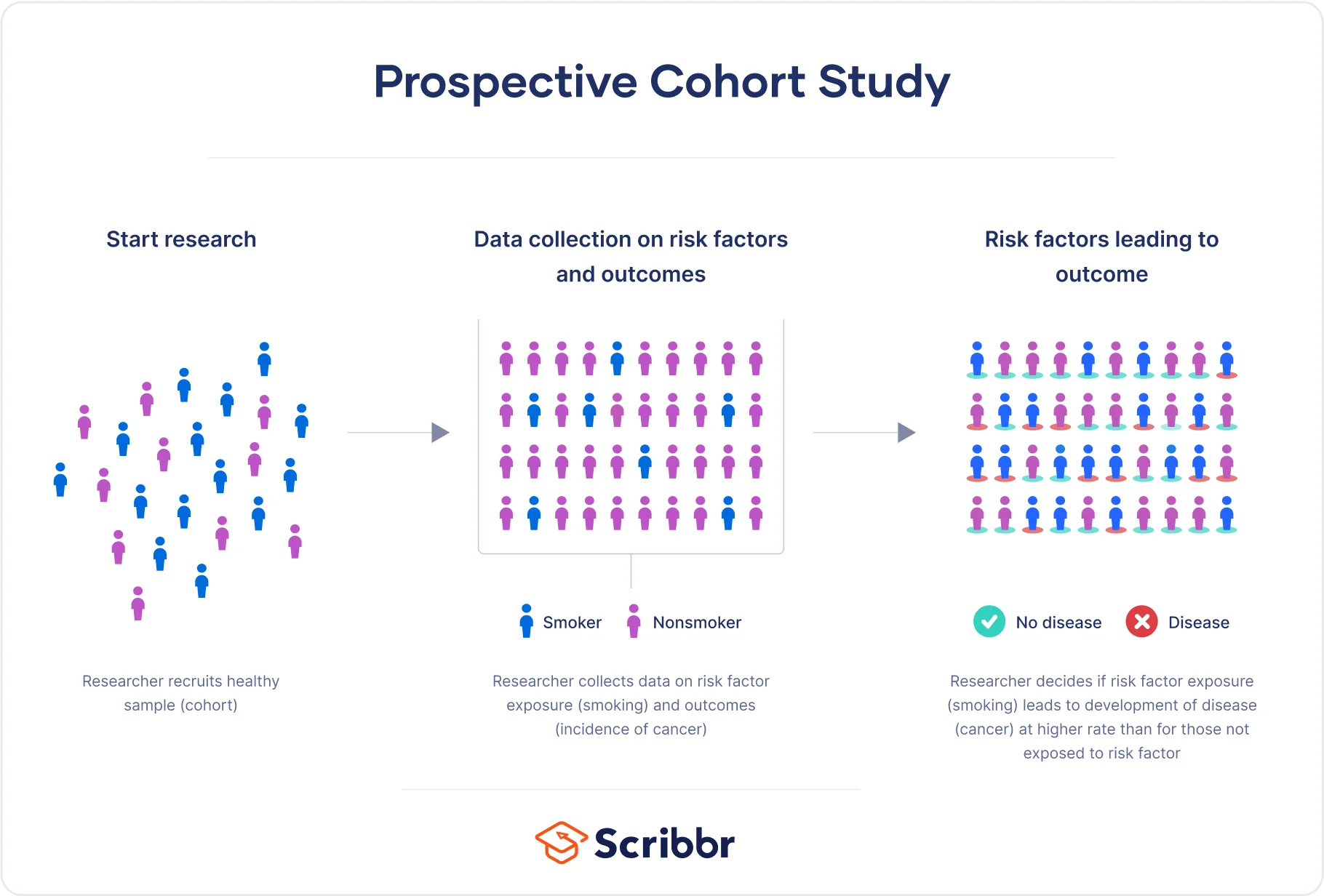
The steps are as follows:
- Start of Study (Present): Researchers define and recruit a cohort of individuals who are all free of the outcome of interest.
- Assess Exposure (Present): Data on their exposure to various risk factors is collected at the beginning of the study (baseline).
- Follow-Up (Future): The cohort is followed over a specified period, which can be years or even decades. During this time, researchers track the development of new cases of the outcome.
- Analysis: At the end of the study, researchers compare the incidence of the outcome in the exposed group to the incidence in the unexposed group.
This design is powerful because the researcher defines and collects the data specifically for the research question, leading to high-quality information. The following reading provides a more formal definition.
6 Cohort Studies – STAT 507 - Statistics Online
This resource from Penn State's Department of Statistics outlines the concurrent, or forward-looking, nature of prospective cohort studies.
Please read the section titled Prospective Cohort Design. Focus on the description of how investigators identify the cohort and follow them forward in time. Notice the mention of the famous Framingham Heart Study, a landmark prospective study that has shaped our understanding of cardiovascular disease.
Because they follow people forward in time, prospective cohort studies are the strongest observational design for establishing that an exposure precedes an outcome.
Retrospective Cohort Studies: Looking Back
Now, let's consider the retrospective cohort study. This design uses the same underlying logic—comparing outcomes in exposed versus unexposed groups—but all the events have already occurred in the past. Researchers use historical records to reconstruct the entire sequence of events.
The steps are:
- Start of Study (Present): Researchers decide on a research question.
- Identify Cohort (Past): Using existing records (e.g., employee files, medical charts, military records), they identify a cohort that was assembled at some point in the past. Crucially, all members were free of the outcome at that past time point.
- Assess Exposure (Past): The same historical records are used to determine the exposure status of each cohort member at that past time point.
- Determine Outcome (Past to Present): Researchers then trace these individuals forward in time from the past starting point up to the present day, using subsequent records (like medical databases or death registries) to determine who developed the outcome.
This design is "retrospective" because the researcher is looking back in time to collect the data. However, the study logic is "prospective" in the sense that it starts with a (past) exposure and looks forward (in historical time) for an outcome. This is a critical distinction that often causes confusion.
The image below perfectly illustrates the temporal difference between the two designs.

To solidify this concept, the following reading defines the retrospective design and contrasts it with other study types.
6 Cohort Studies – STAT 507 - Statistics Online
This section of the Penn State resource defines the retrospective design and clarifies how it differs from a case-control study, which we will cover later.
Please read the section Retrospective Cohort Study. Focus on the description of how an investigator uses a historical roster. Also, review the "Try It!" box that follows, which explains the key difference: a retrospective cohort study uses the entire cohort, whereas a case-control study starts by sampling cases and controls separately.
Comparing Prospective and Retrospective Designs
The choice between a prospective and a retrospective design involves a series of practical trade-offs related to time, cost, and data quality. From your background in information systems, you can think of this as the difference between setting up a new logging system to track user events going forward (prospective) versus analyzing historical server logs from five years ago to reconstruct user behavior (retrospective). The former gives you cleaner, more relevant data but takes a long time, while the latter is faster but depends on the quality and completeness of old records.
The following resource provides an excellent, detailed comparison of the two approaches.
11 Retrospective vs Prospective Cohort Study Differences - Formplus
This article from the Formplus blog breaks down the key differences between the two cohort study designs across several practical dimensions.
Please read the main section titled Here are 11 Key Differences between retrospective and prospective studies. Pay close attention to the comparisons made regarding: Data Collection Cost and Time Advantages and Disadvantages
Here is a summary of the most critical trade-offs:
| Feature | Prospective Cohort Study | Retrospective Cohort Study |
|---|---|---|
| Timing | Events occur after the study begins. | Events occurred before the study begins. |
| Cost | Very expensive. | Relatively inexpensive. |
| Time | Very time-consuming (can take decades). | Relatively quick. |
| Data Quality | High. Data is collected for the research question. | Variable. Relies on existing data that may be incomplete, inaccurate, or not fit for purpose. |
| Usefulness | Good for common exposures. Better for assessing many outcomes from one exposure. | Good for diseases with long latency periods. Good for rare exposures (e.g., an industrial chemical). |
Conclusion
In this lesson, we explored the cohort study, a powerful observational design that overcomes the temporal ambiguity of cross-sectional studies. By following groups over time, it allows researchers to establish that an exposure precedes an outcome.
Here are your key takeaways:
- Cohort Study Principle: A group of outcome-free individuals is identified, classified by exposure status, and followed over time to compare the incidence of the outcome between groups.
- Prospective Design: Researchers assemble a cohort in the present and follow it into the future. This design is strong but slow and expensive.
- Retrospective Design: Researchers use historical records to reconstruct a cohort from the past, assess past exposures, and determine outcomes that have occurred up to the present. This design is faster and cheaper but is limited by the quality of existing data.
- Primary Strength: The defining feature of all cohort studies is their ability to establish a clear temporal relationship between exposure and outcome.
Because cohort studies measure the development of new cases over time, they are the ideal design for directly calculating measures of risk. In our next lesson, we will focus on exactly that: how to calculate and interpret the risk ratio and rate ratio, the primary measures of association used in cohort studies.