In our previous lesson, we established the broad framework for clinical trials, covering the essential ethical principles and the overall regulatory pathway from the lab to the public. We saw that this journey is a structured, multi-stage process. Now, we're going to zoom in on the heart of this process: the first three phases of human testing.
This lesson focuses on the distinct purpose of each of these crucial early stages. By the end of our session, you will be able to describe the objectives of Phase I (safety), Phase II (efficacy), and Phase III (comparative efficacy) trials. Understanding these objectives is key to appreciating how researchers systematically build a case for a new treatment's value, progressing logically from "Is it safe?" to "Does it work?" and finally, "Is it better than what we already have?"
A Phased Approach to Answering Critical Questions
Before we break down each phase, it's helpful to read a concise, authoritative overview from the U.S. Food and Drug Administration (FDA), the primary regulatory body for drugs in the United States. This will give you a solid foundation for the more detailed discussion to follow.
This document from the FDA provides a clear, official description of the clinical trial phases. It outlines the purpose, participants, and duration of each phase and even includes statistics on how many drugs successfully move from one phase to the next.
Please read the entire section titled Clinical Research Phase Studies. Pay close attention to the distinct Purpose stated for Phase 1, Phase 2, and Phase 3.
The FDA resource you just read outlines the formal progression of a clinical trial. Now, let's explore the strategic goal behind each phase, adding context and detail to what you've learned. The entire process can be thought of as a funnel: many potential treatments enter Phase I, but only a small fraction will successfully navigate all the way through Phase III to be considered for approval.
The following video provides an excellent conversational explanation of each phase, introducing some key terminology we will discuss.
Phases of Clinical Trials: Explained
This video from the HealthTree Foundation features experts explaining the goals and structure of each trial phase in clear terms.
Please watch the segments covering the first three phases: Phase I, which focuses on safety and the concept of a maximum tolerated dose (MTD). Phase II, which introduces the goal of measuring efficacy or response rate. Phase III, which explains the role of large, randomized trials that compare a new treatment to the existing standard of care.
Now that you have both a formal reading and an expert discussion as reference, let's synthesize and expand on the objectives of each phase.
Phase I: Safety and Dosage
The first time a new investigational drug is given to humans, the single most important question is: Is it safe?
- Primary Objective: To assess the safety, tolerability, and pharmacokinetic profile of a new drug. This includes identifying a safe dosage range.
- Participants: A small group, typically 20 to 100 individuals. For most drugs, these are healthy volunteers. However, for treatments with expected high toxicity (like chemotherapy), the trial enrolls patients who have the disease and have often exhausted other treatment options.
- Key Activities: Researchers start with very low doses and gradually increase them in a process called dose escalation. They carefully monitor participants to see how the drug is absorbed, distributed, metabolized, and excreted by the body (this is its pharmacokinetics). The goal is to find the maximum tolerated dose (MTD)—the highest dose that can be given without causing unacceptable side effects.
From a systems perspective, Phase I is analogous to the initial unit testing or "alpha testing" of a new piece of software. You're not yet testing it on a large user base, but rather in a highly controlled environment to check for fundamental errors (adverse effects) and determine the basic operational parameters (safe dosage).
Phase II: Efficacy and Side Effects
Once a drug has been deemed reasonably safe in Phase I, the next critical question is: Does it work?
- Primary Objective: To evaluate whether the drug has any biological activity or effect on the target disease (efficacy) and to continue monitoring safety in a larger group of individuals.
- Participants: A larger group, typically up to several hundred patients who have the specific condition the drug is intended to treat.
- Key Activities: Researchers administer the drug at the dose or doses determined to be safe in Phase I. They look for preliminary evidence that the drug is having the desired effect—for example, shrinking a tumor, lowering blood pressure, or reducing viral load. This is often where researchers look for a "signal" of efficacy. These trials also collect more data on short-term side effects.
Continuing our analogy, Phase II is like a "closed beta test." The product is now being tested by its intended end-users (patients with the disease) to see if it actually performs its core function (efficacy). This phase is a critical filter; as the FDA resource noted, only about one-third of drugs that enter Phase II will proceed to the next stage. Many drugs that are safe simply don't work well enough to justify further development.
Phase III: Comparative Efficacy and Safety
If a drug shows promise in Phase II, it must finally answer the most important question for medical practice: Is it better than the current standard of care?
- Primary Objective: To confirm the treatment's effectiveness, monitor safety in a large population, and, crucially, compare it to existing standard treatments. This is often called a pivotal trial because its results are pivotal for gaining regulatory approval.
- Primary Goal: To establish comparative efficacy.
- Participants: A very large group, ranging from several hundred to several thousand patients.
- Key Activities: These are large-scale, often multi-center, randomized controlled trials (RCTs). Participants are randomly assigned to receive either the new treatment or the best available existing treatment (the "standard of care"). By comparing the outcomes between these groups, researchers can definitively determine if the new drug offers a significant advantage in terms of efficacy or safety. The long duration (1-4 years or more) also allows for the detection of rarer or long-term side effects.
This is the equivalent of a final, large-scale public benchmark against the leading market competitor. The goal is to generate robust, statistically significant evidence that the new product is a superior choice. A successful Phase III trial is the cornerstone of the New Drug Application (NDA) submitted to the FDA for marketing approval.
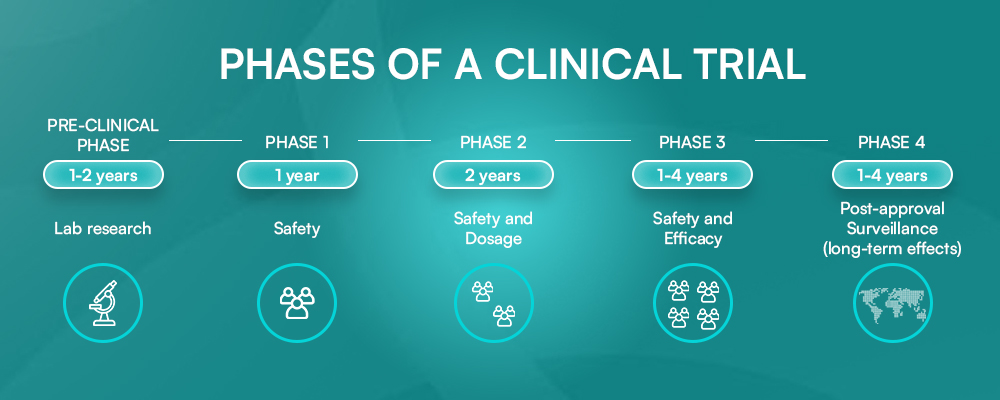
Visualizing the Journey
The following infographics provide a clear visual summary of this progression.

Conclusion
In this lesson, we have dissected the core objectives of the first three phases of clinical trials. You've seen how this structured process is designed to answer a series of progressively more complex questions, all while prioritizing patient safety.
Here are the main takeaways:
- Phase I is primarily concerned with safety and dosage, establishing a safe therapeutic window in a small number of participants.
- Phase II shifts the focus to preliminary efficacy, seeking a "signal" that the drug works in a medium-sized group of patients with the target disease, while continuing to gather safety data.
- Phase III is the definitive test of comparative efficacy and safety. These large-scale, randomized trials compare the new treatment to the existing standard, providing the pivotal evidence needed for regulatory approval.
In our next lesson, we will delve into the essential design features that make Phase III trials so powerful. We'll explore the concepts of randomization, blinding, and the use of control groups—the methodological pillars that make RCTs the gold standard for establishing cause-and-effect in medical research.