In our last lesson, we outlined the progression of clinical trials, focusing on the specific objectives of Phases I, II, and III. We established that a Phase III trial's primary goal is to generate definitive evidence of a new treatment's comparative efficacy and safety against the current standard of care.
This lesson delves into the methodological heart of these pivotal trials. We will examine the core design features that enable researchers to draw valid, unbiased conclusions. By the end of this session, you will be able to describe the key design features of Phase III trials, including randomization, blinding, and the use of control groups. These three pillars work together to isolate the true effect of a treatment, ensuring that the results are scientifically sound. Think of it as carefully controlling the variables in a complex system to confidently attribute an outcome to a specific change.
The Control Group: Establishing a Benchmark
To determine if a new treatment works, we must compare it to something. This "something" is the control group. A control group provides a benchmark, allowing researchers to distinguish the effects of the experimental treatment from other factors, such as:
- The natural progression of the disease (some people might get better or worse on their own).
- The psychological impact of being in a study (the placebo effect).
- The effects of other care or treatments received during the trial.
Without a control group, observing improvement in patients receiving a new drug would be inconclusive; we wouldn't know if they improved because of the drug or if they would have improved anyway.
There are several types of control groups, and the choice depends on the research question and ethical considerations. For an excellent overview, please consult the following resource.
Selection of Control, Randomization, Blinding, and Allocation ...
This article from the Indian Dermatology Online Journal provides a clear breakdown of fundamental trial design concepts. We'll return to it for randomization and blinding, but for now, we'll focus on its explanation of control groups.
Please read the section titled Controls in clinical trials, as well as the brief definitions of Active control and Historical control.
As you've just read, the main types of controls used in clinical trials are:
- Placebo Control: An inert substance designed to look, taste, and feel exactly like the active treatment. This is the ideal control for demonstrating any effect, but it's only ethical to use when no effective standard treatment exists. Using a placebo would be unethical if it meant withholding a known, effective therapy from a patient.
- Active Control: This is the current best-available treatment, often called the "standard of care." In Phase III trials, this is the most common type of control. The research question isn't just "Does the new drug work?" but "Is the new drug better, safer, or more convenient than what we already use?"
- Historical Control: This involves using data from previously conducted trials. While efficient, this approach is prone to bias because patient populations, diagnostic criteria, and general medical care can change over time. In data science, this would be analogous to comparing a new algorithm's performance on a modern dataset with an old algorithm's results on a dataset from ten years ago—the comparison is often not a fair one.
Randomization: Ensuring a Fair Comparison
Once we have our treatment and control groups, how do we decide which participant goes into which group? If researchers were allowed to choose, they might subconsciously assign healthier or more motivated patients to the new treatment, a phenomenon known as selection bias. This would make the new treatment look better than it really is.
Randomization is the solution. It is the process of assigning participants to groups by chance, much like flipping a coin.
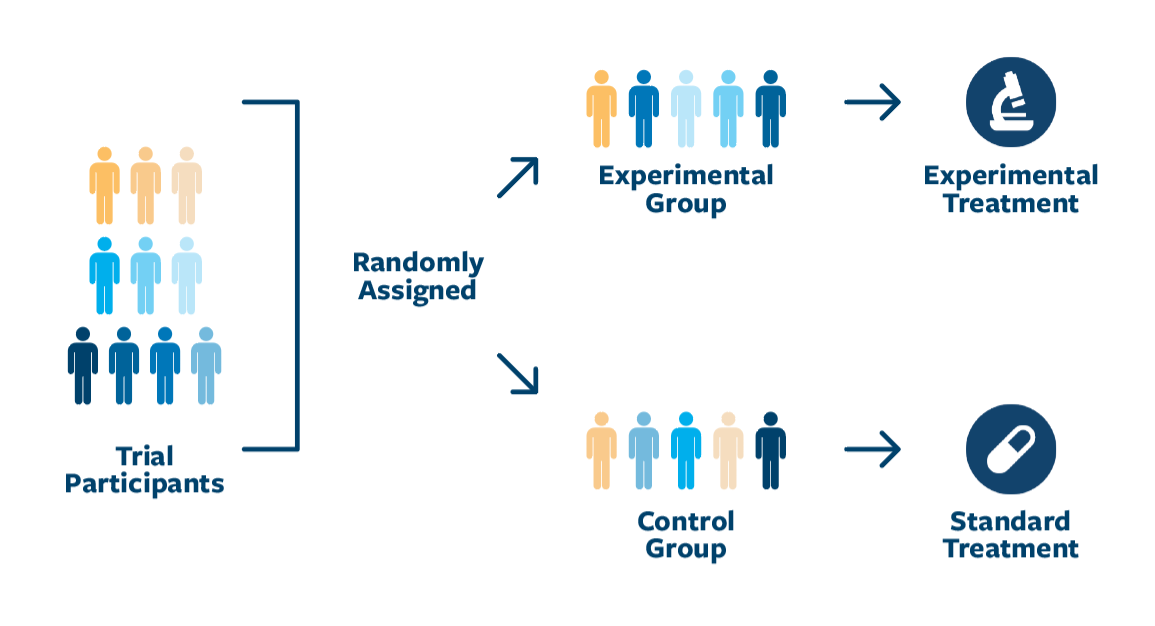
The fundamental power of randomization is that, in a sufficiently large trial, it ensures the treatment and control groups are balanced, on average, for all baseline characteristics—not just the ones we know about (like age and disease severity), but also for the unknown and unmeasured factors (like genetic predispositions or lifestyle habits). This isolates the intervention as the only systematic difference between the groups, allowing us to attribute any observed differences in outcomes to the treatment itself.
The following video provides a concise explanation of this crucial concept.
Randomized control trial (RCT) explained
This short video from Henrik's Lab clearly articulates the "why" behind randomization.
Watch the segment from the beginning of the explanation on the importance of creating similar groups through random allocation.
While the principle is simple, there are different techniques for randomization. The resource we consulted earlier provides an excellent, detailed breakdown.
Selection of Control, Randomization, Blinding, and Allocation ...
Now, we return to the same article to understand the mechanics of randomization.
Please read the entire section B. Randomization. Focus on understanding the three main benefits and the difference between the randomization techniques, especially simple, block, and stratified randomization.
To summarize the key methods you just read about:
- Simple Randomization: Like a coin flip for each participant. It's easy but can lead to unequal group sizes by chance, especially in smaller trials.
- Block Randomization: Ensures that the number of participants in each group remains balanced as the trial progresses. For example, in blocks of four participants, two will always be assigned to treatment A and two to treatment B, with the order randomized within the block.
- Stratified Randomization: This technique ensures balance on specific, important prognostic factors. It's analogous to stratified sampling in machine learning. If you know that disease stage heavily influences outcomes, you would first separate patients into strata (e.g., "early stage" and "late stage") and then randomize them to treatment or control within each stratum. This guarantees that both the treatment and control groups have a similar proportion of early- and late-stage patients.

Blinding: Preventing Bias During the Trial
Randomization creates fair groups at the start, but bias can still creep in during the trial. If patients or investigators know who is receiving which treatment, it can influence their behavior, reporting, and assessments. Blinding (or masking) is the practice of concealing the treatment assignment from those involved in the study.
Blinding is critical for preventing two major types of bias:
- Performance Bias: Systematic differences in the care provided to the groups. If a doctor knows a patient is on the exciting new drug, they might unconsciously offer more encouragement or ancillary care.
- Ascertainment (or Detection) Bias: Systematic differences in how outcomes are assessed. If an investigator expects the new drug to work, they may interpret subjective measures (like "improvement in pain") more favorably for patients in that group.
The following video provides a clear explanation of these biases and how blinding helps prevent them.
In this video, Dr. Terry Shaneyfelt explains the rationale for blinding, the biases it addresses, and the methods used to achieve it.
Please watch the entire video. Pay particular attention to the definitions of performance and ascertainment bias and the methods used to achieve blinding, such as placebos and sham interventions.
As the video explained, there are different levels of blinding:
- Open-label: Everyone knows the treatment assignment. This is sometimes unavoidable (e.g., comparing a surgical procedure to a medication) but is highly susceptible to bias.
- Single-blind: One party, usually the participant, is unaware of the treatment assignment.
- Double-blind: Both the participants and the investigators/clinicians are unaware. This is the gold standard for Phase III trials as it minimizes bias from both sides.
- Triple-blind: The participants, investigators, and the committee monitoring the data and results are all unaware of the assignments until the study is over.
Finally, it's important to distinguish blinding from a related concept: allocation concealment.
- Allocation Concealment protects the randomization process before assignment. It prevents the person enrolling patients from knowing which group the next patient will be assigned to. This stops selection bias.
- Blinding protects the trial after assignment. It prevents performance and ascertainment bias during the study.
The article we've been using has a superb table that clarifies this distinction.
Selection of Control, Randomization, Blinding, and Allocation ...
Let's look at one final section from this article to cement the difference between these two critical concepts.
Read section D. Allocation concealment to understand how it protects randomization, and then review the table in section E. Differences between allocation concealment and blinding for a direct comparison.
Conclusion
In this lesson, we have explored the three methodological pillars that give Phase III Randomized Controlled Trials (RCTs) their scientific rigor. These are not merely administrative procedures but are essential tools for producing trustworthy evidence about a treatment's effects.
Here are the key takeaways:
- Control Groups provide the necessary benchmark to determine if an observed effect is due to the treatment or other factors. The choice between a placebo or an active control depends on the existence of a standard of care.
- Randomization is the cornerstone of fair comparison. It minimizes selection bias by creating groups that are comparable at baseline, not just for factors we can measure, but for unknown confounders as well.
- Blinding minimizes performance and ascertainment bias during the trial by keeping participants and/or investigators unaware of the treatment assignments, ensuring that outcomes are assessed objectively.
Together, these features allow researchers to confidently attribute differences in outcomes between groups to the intervention being studied.
In our next lesson, we will address another critical design question: how many people do we need? We will explore the concept of statistical power and the factors that influence sample size calculations, ensuring a trial is large enough to detect a meaningful treatment effect if one truly exists.