Welcome to the first lesson in our module on clinical trials. In the previous modules, we explored observational studies, where we as researchers observe exposures and outcomes without intervening. We learned to navigate their complexities, particularly the challenges of confounding and effect modification. Now, we shift our focus to a powerful experimental design: the clinical trial. Here, the researcher actively assigns an intervention, a design choice that fundamentally aims to minimize confounding from the outset.
This lesson provides the foundational framework for all subsequent discussions on clinical trials. We will explore the two pillars that support this entire field of research. By the end of our session, you will be able to describe the ethical principles and regulatory phases (I-IV) of clinical trials. We'll start with the "why"—the crucial ethical principles that govern research on human beings—and then move to the "how"—the structured, multi-phase process that brings a potential new treatment from the laboratory to the public.
The "Why": Ethical Foundations of Clinical Research
To understand why clinical research is so rigorously regulated, we must first look to the past. History is unfortunately filled with examples of research where the pursuit of knowledge came at an unacceptable human cost. These events were not minor missteps; they were profound violations of human rights that led to the development of the strict ethical codes we have today.
The Ultimate Guide to Understanding Clinical Trials and Research ...
This article from Studypages provides a concise overview of several infamous historical cases of unethical research. Understanding them provides the essential context for the principles we will discuss next.
Please read the section under the heading "Avoiding Mad Science", and then review the four brief case descriptions from the Tuskegee Syphilis Study through the Willowbrook Hepatitis Experimentation. As you read, reflect on the fundamental rights that were violated in each case.
The abuses you just read about, especially the horrific experiments conducted during World War II and the deeply unethical Tuskegee Syphilis Study, created a global consensus that research involving human subjects required a formal ethical framework.
The Belmont Report: Three Core Principles
In the United States, the cornerstone of this framework is The Belmont Report. Published in 1979, it outlines three fundamental ethical principles that guide all human subject research. The following short video provides a clear and concise explanation of each.
The Belmont Report: Respect for Persons, Beneficence, and Justice | Research Ethics
This video from MedCat breaks down the three core principles of the Belmont Report: Respect for Persons, Beneficence, and Justice.
Please watch the segments explaining each of these principles: Respect for Persons, which covers autonomy and the protection of vulnerable individuals. Beneficence, which involves the dual obligations to do no harm and to maximize benefits while minimizing risks. Justice, which addresses the fair distribution of the burdens and benefits of research.
These three principles—Respect for Persons, Beneficence, and Justice—are not just abstract ideals. They are the foundation of practical rules and procedures that govern every clinical trial.
From Principles to Practice: GCP and IRBs
To translate these ethical principles into actionable guidelines, the international community developed the standard of Good Clinical Practice (GCP). GCP is a set of quality standards for the design, conduct, performance, monitoring, auditing, recording, analysis, and reporting of clinical trials. Adherence to GCP ensures that the rights, safety, and well-being of trial subjects are protected and that the clinical trial data are credible.

The primary body responsible for enforcing these principles at the local level is the Institutional Review Board (IRB), also known as an Independent Ethics Committee (IEC). Before a single participant can be enrolled, the IRB—a committee of scientists, non-scientists, and community members—must review and approve the entire study plan, or protocol. Their job is to ensure the trial is ethical and that the rights and welfare of participants are protected.
The following video segment explains the critical role of the IRB.
Clinical Trials Overview: Phrases and Phases of a Clinical Trials
This excerpt from the "Clinical Trials Overview" video by the Barth Syndrome Foundation explains what an IRB is, who is on it, and what its responsibilities are.
Watch the section that begins with the discussion of what happens at individual study sites, focusing on the explanation of the IRB's function and ongoing review process, which starts at this timestamp.
The "How": A Phased Approach to Clinical Trials
With the ethical framework as our foundation, we can now examine the structured process of a clinical trial. To ensure safety and efficacy, the development of a new drug or treatment is not a single event, but a long, methodical journey through a series of "gates" or phases. Each phase is a separate study designed to answer a different set of questions. A new treatment can only proceed to the next phase if it successfully meets the goals of the current one. This entire process is overseen by a national regulatory agency, such as the Food and Drug Administration (FDA) in the United States.
The infographic below provides a high-level map of this journey.
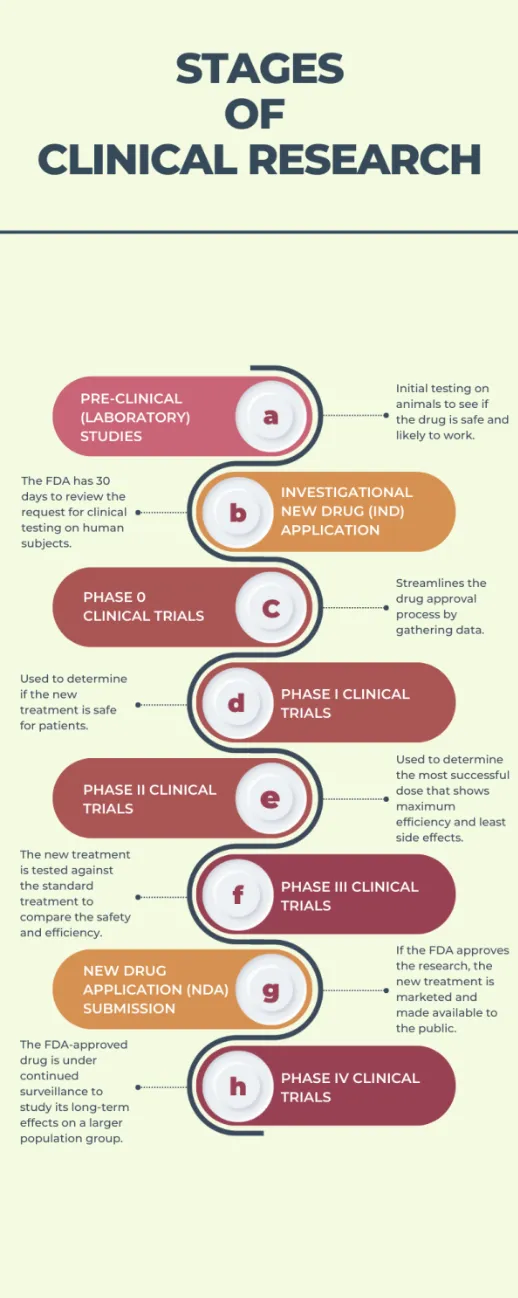
Let's walk through this process step-by-step, using a more detailed video explanation.
Clinical Trials Overview: Phrases and Phases of a Clinical Trials
This video provides a clear, narrated walkthrough of the entire clinical trial process.
Watch the following two segments: First, watch the explanation of the crucial first steps that happen before any human testing: the Pre-clinical studies and the Investigational New Drug (IND) application. This is the data package submitted to the FDA to get permission to even start human trials. Next, watch the detailed breakdown of the four phases of human clinical trials, from Phase I to Phase IV. Pay attention to the primary goal and typical participants of each phase.
To solidify what you just watched, here is a summary of the key stages:
- Pre-clinical Studies: Before a drug is ever tested in humans, it undergoes extensive laboratory and animal testing. This stage assesses basic safety and biological activity. The goal is to determine if the compound is a reasonable candidate for human testing.
- Investigational New Drug (IND) Application: If the pre-clinical data is promising, the sponsor submits an IND application to the FDA. This massive application contains all known information about the drug and a detailed plan for human testing. The FDA has 30 days to review it before human trials can begin.
- Phase I Trials: The primary goal is safety. The drug is given to a small number of people (typically 20-80 healthy volunteers) to evaluate its safety profile, determine a safe dosage range, and identify side effects.
- Phase II Trials: The primary goal is efficacy and further safety assessment. The drug is given to a larger group of people (typically 100-300) who have the target disease or condition. The goal is to see if the drug works and to continue monitoring its safety.
- Phase III Trials: The primary goal is comparative efficacy and safety. The drug is given to large groups of people (typically 1,000-3,000) to confirm its effectiveness, monitor side effects, compare it to commonly used treatments, and collect information that will allow the drug to be used safely. Successful completion of Phase III is usually required for regulatory approval (e.g., submitting a New Drug Application or NDA).
- Phase IV Trials: These are post-marketing studies conducted after a treatment is approved and on the market. These trials gather additional information on the drug's risks, benefits, and optimal use in the general population over a longer period.
This structured, phased approach is designed to systematically build a complete picture of a new treatment, ensuring that the principles of beneficence (maximizing benefit, minimizing harm) and justice are upheld at every step.
Conclusion
In this lesson, we have laid the essential groundwork for understanding clinical trials. You've learned that these studies are not conducted in a vacuum; they are built upon a robust ethical framework and a rigorous regulatory process.
Here are the key takeaways:
- Ethical conduct in clinical research is paramount, guided by foundational documents like the Belmont Report, which establishes the principles of Respect for Persons, Beneficence, and Justice.
- Institutional Review Boards (IRBs) are the primary bodies responsible for protecting the rights and welfare of research participants by reviewing and monitoring trial protocols.
- The development of new treatments follows a sequential, multi-stage process overseen by regulatory agencies like the FDA.
- This process includes pre-clinical research, an IND application, and four distinct human trial phases (I-IV), each designed to answer specific questions about a drug's safety and effectiveness.
In our next lesson, we will take a closer look at the specific objectives and design considerations for Phase I, II, and III trials. This will prepare you to understand the intricacies of designing a large-scale randomized trial, the gold standard for establishing treatment efficacy.