Welcome to your fifth lesson. In our previous session, we established how the external environment—from technological shifts to economic cycles—profoundly influences actuarial assumptions and the very design of financial products. Today, we focus on one of the most structured and impactful components of that environment: regulation. This force doesn't just influence actuarial work; it sets the boundaries and rules of the game.
This lesson unpacks the world of financial regulation. We will investigate the fundamental reasons for its existence and then dissect its primary forms. Our main goal is to understand the crucial distinction between prescriptive (rules-based) and principles-based regulatory philosophies, a conceptual divide that shapes how financial institutions operate and how actuaries carry out their duties.
The Rationale for Regulation
Before diving into the different types of rules, it's essential to ask a foundational question: why do we regulate financial markets at all? At its core, regulation exists to address market failures and protect stakeholders. A financial market is not merely a place for transactions; it's a complex system built on trust, and regulation is the architecture that supports this trust.
Let's begin by exploring the primary objectives of financial market regulation.
[PDF] Securities Regulation vs Prudential Regulation - IOSCO
This speech by Andrew Sheng, a former regulator, provides an excellent high-level overview of the 'first principles' of financial regulation. It explains why regulators intervene in markets.
Please read the following sections: Start with the paragraph at the beginning of the macro view to understand the core goals of protecting property rights and ensuring stability. Continue to the paragraph explaining the "5 'P's'" of a financial market, from "In thinking through...". This provides a useful mental model for analyzing a financial system. Finally, read from the summary of why we regulate. This section clearly outlines the problems regulation seeks to solve, such as asymmetric information and systemic risk.
As the text highlights, financial regulation serves several critical purposes:
- Protecting Consumers and Investors: This is perhaps the most visible function. Financial products are often complex, and there is a significant information imbalance (asymmetric information) between the institutions selling them and the individuals buying them. Regulation aims to ensure that products are sold fairly, that disclosures are clear, and that customers are not exploited.
- Ensuring Financial Stability (Systemic Risk Management): Financial institutions are highly interconnected. The failure of one large bank or insurer could trigger a domino effect, leading to a broader financial crisis. A key purpose of regulation is to ensure the soundness of individual firms and the stability of the financial system as a whole. This is often called managing systemic risk.
- Maintaining Market Integrity: For markets to function, participants must have confidence that the game is not rigged. Regulation combats market abuse, such as insider trading and market manipulation, to ensure a level playing field and maintain public trust.
- Influencing Intermediary Behaviour: As Professor Charles Goodhart is quoted in the reading, the ultimate goal is to "influence the behaviour of intermediaries." This involves setting standards for conduct and competence to prevent misconduct that could harm both individual consumers and the market's reputation.
The Main Categories of Financial Regulation
With the "why" established, we can now turn to the "what." While regulatory systems vary by country, they generally fall into two or three broad categories. The IOSCO paper you just read introduces this concept, which is often visualized as the "twin peaks" model of regulation, famously adopted in Australia.
[PDF] Securities Regulation vs Prudential Regulation - IOSCO
This section of the speech clearly lays out the main types of regulation.
Please read the paragraph that begins "There are three broad categories...". Focus on the definitions of prudential regulation and conduct regulation.
-
Prudential Regulation: This is concerned with the safety and soundness of financial institutions. Its primary goal is to ensure that firms are financially resilient and can meet their obligations to policyholders and depositors, even under stress. This involves a macro perspective, focusing on the institution's financial health. Key areas of prudential oversight include:
- Capital adequacy (ensuring firms have enough capital to absorb losses)
- Liquidity management (ensuring firms can meet their short-term cash needs)
- Risk management systems and controls
- Governance and management quality
-
Conduct Regulation: This is concerned with how firms behave in their dealings with customers and the wider market. Its goal is to ensure that markets are fair, transparent, and that consumers are treated equitably. This involves a micro perspective, focusing on transactions and relationships. Key areas of conduct oversight include:
- Sales and marketing practices (preventing mis-selling)
- Disclosure of information to customers
- Handling of customer complaints
- Combating market abuse and financial crime
-
Competition Regulation: While often handled by a separate cross-industry body, this is the third pillar. It aims to prevent anti-competitive behaviour like monopolies and cartels, ensuring that consumers benefit from choice and innovation.
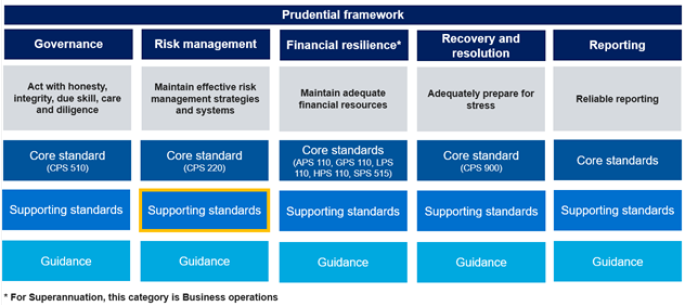
The image below shows a real-world example of a prudential framework from the Australian Prudential Regulation Authority (APRA). It neatly illustrates how a prudential regulator structures its oversight around key pillars like governance, risk management, and financial resilience.
How to Regulate: Prescriptive vs. Principles-Based Approaches
Now we arrive at the central distinction for this lesson: the how of regulation. Given the pace of change in the modern world, especially in technology, regulators face a significant challenge known as the "pacing problem."
The Pacing Problem Unplugged Part 1 - Actuary.org
This article from Actuary.org introduces the "pacing problem," which is the perfect context for understanding why different regulatory approaches have evolved.
Please read the section titled "The Pacing Problem." Pay close attention to the reasons why regulators might adopt a "wait until it matures" approach.
The pacing problem—the lag between innovation and regulation—forces a choice between two fundamentally different philosophies: telling firms exactly what to do, or telling them what outcome to achieve. This is the difference between prescriptive and principles-based regulation.
Prescriptive (Rules-Based) Regulation
This is the traditional "command-and-control" approach. The regulator writes detailed, specific rules, and firms are judged on whether they have followed those rules to the letter.
The Pacing Problem Unplugged Part 1 - Actuary.org
This section gives a clear definition of the prescriptive approach.
Please read the section titled "Prescriptive regulation." This will explain the core concept and its variants.
- Characteristics: Clear, unambiguous, and detailed rules. Leaves little room for interpretation.
- Advantages: Provides certainty for firms. Compliance is straightforward to audit ("Did you do X? Yes/No").
- Disadvantages: It can be rigid and quickly become outdated. It can foster a "tick-box" mentality, where firms focus on complying with the letter of the law rather than its spirit. Clever firms can find loopholes. The IOSCO paper describes a similar idea as "pre-vetting," where the regulator must approve everything, which can stifle innovation and create moral hazard.
Principles-Based (and Outcome-Based) Regulation
As markets became more complex and fast-moving, the limitations of prescriptive rules became apparent. This led to the rise of more flexible approaches that focus on high-level principles or desired outcomes.
The Pacing Problem Unplugged Part 1 - Actuary.org
This final reading clearly defines and distinguishes between outcome-based and principle-based regulation.
Read the section titled "Flexible regulations." Focus on the distinction it makes between the two approaches.
- Characteristics: The regulator sets broad, qualitative principles (e.g., "A firm must treat its customers fairly") or specific, measurable outcomes (e.g., "Customer complaint levels must not exceed X%"). The firm then has the flexibility to decide the best way to achieve these goals.
- Advantages: This approach is flexible and can adapt to new products and technologies without needing new rules. It encourages firms to think about the substance of what they are doing and to build a positive culture of risk management and customer care.
- Disadvantages: It can create uncertainty for firms about whether they are compliant. It requires significant judgment from both the firm and the regulator. The IOSCO paper refers to a related concept, "back-end enforcement," where the regulator sets the rules of the game and then disciplines those who cross the line.
In practice, most modern regulatory systems are a hybrid, using prescriptive rules for areas where clarity is paramount (like capital calculations) and principles-based approaches for areas where judgment and culture are more important (like customer treatment).
Your Cheatsheet: Regulation at a Glance
As you requested, here is a condensed summary to help with your revision.
Main Types of Regulation
| Type | Key Objective | Focus | Examples of Oversight |
|---|---|---|---|
| Prudential | Financial soundness & stability | The institution's ability to meet its promises (macro view) | Capital requirements, liquidity rules, risk management systems |
| Conduct | Consumer protection & market integrity | How the institution treats its customers (micro view) | Sales practices, disclosure rules, complaints handling, anti-fraud |
Prescriptive vs. Principles-Based Approaches
| Aspect | Prescriptive Approach | Principles-Based Approach |
|---|---|---|
| Philosophy | "Here are the rules you must follow." | "Here are the outcomes you must achieve." |
| Focus | Compliance with specific, detailed rules. | Adherence to the spirit of high-level principles. |
| Flexibility | Low. Rigid and slow to change. | High. Adapts to new situations and innovation. |
| Certainty | High. It's clear what is and isn't allowed. | Lower. Requires judgment and interpretation. |
| Firm's Mindset | "Have we ticked all the boxes?" | "Are we doing the right thing for our customers?" |
| Best For | Areas needing absolute clarity (e.g., solvency calculations). | Areas involving behaviour, culture, and rapid change. |
Conclusion
In this lesson, we have demystified the world of financial regulation. We've established that it exists to protect consumers, ensure financial stability, and maintain market integrity. We've also categorized the main types of oversight into prudential (soundness) and conduct (behaviour). Most importantly, we have contrasted the rigid, "command-and-control" style of prescriptive regulation with the flexible, "what gets results" style of principles-based regulation.
Key Takeaways:
- Regulation is a fundamental response to inherent market failures like asymmetric information and systemic risk.
- Prudential regulation is about ensuring firms can pay, while conduct regulation is about ensuring they play fair.
- The "pacing problem" created by rapid innovation has driven a shift from purely prescriptive rules towards more flexible, principles-based approaches.
- Prescriptive regulation offers certainty but can be rigid, while principles-based regulation offers flexibility but can be ambiguous. Most modern systems use a blend of both.
In our next lesson, we will build directly on this foundation by examining the specific institutions that create and enforce these rules. We will explore the role of regulatory bodies and their direct impact on the day-to-day practice of an actuary.