Welcome to your third lesson. In our previous discussion, we explored the internal habits that define an effective actuary, using the "7 Habits" framework. We concluded that being proactive—the first habit—involves looking outwards to anticipate change. Today, we will build directly on that idea by focusing on the world outside the actuary's office.
This lesson addresses the external environment, the vast and dynamic landscape of forces that shape the work of every actuary. Our goal is to analyze the key components of this environment: the economic, demographic, social, technological, and legislative factors that influence risk, product design, and financial stability. We will use a powerful framework known as STEEPLE analysis to structure our exploration. Understanding these external drivers is the first and most critical step in defining a problem within the Actuarial Control Cycle, as they provide the context for all subsequent analysis.
Why Scan the Environment?
Before we dive into the framework, it's important to understand why actuaries dedicate so much effort to scanning the external environment. Actuarial work is fundamentally about forecasting the future. To do this, actuaries must make informed assumptions about future events. These assumptions aren't plucked from thin air; they are careful estimates based on an analysis of external trends.
Let's begin with a short reading that connects the external environment directly to the process of setting actuarial assumptions.
[PDF] Understanding Actuarial Assumptions - Gabriel, Roeder, Smith
This document from GRS Consulting explains how actuaries develop the assumptions that underpin their work. It provides a crucial link between observing the outside world and quantifying its future impact.
Please read the sections What Are Actuarial Assumptions? and the paragraph under "How Are Actuarial Assumptions Determined?" that begins "Someone once jokingly said...". Take note of the two main categories of assumptions (demographic and economic) and the emphasis on considering "current trends, external conditions, and future projections."
As you can see, demographic and economic assumptions are direct reflections of the external world. The actuary’s job is to translate observable trends into quantifiable estimates. Now, let's look at the framework used to systematically identify these trends.
The STEEPLE Framework: A Lens on the World
To analyze the external environment, professionals use frameworks like PEST, PESTLE, or STEEPLE. We will use STEEPLE, as it is one of the most comprehensive variants. The acronym stands for:
- Social
- Technological
- Economic
- Environmental
- Political
- Legal
- Ethical
It's important to distinguish the broad, uncontrollable factors covered by STEEPLE (the macro-environment) from the more immediate industry-level factors like competitors, suppliers, and customers (the task environment). STEEPLE analysis focuses on the former.
To solidify this distinction, let's watch the introduction to a video that explains the PESTEL framework (a close cousin of STEEPLE).
PESTEL Analysis EXPLAINED | B2U | Business To You
The video "PESTEL Analysis EXPLAINED" by Business To You provides a clear overview of this strategic tool. We'll watch the beginning to understand its scope.
Please watch from the start until the end of the introduction. Focus on the distinction the presenter makes between the internal environment, the task environment, and the macro-environment that is the focus of PESTEL analysis.
Now that we have our framework, let's explore each component through the lens of an actuary, using a detailed analysis of the European insurance industry as our guide.
The Components of the External Environment
Social and Demographic Factors
This category includes population trends (ageing, birth rates, migration), societal values, education levels, and lifestyle changes. Your background as a social researcher gives you a distinct advantage in appreciating the nuances of these shifts. Changes in family structures, employment patterns, and cultural norms directly influence the need for and design of financial products.
The European Insurance Industry: A PEST Analysis - MDPI
This paper by Cassar, Chetcuti, and Spiteri from MDPI applies a PEST analysis to the European insurance market. We will use it to see how general trends translate into specific actuarial concerns.
Please read Section 4, "Social and Cultural Environment." Pay close attention to the discussions on: Work and Employment Patterns: How does the shift from lifelong employment to a "gig economy" affect pension design? Fertility, Mortality, and Migration: How do these core demographic drivers impact the demand for life insurance and pensions? Ageing Population: What are the challenges and opportunities for insurers as life expectancy increases? Community Values: How has anti-discrimination legislation (e.g., gender-neutral pricing) changed underwriting practices?
Technological Factors
Technology is a disruptive force that creates both opportunities and threats. It affects how products are designed, priced, and distributed, how data is collected and analyzed, and even the nature of the risks being insured.
The European Insurance Industry: A PEST Analysis - MDPI
Now let's examine the technological impacts discussed in the same paper.
Please read the first part of Section 5, the subsection titled "Advances in Technology." Note the dual impact of technology: it's a tool for insurers (telematics, AI, mobile distribution) but also creates new risks (cyber liability, insuring new technologies like solar panels) and impacts assumptions (advances in medicine affecting longevity).
Economic Factors
This is perhaps the most traditional area of focus for actuaries. Economic factors include interest rates, inflation, economic growth, exchange rates, and unemployment. These variables have a direct and profound impact on both sides of an insurer's balance sheet—the value of its assets and the size of its liabilities.
The European Insurance Industry: A PEST Analysis - MDPI
The paper's section on the economic environment is particularly detailed.
Please read the subsections within Section 3 on "Interest Rates" and "Inflation Rates." For Interest Rates, consider why low interest rates are particularly challenging for life insurers with long-term guarantees. For Inflation, think about how it affects non-life insurance (e.g., cost of car repairs) differently from life insurance (where payouts are often fixed).
Environmental Factors
This dimension has grown in importance dramatically. It relates to the physical environment and includes climate change, the frequency and severity of natural disasters, pollution, and the push for sustainable business practices. For general insurers, in particular, this is a core area of risk.
The European Insurance Industry: A PEST Analysis - MDPI
Let's return to Section 5 of the paper to look at the physical environment.
Please read the subsection titled "The Physical Environment." Focus on how climate change is not just a risk to be insured (e.g., more floods and storms), but also an opportunity for insurers to develop new products and advisory services.
Political and Legal Factors
These two are closely related. Political factors concern government-level actions and stability (e.g., tax policy, trade policy, public spending priorities). Legal (or Legislative) factors refer to the specific laws and regulations that govern how businesses must operate. For actuaries, the regulatory framework is a dominant feature of the external environment.
The European Insurance Industry: A PEST Analysis - MDPI
The paper combines these into one section, which clearly demonstrates their interplay.
Please read Section 2, "Political and Legislative Factors." As you read, identify examples of: Broad Regulation: How did the Solvency II directive aim to harmonize the European insurance market? Specific Laws: How could a government making third-party motor insurance non-compulsory affect the industry? Judicial Decisions: How can court rulings on policy wording create unforeseen claims?
Ethical Factors
The final component, Ethics, considers societal norms of behavior, corporate governance, and social responsibility. While legal factors set out what a company must do, ethical factors concern what it should do. This includes issues like fairness to customers, data privacy, and avoiding bribery or corruption.
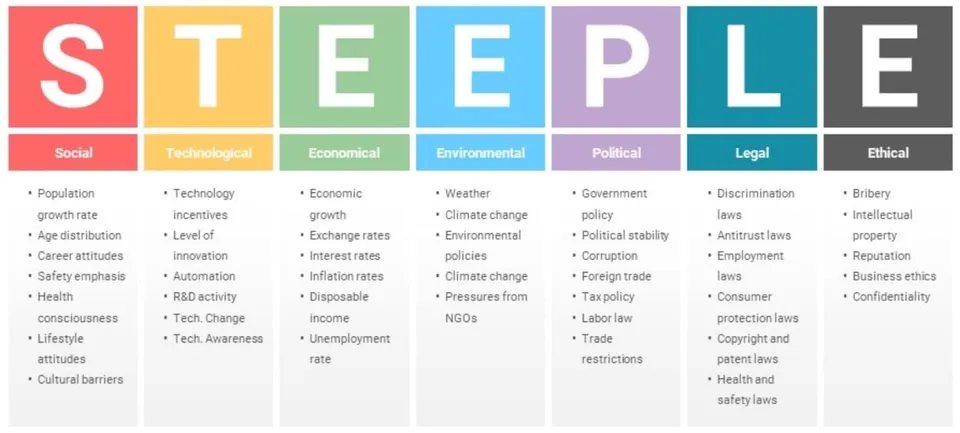
Your Cheatsheet: The STEEPLE Framework for Actuaries
The following table summarizes the STEEPLE framework and provides actuarial examples, giving you a condensed reference for revision.
| Factor | Key Components | Actuarial Relevance & Examples |
|---|---|---|
| Social | Demographics (ageing, migration), lifestyles, education, culture | - Pensions & Annuities: An ageing population increases demand and longevity risk. - Product Design: Changing family structures require new beneficiary definitions. - Marketing: Higher financial literacy affects how products are sold. |
| Technological | Innovation, automation, R&D, data analytics, mobile tech | - Pricing & Underwriting: Telematics allows for usage-based car insurance. - Distribution: Online aggregators and direct-to-consumer apps change business models. - Assumptions: Medical advances improve mortality rates. - New Risks: Cyber-attacks create a need for cyber insurance. |
| Economic | Interest rates, inflation, GDP growth, exchange rates, employment | - Valuation: Low interest rates increase the present value of liabilities. - Asset Management: Economic growth affects investment returns. - Pricing: Inflation increases expected future claims costs, especially in general insurance. |
| Environmental | Climate change, natural disasters, pollution, sustainability | - Catastrophe Risk: Increased frequency/severity of weather events impacts property insurance. - Regulation: Carbon footprint targets may influence investment strategy. - Reputation: A company's "green" credentials can become a competitive factor. |
| Political | Government policy, political stability, tax, trade, public spending | - Pensions: Government changes to state pension age/benefits affect private provision. - Healthcare: Policy on public healthcare funding drives demand for private health insurance. - Tax: Tax incentives can encourage or discourage certain savings products. |
| Legal | Specific laws (consumer protection, employment), regulation | - Solvency: Capital requirements (e.g., Solvency II) dictate how much capital an insurer must hold. - Underwriting: Anti-discrimination laws restrict rating factors (e.g., gender). - Sales: Consumer protection laws govern how products can be sold. |
| Ethical | Business ethics, corporate governance, fairness, social responsibility | - Pricing: Ensuring fairness between different groups of policyholders. - Data: Ethical use of customer data (e.g., from genetic tests or social media). - Investment: Socially Responsible Investing (SRI) mandates may exclude certain industries. |
Conclusion
Today, we have systematically dissected the external environment using the STEEPLE framework. We have seen that the world in which an actuary operates is a complex interplay of social, technological, economic, environmental, political, legal, and ethical forces. A successful actuary does not simply react to these forces but actively monitors and analyzes them to anticipate their impact.
Key Takeaways:
- Actuaries analyze the external environment to make informed assumptions about the future.
- The STEEPLE framework provides a structured way to scan the macro-environment.
- Social & Demographic trends shape customer needs and long-term assumptions like mortality.
- Technological change is a dual-edged sword, creating new efficiencies and new risks.
- Economic variables like interest rates and inflation are fundamental drivers of an insurer's financial health.
- Environmental, Political, Legal, and Ethical factors create a complex web of constraints and opportunities for the industry.
In our next lesson, we will focus on exactly how actuaries translate this qualitative understanding of the external environment into the quantitative inputs for their models. We will explore how changes in these external factors directly influence the setting of actuarial assumptions and the design of financial products.