Hello! Welcome to your first lesson in this course designed to prepare you for the CP1 Actuarial Practice exam. Given your extensive background in the technical actuarial papers, our focus here will be on applying that knowledge within the practical and professional context that CP1 demands.
Today, we will begin by exploring the foundational framework that underpins almost all actuarial work: the Actuarial Control Cycle. The goal of this lesson is to describe this cycle as the systematic approach actuaries use to solve complex problems involving financial uncertainty. Understanding this cycle is crucial, as it provides a mental map that connects the many diverse topics you will encounter throughout this course and in your future practice.
The Core of Actuarial Problem Solving
At its heart, problem-solving in any field follows a logical sequence. You identify a problem, create a solution, and then check to see if your solution worked. Actuarial science formalizes this process into what is known as the Actuarial Control Cycle (ACC).
To begin, let's establish a clear definition of this framework. Please read the following short introduction from the Society of Actuaries' text, Understanding Actuarial Management.
[PDF] Understanding Actuarial Management: - SOA.org
This reading introduces the Actuarial Control Cycle as a fundamental problem-solving process.
Please read the first four paragraphs of the introduction, from the initial definition. As you read, focus on the three core steps and the two major elements that form the environment of the cycle.
As you've just read, the cycle consists of three fundamental stages:
- Define the Problem: Clearly understanding the issue at hand.
- Design the Solution: Developing a strategy or model to address the problem.
- Monitor the Results: Tracking the outcomes of the solution and comparing them to expectations.
This process is not a linear path but a continuous, iterative loop. The results from the monitoring stage feed back into refining the problem definition or redesigning the solution.
The text also highlights two critical contextual layers that surround this entire process.

- External Forces: These are factors outside the actuary's direct control, such as economic conditions, demographic trends, legislative changes, and technological advancements. We will explore these in detail in a later lesson.
- Professionalism: This is the internal compass guiding an actuary's work, encompassing ethical standards, communication, and sound judgment.
What Makes the Cycle "Actuarial"?
You might recognize this problem-solving structure from other disciplines. Indeed, it's a universal process. What, then, makes its application distinctly actuarial?
Your background in statistics and probability theory is key here. The problems actuaries tackle are unique due to their inherent nature: they almost always involve estimating the financial impact of uncertain future events over a long time horizon.
The following resource elaborates on the specific considerations that make the ACC an actuarial tool.
Chapter 3 Actuaries and Actuarial Thinking
This resource explains the specific characteristics that define the Actuarial Control Cycle in the context of actuarial work.
Read the section beginning just after the diagram, from the key characteristics. Pay attention to how these points differentiate the cycle from a generic business or data science framework.
To summarize, the cycle becomes "actuarial" when it incorporates:
- Uncertain Future Events: Using probabilistic and stochastic methods to model outcomes like mortality, investment returns, or claim frequencies.
- Long-Term Horizon: Making decisions today that have financial consequences for decades to come.
- Stakeholder Complexity: Balancing the needs of policyholders, shareholders, regulators, and management.
- Use of Models and Assumptions: Building complex financial models based on assumptions derived from historical data and expert judgment—a core skill you developed in the CS and CM series.
- Experience Monitoring: The crucial feedback loop of systematically comparing actual outcomes to the assumptions made, and updating models accordingly.
The Cycle in Action: A Practical Example
Let's ground this theory in a concrete scenario. The most effective way to understand the ACC is to see how it applies to a real-world actuarial task. We will walk through the process of a life insurance company launching a new lifetime annuity product.
The following reading provides an excellent, step-by-step illustration.
[PDF] Understanding Actuarial Management: - SOA.org
This case study demonstrates how each stage of the ACC is applied when designing, pricing, and managing an inflation-linked lifetime annuity.
Please read the entire section titled An illustration of the Actuarial Control Cycle. As you read, try to map the activities described back to the three main stages of the cycle: defining the problem, designing the solution, and monitoring the results.
Let's break down that example using the ACC framework:
1. Define the Problem:
The company wants to sell inflation-linked lifetime annuities. The initial problem specification involves understanding the context.
- Customer Need: People need a secure income in retirement that is protected from inflation. Your experience as a social researcher gives you a unique appreciation for understanding these fundamental human financial needs.
- Risks: The company faces significant risks: people living longer than expected (longevity risk) and inflation being higher than expected (investment risk).
- External Environment: What are competitors doing? What is the regulatory environment? What is the economic outlook for interest rates and inflation?
2. Design the Solution:
This is where the technical skills from your prior exams come into play.
- Product Specification: The actuary helps decide the product features (e.g., guaranteed payment periods).
- Modeling: An actuary builds a cash flow projection model. This requires analyzing data and setting assumptions for mortality, inflation, investment returns, and expenses.
- Pricing: The model is used to determine the premium to charge for the annuity, ensuring it is profitable, competitive, and fair.
- Capital & Reserving: The actuary calculates the amount of capital the company must hold to cover unexpected losses and the value of the long-term liability it is taking on.
- Investment Strategy: The premium received is invested. The actuary helps select assets that will generate returns to meet the future annuity payments (this is known as Asset-Liability Management, a topic we'll cover in depth).
3. Monitor the Results:
The work isn't finished once the product is launched.
- Experience vs. Assumptions: The company continuously monitors actual experience. Are annuitants dying at the rate assumed? Is inflation matching the assumption?
- Analysis of Surplus: Any differences between actual and expected results are analyzed to understand the sources of profit or loss.
- Feedback Loop: The actuary advises the company on how to respond. If people are living longer, perhaps the price for new annuities needs to increase, or the reserves for existing ones need to be strengthened. This analysis feeds directly back into the 'Define the Problem' and 'Design the Solution' stages for the next iteration.
A More Detailed Framework: Your First "Cheatsheet"
The three-stage model is a powerful high-level summary. In practice, each stage involves a more detailed set of activities. The diagram below shows a more granular version of the cycle often used within organizations.
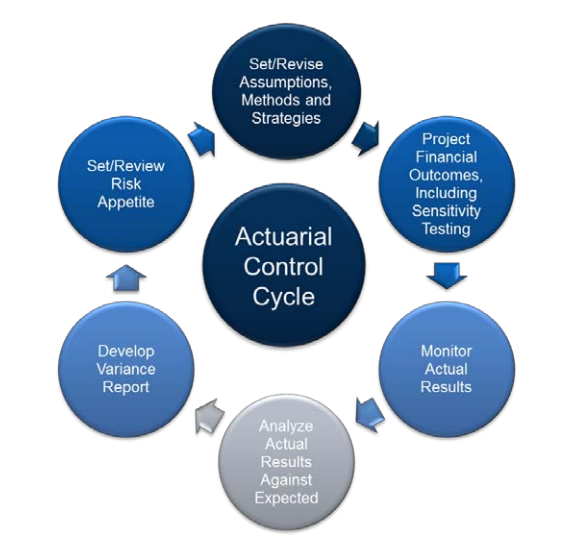
To help with the memorization you requested, we can break down the cycle into a more detailed checklist of activities and questions. The following framework, drawn from the resource "Actuaries and Actuarial Thinking", is an excellent tool for exam preparation.
Framework: The Actuarial Control Cycle in Detail
Stage 1: Specifying the Problem
- Key Activities:
- Identify client/stakeholder objectives.
- Assess risks and potential mitigation strategies for each stakeholder.
- Gather all relevant financial, demographic, and market data.
- Clarify all constraints (e.g., regulatory, legal, financial).
- Key Questions to Ask:
- Who owns the problem?
- What questions truly need answering?
- What are the timescales and resources available?
- How will the results be used (e.g., for executive action or purely as advice)?
Stage 2: Developing the Solution
- Key Activities:
- Select, construct, or adapt an appropriate model.
- Set assumptions for all key variables (e.g., mortality, interest rates, expenses).
- Understand the sensitivity of the model's output to changes in assumptions.
- Test various scenarios to understand the range of possible outcomes.
- Interpret the model results in the context of the problem and stakeholders.
- Formalize a proposed solution, considering alternatives.
Stage 3: Monitoring the Experience
- Key Activities:
- Track actual outcomes and compare them against the expected results from the model.
- Analyze any deviations to identify their causes (e.g., one-off event or a new trend).
- Provide management information that is clear and actionable.
- Use the analysis as a feedback loop to review and update assumptions, models, and strategies.
- Monitor for adverse trends that may require corrective action.
Finally, it's worth noting that this cycle is scalable. It can be applied to the management of an entire financial institution, a single product line, or even a specific operational function like claims processing. You will often find "cycles within cycles" in practice.
Conclusion
In this lesson, we have introduced the Actuarial Control Cycle as the central, systematic framework for actuarial work.
Here are the key takeaways:
- The ACC is an iterative, three-stage process: Define the Problem, Design the Solution, and Monitor the Results.
- It is distinguished as "actuarial" by its application to problems involving long-term financial uncertainty and its deep reliance on models, assumptions, and experience monitoring.
- The entire cycle operates within the dual context of external forces (like the economy) and internal professionalism.
- This framework provides the overarching structure for nearly every topic in the CP1 syllabus, from product design and pricing to reserving and capital management.
The ACC provides the what and how of actuarial work. In our next lesson, we will delve deeper into the context of "professionalism" by exploring the who—that is, the key habits and mindset of an effective actuarial practitioner.