Introduction
In our previous lesson, we established the distinction between regulatory capital (SCR), a standardized requirement, and economic capital (EC), a firm's own internal and strategic measure of necessary financial resources. Having answered the question of "how much capital do we need?", we now turn to the practical matter of "how do we manage that capital level?". An insurer whose capital falls below its target must take action, just as an over-capitalized insurer may seek to deploy its capital more efficiently.
This lesson addresses precisely that challenge by describing the main tools an insurer can use to manage its capital position. We will explore three primary categories of instruments: reinsurance, debt and equity financing (with a focus on subordinated debt), and hedging strategies using derivatives. Our exploration will be guided by a simple but powerful framework: capital management tools primarily work by either increasing the financial resources a firm has (its available capital) or by reducing the amount of capital it is required to hold against its risks (its required capital).
The Capital Management Toolkit: A Strategic Framework
An insurer's solvency is typically measured by a ratio, such as the Solvency Ratio under Solvency II:
From this, it's clear there are two levers to pull to manage this ratio: change the numerator or change the denominator. The most effective capital management strategies often involve a combination of actions tailored to the company's specific circumstances.
[PDF] A capital management toolkit for life re/insurers - Milliman
This article from Milliman provides an excellent introduction to capital optimization techniques. It establishes the core framework we will use throughout this lesson.
Please read the introductory sections, starting from the overview. Focus on the two main ways transactions can enhance an insurer's capital position: by reducing the SCR or increasing available capital.
As the article points out, reducing the SCR (the denominator) can be more "efficient" than increasing own funds. This is because firms typically target a solvency ratio significantly above 100%. For instance, with a 150% target ratio, every €1 reduction in SCR reduces the total capital the firm needs to hold by €1.50.
The universe of capital management tools is broad, but for our purposes, we will focus on three major categories that directly alter the firm's balance sheet and risk profile.
Tool 1: Reinsurance
Reinsurance is perhaps the most traditional capital management tool in the insurance industry. At its core, it is "insurance for insurance companies." An insurer (the ceding company) pays a premium to another insurer (the reinsurer) to transfer a portion of its risks.
Insurance Companies: How they make money | Primerli
This short clip from Primerli gives a very clear and simple explanation of the basic reinsurance mechanism.
Please watch the section from this part that explains how ceding premiums to a reinsurer reduces the insurer's exposure.
The primary capital management effect of reinsurance is to reduce the Solvency Capital Requirement (SCR). By transferring underwriting risk (e.g., mortality, catastrophe, or claims inflation risk) to the reinsurer, the ceding company's own risk profile is smaller, and therefore the capital required to support it decreases. Reinsurance also serves to smooth earnings by protecting the insurer from large, unexpected losses.
To understand the strategic rationale for using reinsurance, let's explore a more detailed document.
[PDF] TECHNICAL NEWSLETTER - SCOR
This technical newsletter from SCOR, a major global reinsurer, provides an industry perspective on how reinsurance is used as a capital optimization tool.
First, read the section "Use of Reinsurance in Managing Risk Appetite". Note the dual purpose of managing earnings volatility and capital preservation. Also, pay attention to the concept of "capital cost arbitrage"—transferring risks to a reinsurer who can hold that risk more cheaply due to greater diversification. Next, skim the table under the heading "Ways Reinsurance Impacts Insurers' Capital Framework". You don't need to memorize the details, but observe how different types of reinsurance (like Quota Share or Catastrophe Excess of Loss) have different impacts on the various components of the SCR (premiums, reserves, catastrophe). This shows how reinsurance can be targeted to specific capital needs.
In summary, reinsurance is a powerful tool for reducing required capital (the denominator) and, in some cases, can also increase available capital by allowing the insurer to release prudent margins held in its reserves.
Tool 2: Debt and Equity Instruments
The second major category of tools involves directly raising capital, thereby increasing Eligible Own Funds (the numerator). The two main ways to do this are by issuing new equity or by taking on debt.
-
Equity Increase: A company can issue new shares to investors. This provides the highest quality of capital (known as Tier 1 capital) with no restrictions. However, it comes at a cost: it dilutes the ownership stake of existing shareholders and, by increasing the equity base, can lower the reported Return on Equity (ROE), a key performance metric.
-
Debt Instruments: A more nuanced approach is to issue debt. For a financial institution like an insurer, not all debt is created equal. Regulators are concerned with the "loss-absorbing capacity" of capital. To protect policyholders, capital instruments must be able to absorb losses while the company is still a going concern. This leads to a hierarchy of capital.
The following diagram illustrates this hierarchy, often called the "capital stack."
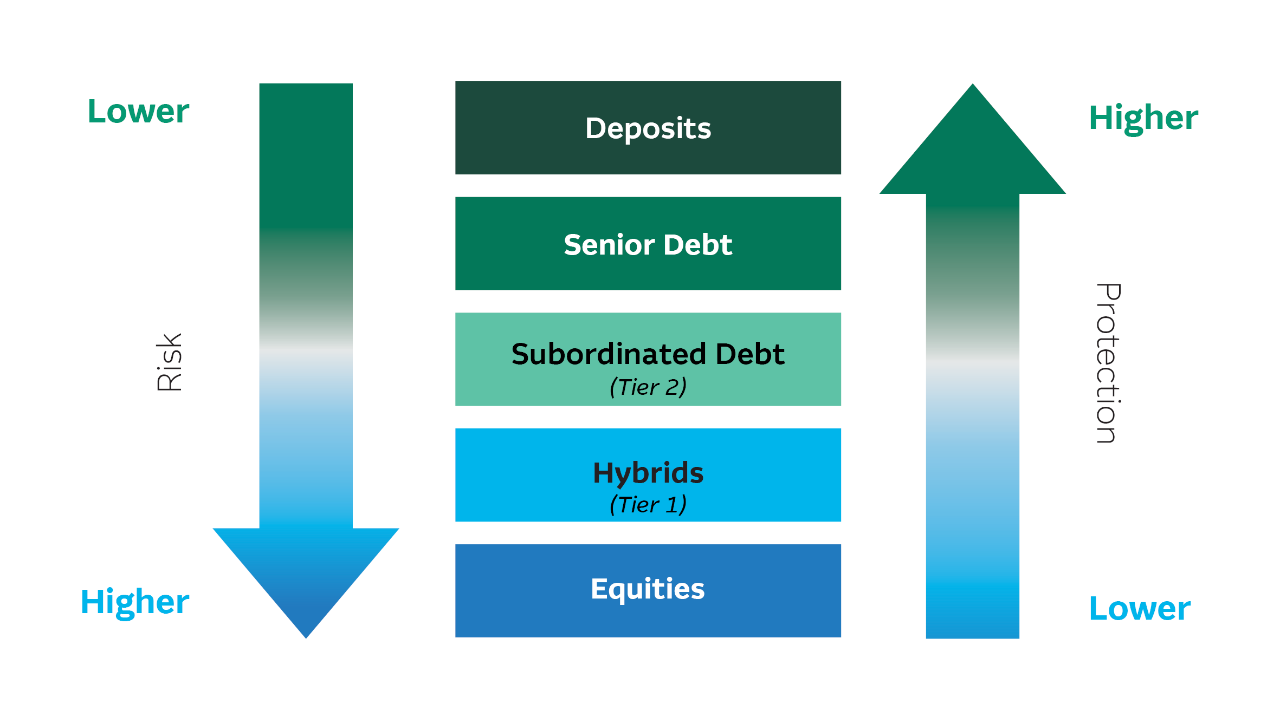
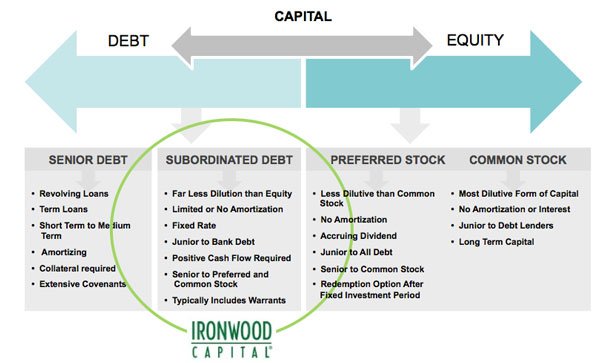
Subordinated Debt is a key tool in this context. It is a loan that, in the event of the insurer's liquidation, is only paid back after all policyholder claims and other senior debts have been settled. Because it carries more risk for the lender, regulators allow it to be counted as regulatory capital, typically classified as Tier 2 or Tier 3 capital under Solvency II.
This makes subordinated debt an attractive option. It is typically cheaper to issue than equity and does not dilute shareholders. However, regulators place limits on how much of an insurer's capital requirement can be met with these lower tiers of capital.
The choice between using reinsurance and issuing debt is a classic strategic decision in capital management.
[PDF] TECHNICAL NEWSLETTER - SCOR
Let's return to the SCOR newsletter to see a direct comparison of these tools.
Please read the subsection titled "Debt instruments". Focus on the comparison between issuing debt and purchasing reinsurance (specifically a Quota Share, or QS). This highlights the trade-offs: debt is efficient for managing the solvency ratio, while reinsurance is better for controlling losses and managing risk.
Tool 3: Hedging and Derivatives
The third major tool, hedging, is conceptually similar to reinsurance in that it aims to reduce the SCR by transferring risk. However, hedging is typically used to target very specific financial risks, whereas reinsurance is often used for broader underwriting risks. Hedging is accomplished using financial instruments called derivatives.
Hedging Explained - The Insurance of Investing
This video from The Plain Bagel provides an excellent non-technical introduction to the concept of hedging.
Please watch the following segments: First, the introduction that compares hedging to insurance, from the start. Next, the explanation of how hedging works by using assets that move in the opposite direction, from this section. Your background in probability will make the concept of seeking a negative correlation intuitive. Finally, the segment on using derivatives like options and swaps as explicit hedging tools, from this part. The example of a put option as an insurance policy on a stock is particularly clear.
For an insurer, hedging strategies are commonly used to manage market risks. For example:
- An insurer with significant investments in foreign bonds might use currency swaps to hedge against exchange rate fluctuations.
- An insurer with long-term liabilities that are sensitive to interest rates might use interest rate swaps or options to protect its balance sheet from a fall in rates.
- A life insurer with large annuity books faces longevity risk (the risk that annuitants live longer than expected). They might enter into a longevity swap, where they pay a fixed series of payments and in return receive a variable series of payments based on the actual survival rates of a specified population.
Like reinsurance, hedging reduces the SCR by removing a specific risk from the balance sheet. It is a precise and often highly efficient way to manage the denominator of the solvency ratio.
Cheatsheet: Capital Management Tools
Here is a summary framework to help you organize these concepts for your CP1 exam preparation.
| Feature | Reinsurance | Subordinated Debt | Hedging (with Derivatives) |
|---|---|---|---|
| Primary Effect | Decrease SCR (denominator) | Increase Own Funds (numerator) | Decrease SCR (denominator) |
| Mechanism | Transfer of underwriting risk (e.g., mortality, catastrophe) to a reinsurer via a contract. | Borrowing money that is contractually subordinated to policyholder claims. | Transfer of a specific financial risk (e.g., interest rate, currency) to a counterparty via a derivative contract. |
| Key Advantages | Reduces earnings volatility; provides reinsurer expertise; can be tailored to specific risks. | Cheaper than equity; no shareholder dilution; well-understood by markets. | Precise and efficient for specific, measurable risks; can be tailored to the exact exposure. |
| Key Disadvantages | Cost of reinsurance premiums; creates counterparty credit risk to the reinsurer. | Counts as lower-tier capital with regulatory limits; interest payments are a fixed cost. | Creates counterparty credit risk; can be complex to value and manage; basis risk (the hedge isn't perfect). |
| Primary Risks Managed | Insurance risks (mortality, morbidity, lapse, catastrophe, P&C claims). | N/A (It's a source of capital, not a risk management tool itself). | Market risks (interest rate, currency, equity) and some insurance risks (longevity). |
Conclusion
In this lesson, we have demystified the principal tools that insurers use to actively manage their capital position. We saw that these tools can be organized by their primary effect: either increasing available capital (the numerator of the solvency ratio) or decreasing required capital (the denominator).
- Reinsurance serves as a broad instrument to transfer underwriting risk, thereby reducing required capital and smoothing profits.
- Debt and Equity Instruments, particularly subordinated debt, are used to directly inject new capital into the firm, increasing available own funds.
- Hedging with derivatives offers a surgical approach to transfer specific financial risks, precisely reducing the capital required to cover those exposures.
Understanding this toolkit is essential for appreciating how an insurance company moves from the theoretical calculation of capital to the practical, strategic management of its financial strength and resilience.
In our next lesson, we will build upon this by considering what happens when a company is well-capitalized. We will discuss surplus management, exploring the key decisions a firm must make about what to do with capital that is in excess of its requirements.