Introduction
In our last lesson, we explored the toolkit insurers use to manage their capital levels, focusing on instruments like reinsurance and subordinated debt to align their actual capital with their target capital. Having established how to reach a desired level of financial strength, we now turn to a related and equally important question: what does a company do when it has more capital than it needs? This excess of assets over liabilities is known as surplus.
This lesson will define surplus and explain the key approaches to its management. We will explore the fundamental strategic decision an insurer faces: whether to distribute this surplus to its owners and policyholders, retain it to strengthen the company and fund future growth, or alter its investment strategy to generate higher returns. Understanding this trade-off is central to the long-term strategic management of any financial institution. These decisions directly influence the company's resilience and profitability, which are key themes we will revisit in our next lesson on ongoing financial monitoring.
What is Surplus?
At its most fundamental level, surplus is the excess of a company's assets over its liabilities. It represents the net worth of the company and serves as a buffer to absorb unexpected losses.
Chapter 38 - Surplus and surplus management Flashcards by ...
This flashcard provides the core definitions we need.
Please read the first card to understand the distinction between ‘surplus’ and ‘surplus arising’.
As you just read, it's important to distinguish between two related concepts:
- Surplus: The value of assets less the value of liabilities at a specific point in time. .
- Surplus Arising: The change in surplus over a period, equivalent to the profit or loss generated during that period.
The image below provides a simple visualisation of how surplus fits into the balance sheet.
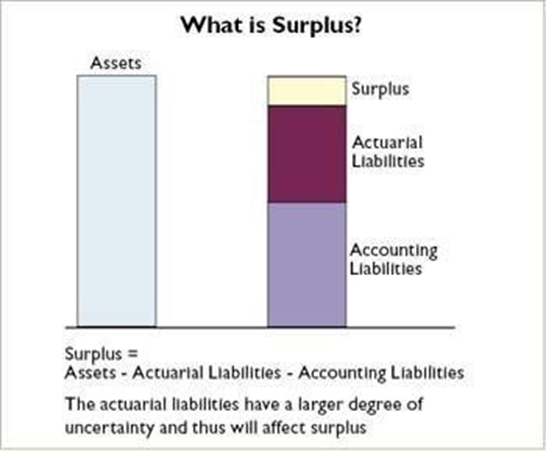
While this static, accounting-based view is useful, your background in probability theory allows us to adopt a more dynamic and powerful perspective. We can model the evolution of surplus over time as a stochastic process.
8.4 Surplus processes and dividend strategies - Actuarial... - Fiveable
This study guide introduces a formal model for the surplus process, which should be familiar from your prior studies.
Please read the section "Surplus process fundamentals". Pay close attention to the definition of the Cramér-Lundberg model.
The classical surplus process, or Cramér-Lundberg model, defines the surplus at time as:
where:
- is the initial surplus.
- is the rate of premium income (net of expenses).
- is the cumulative claims process, often modeled as a compound Poisson process.
This model elegantly captures the core dynamics: surplus grows deterministically with premium income and drops stochastically when claims occur. The central goal of an insurer is to manage its affairs to ensure for all , thereby avoiding ruin. Surplus management is, in essence, the set of strategic decisions that influence the parameters and path of this process.
The Core Dilemma: Distribution vs. Retention
When an insurer generates surplus (i.e., when profits emerge), it faces a fundamental dilemma: should it return this value to its stakeholders, or should it hold onto it? This is the primary trade-off between distribution and retention.
- Distribution: Paying out excess surplus, typically as dividends to shareholders or as bonuses/dividends to policyholders. This rewards capital providers and can make products more attractive to customers.
- Retention: Keeping the surplus within the company. This increases the capital base, providing a larger buffer against future shocks and making capital available to support new business growth.
This is not an all-or-nothing choice. The art of surplus management lies in finding the right balance to satisfy competing objectives. An overly generous distribution policy might increase the firm's risk of ruin, while an overly conservative retention policy might lead to an inefficient balance sheet and unhappy shareholders who see their capital "trapped" in the company.
Approaches to Surplus Management
The strategic balancing act between distribution and retention, combined with decisions on how to invest the underlying assets, forms the three key levers of surplus management.
1. Distribution Strategy
Distribution is the process of returning profits to stakeholders. The key questions are who to pay, how much to pay, and when. The answer depends heavily on the type of company and its strategic objectives.
8.4 Surplus processes and dividend strategies - Actuarial... - Fiveable
Let's revisit the study guide to explore how distribution decisions are formalized.
Read the sections "Dividend strategy basics" and "Types of dividend strategies". Focus on understanding the three main types of dividend strategies.
As the guide explains, when we introduce dividends into our surplus process model, it becomes:
Every dollar paid out as a dividend directly reduces the surplus available to absorb future claims. The choice of strategy for is therefore critical:
- Fixed Strategy: Pays a constant dividend. This is predictable for investors but is risky as it ignores the company's current financial health.
- Barrier (Threshold) Strategy: Pays out any surplus above a predetermined barrier level, . This is a powerful concept because it explicitly defines a retention level () that acts as a safety buffer. No dividends are paid if the surplus is below this barrier.
- Proportional Strategy: Pays a fixed fraction of the surplus. This allows payments to automatically adjust to the company's performance.
From a theoretical standpoint, an "optimal" strategy is one that maximizes the expected present value of all future dividend payments before ruin. However, in practice, several other factors must be considered.
Chapter 38 - Surplus and surplus management Flashcards by ...
These flashcards provide helpful mnemonics for the practical considerations in surplus distribution, which are highly examinable.
Review the flashcards covering distribution for life insurance companies (COME) and for benefit schemes (DR R LISTS).
The 'COME' and 'DR R LISTS' mnemonics are excellent summaries for your exam revision, covering everything from regulatory rules and capital requirements to stakeholder expectations and the original source of the surplus.
2. Retention Strategy
Retention is the default outcome for any surplus that is not distributed. A company's retention policy is implicitly defined by its distribution strategy. For example, in a barrier strategy, the level of the barrier is the explicit retention target.
The primary reasons for retaining surplus are:
- To increase solvency: A larger surplus provides a stronger buffer against adverse experience (e.g., higher-than-expected claims, market crashes) and reduces the probability of ruin. This corresponds to the 'Margins for future adverse experience' point in the 'COME' mnemonic.
- To fund future growth: Writing new business often creates a capital strain, as acquisition costs are paid upfront while profits emerge over time. Retained surplus provides the necessary capital to finance this growth without needing to raise expensive external capital.
- To maintain strategic flexibility: A strong surplus position allows a company to pursue strategic opportunities, such as acquiring a competitor or investing in new technology.
3. Investment Strategy
Once a decision is made on how much surplus to retain, the final question is how to invest the assets that represent this surplus. This is where surplus management directly connects to investment strategy and asset-liability management (ALM).
A common approach is to conceptually split the company's asset portfolio into two segments, as shown in the diagram below.

-
Liability-Backing Portfolio: These are assets held to match the expected cashflows of the company's liabilities. The investment strategy for this portfolio is defensive and liability-driven. Its objectives are dominated by ALM matching, providing liquidity, and risk management. The goal is to ensure that funds are available to pay claims as they fall due, regardless of market conditions.
-
Surplus Portfolio: These are the "free" assets that back the company's surplus. Since they are not needed to meet specific liability cashflows, they can be invested with a more aggressive, return-seeking objective. The strategy for this portfolio focuses on maximizing returns, generating investment income, and acting as a portfolio diversifier. This is where an insurer might take on higher equity exposure or invest in alternative assets to boost the overall return of the firm.
This two-pronged investment approach allows the company to secure its obligations to policyholders while simultaneously using its financial strength to generate additional profits, which in turn contributes to the growth of future surplus.
Cheatsheet: Surplus Management Approaches
Here is a summary framework of the three key approaches to surplus management, designed for your CP1 exam preparation.
| Approach | Key Objective | Primary Mechanisms & Tools | Key Considerations & Trade-offs |
|---|---|---|---|
| Distribution | Reward shareholders and policyholders; return capital. | Dividends (for stock companies); Bonuses/policy dividends (for mutual/participating business). Strategies: Fixed, Barrier, Proportional. | Trade-off: Higher payouts please stakeholders but increase risk of ruin. Must meet regulatory rules and stakeholder expectations ('COME', 'DR R LISTS'). |
| Retention | Enhance financial stability; fund future growth and strategic opportunities. | Implicitly defined by the distribution strategy (e.g., the barrier 'b'). Reinvesting profits rather than paying them out. | Trade-off: Higher retention improves solvency but can lead to inefficient capital structure and lower Return on Equity (ROE). |
| Investment | Generate returns on the company's net assets. | Segmenting the asset portfolio into a conservative Liability-Backing portfolio and a return-seeking Surplus portfolio. | Trade-off: A more aggressive surplus portfolio strategy can increase expected profits ('c' in the surplus model) but also increases the volatility of the surplus. |
Conclusion
In this lesson, we have defined surplus as the excess of an insurer's assets over its liabilities and framed its management as a core strategic function. We've seen that this involves a dynamic interplay between three key levers:
- Distribution: The strategy for paying out profits to stakeholders, guided by formal rules (like barrier strategies) and practical considerations.
- Retention: The decision to keep profits within the firm to act as a buffer and fuel growth, representing the flip side of the distribution decision.
- Investment: The approach to managing the assets backing the surplus, typically with a more aggressive, return-seeking mandate than the assets backing liabilities.
Mastering this balance is critical for an insurer's long-term success. It requires a deep understanding of the company's risk appetite, strategic goals, and the stochastic nature of its business.
Having established the principles for managing capital and surplus, our next lesson will address how a company keeps track of its financial position in real time. We will explore the key principles and tools for ongoing monitoring, which ensures that the strategies put in place are working as intended and provides early warnings when corrective action is needed.