Introduction
In our last lesson, we explored how actuaries continuously monitor a firm's financial health, using tools like KPIs and Analysis of Surplus to detect deviations from the expected path. This monitoring process serves as a crucial early warning system. Today, we turn our attention to what happens when these warnings are severe, and the company's viability is fundamentally threatened. This brings us to the critical topics of insolvency and closure.
Within the Actuarial Control Cycle, insolvency represents the ultimate breakdown. It occurs when the feedback loop of monitoring and corrective action fails to restore the firm to a stable footing. Understanding the triggers that signal this breakdown and the formal processes that follow is a key responsibility for actuaries and a core part of the CP1 syllabus.
This lesson will describe the key triggers that lead to a financial institution being declared insolvent and the different legal and regulatory processes that can unfold, from attempts to rescue the business to its orderly closure.
Defining Insolvency: From Balance Sheets to Non-Viability
At its most basic, insolvency can be defined in two ways:
- Cash-flow insolvency: The inability to pay debts as they fall due.
- Balance-sheet insolvency: The value of total liabilities exceeds the value of total assets.
However, for regulated financial institutions like banks and insurers, the situation is more complex. Because they hold public trust and policyholder funds, regulators cannot wait for a company to be demonstrably balance-sheet insolvent before taking action. By that point, significant value may have already been destroyed.
Instead, regulators operate on the forward-looking concept of non-viability. A firm is considered non-viable when it is judged to have no reasonable prospect of recovery and is unlikely to be able to meet its obligations in the future.
The Toronto Centre, a key body for financial supervision guidance, explains why supervisors must act before a firm is technically insolvent.
Exit Policy: Taking Supervisory Action to Deal with Non-Viable ...
This note explains the supervisory rationale for early intervention.
Please read the section titled "Balance sheet insolvency not a pre-requisite for supervisory action". Focus on the reasons provided for why waiting for balance-sheet insolvency is too late.
As you've read, supervisors must intervene early because:
- Aggressive accounting can mask the true, worsening financial position.
- As the end nears, shareholders or managers may be tempted to extract remaining assets, accelerating the deterioration.
- The process of liquidation itself takes time, during which the financial hole can deepen.
For an insurer or bank, non-viability is often tied to the failure to meet regulatory capital requirements. These requirements impose a much stricter test than simple balance-sheet solvency, demanding a significant buffer of assets over liabilities.
[PDF] Subject CP1 - Actuarial Education
This excerpt from the ActEd study material defines insolvency in the context of regulated entities.
Read the introductory sections for insurance companies and banks. Notice how the definition of solvency is directly linked to maintaining the required solvency capital.
Triggers for Insolvency Proceedings
An insolvency process can be initiated through several different pathways. The main distinction is between processes initiated voluntarily by the company itself, those forced upon it by creditors, and those directed by a regulator.
1. Compulsory Liquidation (Creditor-led)
This is the classic scenario where a company is forced into closure by its creditors. The Kaplan UK video below explains the primary legal trigger in the UK, which serves as a representative example of how such proceedings begin.
Insolvency Explained [ACCA Law]
This video provides a clear overview of compulsory liquidation, a court-ordered process.
Please watch the segment from the start of the section on compulsory liquidation. The speaker explains that it is ordered by the court and details the most common trigger: a company's inability to pay its debts. Pay close attention to the specific criteria mentioned (£750 debt, 3 weeks non-payment).
As the video explains, the key trigger is a court petition, usually from a creditor who is owed money and has not been paid. The court must be satisfied that the company is insolvent before issuing a "Winding up Order."
2. Creditors' Voluntary Liquidation (CVL) (Company-led)
This process, despite its name, is initiated by the company's own directors and shareholders. They recognise that the company cannot pay its debts and decide that the only option is to cease trading and liquidate its assets to pay creditors. It is "voluntary" from the company's perspective but is done for the benefit of its "creditors."
This is often seen as a more responsible route than waiting for a compulsory order, as it can give directors more control over the process and may lead to a better outcome for creditors.
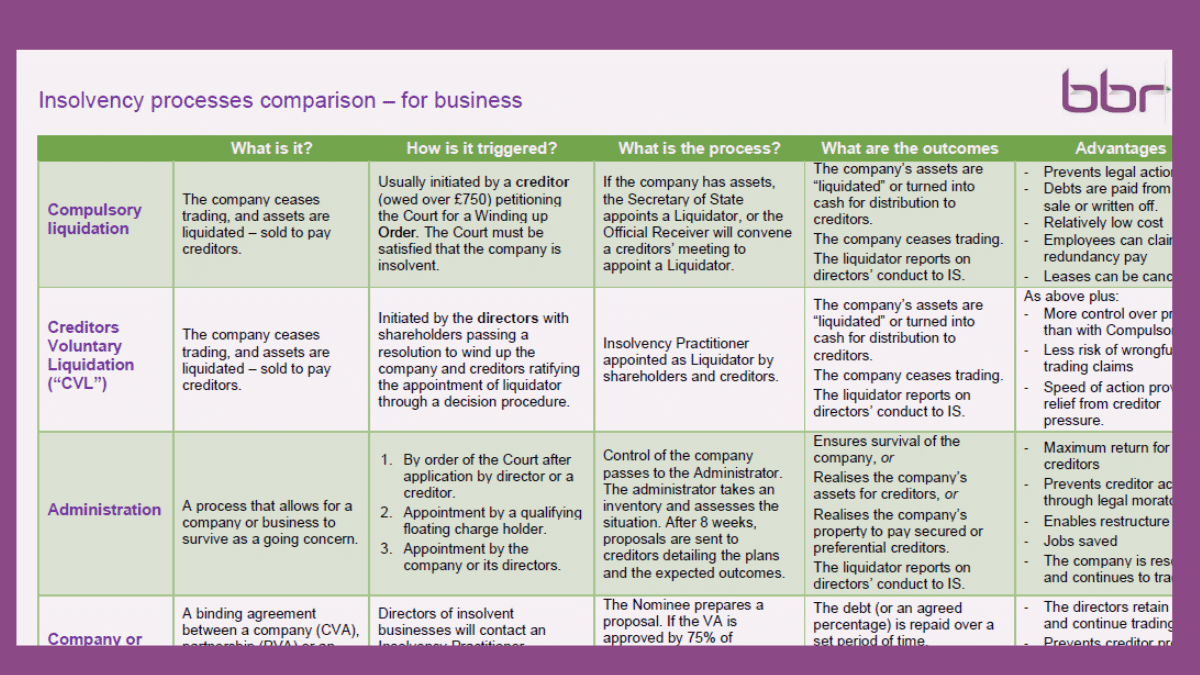
The following image provides a high-level comparison of these liquidation processes alongside other insolvency options we will discuss shortly.
3. Supervisory Intervention (Regulator-led)
For financial institutions, the most common and critical trigger is intervention by the regulator. This is a direct consequence of the ongoing monitoring we discussed in the last lesson. Regulators use a framework often called a "guide to intervention" or "risk ladder" to formalize their response as a firm's risk profile deteriorates.
Exit Policy: Taking Supervisory Action to Deal with Non-Viable ...
This section explains the risk ladder framework used by supervisors.
Please read the section titled "Guide to intervention" and study the accompanying table, "An example guide to intervention". This table is an excellent framework for understanding the escalating stages of regulatory concern.
As you can see from the risk ladder, a firm doesn't fall into insolvency overnight. It moves through stages of escalating risk:
- Level 1-2 (Low/Emerging Risk): Routine monitoring.
- Level 3 (Moderate Risk): Serious concerns, requiring urgent action plans.
- Level 4 (Unacceptable Risk): The firm is on the brink. A formal recovery plan is implemented, and the regulator may take control. The firm is close to being non-viable.
- Level 5 (Non-Viable): The recovery plan has failed. The institution is put into liquidation or resolution.
To make these decisions more objective, supervisors often use "red-lines"—pre-determined financial thresholds. Breaching these red-lines acts as a strong indicator of non-viability. Given your background in statistics, you can think of these as hypothesis tests; crossing a threshold provides strong evidence to reject the "null hypothesis" that the firm is viable. The Toronto Centre note provides a list of example red-lines for banks and insurers, which serves as a practical "cheatsheet."
Exit Policy: Taking Supervisory Action to Deal with Non-Viable ...
This appendix gives concrete examples of financial triggers.
Review the tables of red-lines for Banks, General insurers, and Life insurers. Note how they cover capital adequacy, profitability, risk concentration, and liquidity.
The Insolvency Processes: Liquidation vs. Resolution
Once a firm is deemed insolvent or non-viable, one of several formal processes begins. The fundamental choice is between winding the company down (liquidation) or attempting to rescue it or manage its failure in an orderly manner (administration or resolution).
Liquidation: The End of the Company
The goal of liquidation is to end the company's life. An appointed liquidator takes control, ceases business operations, sells ("liquidates") all company assets, and distributes the cash proceeds to creditors according to a strict legal hierarchy.
The video below gives a practical overview of the steps involved in a typical Creditors' Voluntary Liquidation.
THE LIQUIDATION PROCESS EXPLAINED
This video from an insolvency practitioner explains the liquidation process from the director's point of view.
Watch the segment from the beginning of the video, which walks through the key stages: from the initial inquiry and engagement, to notifying creditors, holding the creditors' meeting, and the official appointment of the liquidator.
A crucial part of liquidation is the order of payment. Not all creditors are treated equally. There is a "waterfall" of payments, and money only flows down to the next level once the level above has been paid in full. This is a frequently tested concept.
Insolvency Explained [ACCA Law]
The Kaplan UK video clearly explains the hierarchy of who gets paid first in a liquidation.
Please watch the final segment of the video, from "order that debts are repaid". The presenter outlines the priority from fixed charge holders down to ordinary shareholders.
The typical order of priority is:
- Fixed Charge Holders: Creditors with security over specific assets (e.g., a mortgage on a building).
- Liquidator's Fees and Expenses.
- Preferential Creditors: Primarily employee wages and certain tax debts (e.g., PAYE, VAT).
- Floating Charge Holders: Creditors with security over a class of assets that can change over time (e.g., stock).
- Unsecured Creditors: Suppliers, customers, and other lenders with no security.
- Shareholders: They are the owners and are last in line, rarely receiving anything in an insolvent liquidation.
Administration and Resolution: The Rescue Path
Unlike liquidation, administration (or resolution for large, systemic firms) provides a breathing space. The goal is to see if the company, or at least its business, can be saved. When a firm enters administration, an Administrator is appointed and a moratorium takes effect, freezing legal action by creditors. This allows the Administrator to assess the situation and formulate a plan, which might be to:
- Restructure the company and return it to solvency.
- Sell the business as a going concern to another company.
- Achieve a better result for creditors by selling off assets in an orderly way, rather than in a fire-sale liquidation.
For systemically important institutions like large banks, regulators have specific resolution plans in place. The aim here is to manage the failure in an orderly way to prevent contagion and protect the wider financial system, a concept known as avoiding systemic risk.
[PDF] Subject CP1 - Actuarial Education
This text describes the modern regulatory approach for insurers and banks, focusing on recovery and resolution.
Read the section on "Intervention" for insurance companies and the parallel section "Intervention" for banks. Focus on the distinction between a recovery plan (actions the firm takes to save itself) and a resolution plan (actions the regulator takes when recovery fails).
If these rescue attempts fail, the company will then typically be moved into liquidation.
Conclusion and Cheatsheet
In this lesson, we have moved from the early warnings of monitoring to the critical state of insolvency. We've seen that for regulated financial institutions, the trigger is not simple insolvency but the forward-looking concept of non-viability, often flagged by regulatory "red-lines" within a "guide to intervention" framework.
We then distinguished between the key insolvency processes. Liquidation (whether compulsory or voluntary) is a terminal process designed to wind up the company and pay creditors according to a strict legal priority. In contrast, administration and resolution are processes designed to provide a chance for rescue or, failing that, an orderly failure that minimizes damage to customers and the wider economy.
To help you consolidate this for your CP1 exam preparation, here is a summary framework comparing the main insolvency procedures.
| Process | Primary Goal | Triggered By | Key Actor | Key Feature / Outcome |
|---|---|---|---|---|
| Compulsory Liquidation | End the company | Creditor petition to court | Court-appointed Liquidator (Official Receiver) | Company ceases trading, assets sold, proceeds paid to creditors in strict order. Directors have no control. |
| Creditors' Voluntary Liquidation (CVL) | End the company | Company directors/shareholders | Insolvency Practitioner appointed by company & creditors | Same outcome as compulsory, but initiated by the company, allowing for more control and potentially a better result for creditors. |
| Administration / Resolution | Rescue the business or manage an orderly failure | Directors, creditors, or (most often for FI) the regulator | Administrator / Resolution Authority | A moratorium freezes legal action. A plan is developed for restructuring, sale, or orderly wind-down. May return to solvency or ultimately enter liquidation. |
This lesson has focused on the failure of the provider of financial products. In our next and final lesson for this module, we will shift perspective to examine what happens when the sponsor of a benefit scheme, such as a company pension, can no longer support it, leading to the process of closure and wind-up.