Introduction
In our last lesson, we examined the process of insolvency for a financial institution—the provider of a product. We saw how regulatory frameworks aim to manage the failure of a bank or insurer to protect customers and the wider financial system. Today, we conclude our final module by shifting our focus from the product provider to the sponsor of a benefit scheme, such as a company providing a Defined Benefit (DB) pension.
This lesson directly addresses the final learning outcome of the course: describing the key triggers and processes for the closure and wind-up of a benefit scheme. This situation is distinct from the provider's insolvency. Here, the sponsoring employer may be perfectly solvent but decides, for strategic reasons, to stop offering the pension scheme. Alternatively, the sponsor's own insolvency can trigger the scheme's demise. We will explore the lifecycle of this process, from the initial decision to close the scheme to new members, through a "run-off" period, to the final act of "wind-up" where the scheme's obligations are settled and it ceases to exist.
The Vocabulary of Termination: Closure, Run-off, and Wind-up
Before diving into the triggers and processes, it's crucial to be precise with our terminology. These terms describe distinct phases in a scheme's journey towards termination.
The Institute and Faculty of Actuaries paper, "Lessons from Closure", provides a good overview of these concepts.
[PDF] LESSONS FROM CLOSURE - Institute and Faculty of Actuaries
This paper compares the closure of pension schemes and life insurance funds, offering valuable context on the topic.
Please read the section titled "Closure". Focus on the different meanings of 'closed' for a pension scheme: closure to new entrants versus cessation of future benefit accrual.
As you've read, "closure" is not a single event. It typically happens in two stages:
- Closed to new members: The scheme no longer accepts new employees. However, existing members continue to work and build up more pension benefits (accrue future service). From a statistical perspective, the population of the scheme is now fixed and will only decline over time through members leaving, retiring, or dying.
- Closed to future accrual: This is a more significant step. Not only are there no new members, but existing members also stop earning any further benefits, even if they continue to work for the company. Their pensionable service is frozen. This is often a more contentious event, as it alters the expected future remuneration for current employees.
Once a scheme is closed to future accrual, it is said to be in run-off. It continues to operate—investing assets, paying pensions to retirees, and managing the frozen benefits of active members—but its sole purpose is to manage its existing liabilities until they are all paid out or transferred elsewhere.
Wind-up is the final stage. This is the formal legal process of dissolving the scheme entirely. The scheme's assets are used to secure the members' benefits with a third party (usually an insurance company), and the scheme's trust is terminated.
Why Do Schemes Close? The Triggers
The decision to close a DB pension scheme is a major strategic one for a sponsoring employer. The reasons are multifaceted and often interconnected, reflecting a fundamental shift in the risk-reward balance of providing such benefits.
The "Lessons from Closure" paper provides a comprehensive list of these drivers.
[PDF] LESSONS FROM CLOSURE - Institute and Faculty of Actuaries
This section details the primary reasons employers have moved away from providing Defined Benefit schemes.
Please read the section "Triggers for the Closure of Pension Schemes". As you read, categorize the triggers into broad themes like Cost, Risk, Legislation, and Market Practice.
Let's synthesize those triggers into a few key themes:
- Cost and Volatility: DB schemes have become prohibitively expensive. The "promise" is open-ended, subject to factors like increasing longevity and volatile investment returns. Closing the scheme provides greater predictability and control over future costs.
- Risk Management: Accounting standards now require pension deficits to be shown on the company's balance sheet, making the financial risks highly visible to investors. Many companies now view a DB scheme as a source of significant, non-core business risk that they wish to eliminate.
- Legislative Burden: Decades of new legislation have added layers of complexity and cost, such as mandatory inflation-proofing for pensions and equal treatment for men and women. The introduction of the Pension Protection Fund (PPF) in the UK, while protecting members, added a significant levy cost for sponsors of underfunded schemes.
- Market Trends: As leading companies began closing their DB schemes, it became easier for others to follow suit without facing a competitive disadvantage in attracting talent.
- Corporate Activity: Mergers, acquisitions, or major restructuring events often act as a catalyst for reviewing and harmonizing employee benefits, frequently leading to the closure of existing DB schemes.
- Sponsor Insolvency: If the sponsoring company goes out of business, the scheme is automatically triggered into a wind-up process (or assessment for entry into a state-run protection fund).
The Journey to Wind-up: A Multi-Year Process
The path from a healthy, open scheme to a fully wound-up one can take over a decade. It involves a series of strategic decisions, financial contributions, and risk management exercises. The following timeline for the Metal Box Pension Scheme provides an excellent real-world example of this journey.
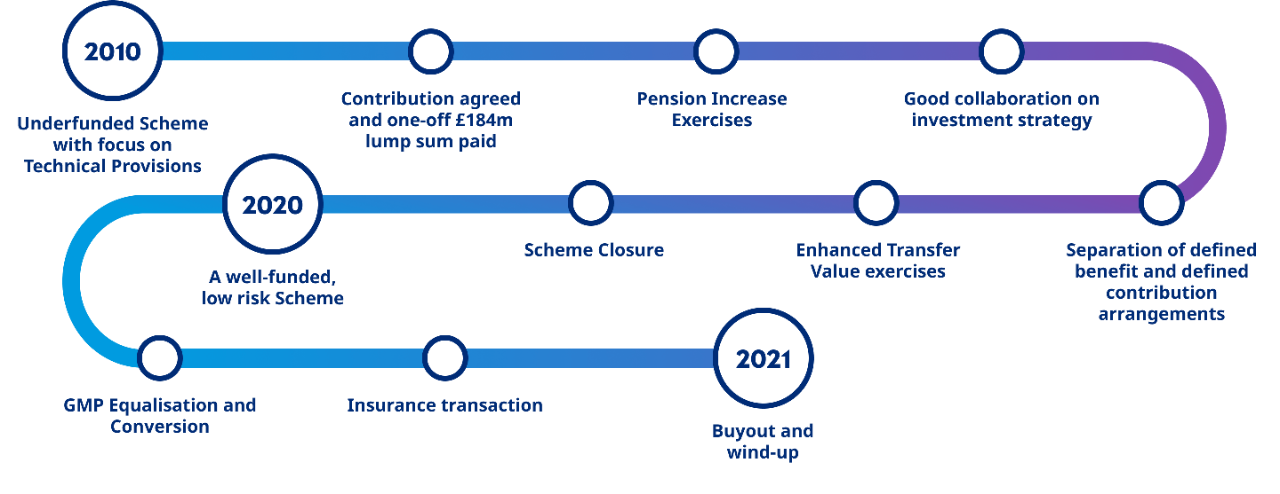
As the timeline illustrates, the process is not simply about closing the doors. It involves:
- Addressing funding shortfalls (the £184m lump sum).
- Proactively managing liabilities (Pension Increase Exercises, Enhanced Transfer Value exercises).
- Collaborating on a de-risking investment strategy.
- Executing the final insurance transaction (buyout) to secure all benefits.
The Final Act: The Wind-up Process and Securing Benefits
Once a scheme is closed and sufficiently funded (or the sponsor becomes insolvent), the wind-up process begins. The ultimate goal of wind-up is to use the scheme's assets to secure the promised benefits for all members, thereby discharging the sponsor and trustees of their obligations.
The ActEd study material outlines the various ways this can be achieved.
[PDF] Subject CP1 - Actuarial Education
This chapter from the core study text details the practical options available when a benefit scheme is discontinued.
First, read the section on "Provision of benefits". Pay close attention to the different destinations for the funds and who bears the ultimate risk in each case. Then, review the table in the Chapter Summary, which provides an excellent "cheatsheet" of these options.
As you've seen, there are several potential destinations for the scheme's assets and liabilities:
| Option for Benefit Provision | Who takes the risk of adverse experience? |
|---|---|
| Pay benefits from the existing (closed) fund | Sponsor (if still solvent) |
| Transfer to another scheme (e.g., scheme merger) | New Sponsor |
| Transfer funds to a member's personal pension (DC) | The individual member |
| Transfer liabilities to an insurance company (Buy-in / Buyout) | Insurance company |
| Transfer liabilities to a non-insurance consolidator ('Superfund') | Consolidator (and ultimately members, through weaker security) |
| Transfer to a central discontinuance fund (e.g., PPF) | Ultimately other scheme sponsors via levies; members face benefit caps |
The "gold standard" and most common end-goal for a solvent wind-up is the buyout. The scheme pays a single premium to an insurance company, which in return takes on the full responsibility for paying all members' pensions for the rest of their lives. This provides the highest security for members and achieves a clean break for the sponsoring company.
Key Actuarial Considerations in Closure and Wind-up
Throughout this process, actuaries play a central role. Two of the most critical issues they must advise on are the funding level and the precise definition of the benefits owed.
1. Level of Assets: Deficit or Surplus?
The funding position dictates the entire process.
- Scheme in Deficit: If assets are less than the liabilities (on a wind-up basis), the sponsor must make up the shortfall. If the sponsor is insolvent, there aren't enough assets to pay everyone their full promised benefits. In this case, legislation and scheme rules dictate a priority order for how the available assets are distributed. Typically, pensions already in payment have the highest priority, and other members may receive reduced benefits. This is where state-sponsored protection funds, like the UK's Pension Protection Fund (PPF), may step in to provide a minimum level of compensation.
- Scheme in Surplus: If assets exceed the liabilities required for a buyout, a contentious question arises: who owns the surplus? The sponsor, who may feel they over-funded the scheme, or the members, who might argue for benefit enhancements? The answer is complex and depends on the scheme's specific rules and prevailing legislation.
2. Level of Benefits: Rights vs. Expectations
Defining the liability to be secured is not always straightforward. Actuaries must distinguish between members' "rights" and their "expectations".
[PDF] Subject CP1 - Actuarial Education
This section explains the crucial distinction between what members are legally entitled to and what they might have reasonably expected.
Read the section titled "Level of benefits". Focus on the definitions of rights and expectations and how they are handled when assets are insufficient.
From your background in statistics, you can think of this distinction in terms of a distribution of possible benefit outcomes:
- Rights represent the core, legally enforceable benefits. This is the minimum entitlement, a high-confidence lower bound on the benefit promise.
- Expectations may include things that are not strictly guaranteed, such as future discretionary pension increases or historically generous early retirement terms. These represent a more 'best-estimate' or expected value of the benefit promise, but they are not legally binding.
When a scheme is in deficit, rights always take priority over expectations. The available funds are first applied to secure the legal rights, and only if a surplus remains can any consideration be given to fulfilling members' expectations.
Conclusion
This lesson has charted the final chapter in the life of a defined benefit scheme, moving from the strategic decision to close it, through the long run-off period, to the finality of wind-up. We've seen that closure is driven by a desire to control cost and risk, while the wind-up process is focused on securing member benefits, ideally through an insurance buyout.
Key Takeaways:
- Closure vs. Wind-up: Closure stops the accrual of new benefits, while wind-up is the legal termination of the scheme.
- Triggers: The shift away from DB schemes is driven by high costs, risk aversion, legislative burdens, and market trends.
- The Wind-up Goal: The primary objective is to use scheme assets to secure member benefits with a third party, removing the liability from the sponsor. A buyout with an insurer is the most secure route.
- Actuarial Challenges: Key issues involve managing funding deficits or surpluses and carefully defining the liabilities based on the priority of member rights over expectations.
This marks the end of our course. We have journeyed through the entire Actuarial Control Cycle, from understanding the external environment and customer needs, through product design, pricing, valuation, and risk management, to the ultimate issues of solvency and closure. You have built a comprehensive map of the concepts required for the CP1 exam. I wish you the very best in your final preparations and the examination itself.