Introduction
In our last lesson, we explored the structured, standardized world of regulatory capital, using the Solvency II standard formula as our guide. We saw how regulators impose a common framework to ensure a baseline level of policyholder protection. Today, we pivot from this external, one-size-fits-all perspective to an internal, bespoke one. We will delve into the concept of economic capital, which represents a firm's own view of the capital it needs to weather potential storms and achieve its strategic objectives.
This lesson will explain what economic capital is and, crucially, how it serves as a cornerstone of a modern Enterprise Risk Management (ERM) framework. Rather than being a simple compliance number, you will see that economic capital is a dynamic tool used for strategic decision-making, performance measurement, and optimizing the trade-off between risk and return. Your background in probability theory will be particularly relevant as we touch on the sophisticated modeling that underpins this concept.
The Context: Enterprise Risk Management (ERM)
Before we can appreciate the role of economic capital, we must first understand the framework in which it operates: Enterprise Risk Management (ERM). Historically, firms often managed risks in isolation—market risk in the investment department, underwriting risk in the actuarial department, and so on. ERM represents a fundamental shift towards a holistic, integrated approach.
What is Enterprise Risk Management? Actuarial Science
This video from MJ the Fellow Actuary provides a concise introduction to the philosophy of ERM.
Please watch the following segments: The definition of ERM from the start. The explanation of the holistic, "big picture" approach from this section. The concluding point on the ultimate goal of ERM from this final part. Focus on how ERM moves beyond isolated "silos" of risk to manage the entire "forest" and how its ultimate purpose is to maximize the firm's value.
As the video emphasizes, ERM is a strategic framework. It's not just about avoiding losses; it's about making informed decisions to enhance profitability and stability. Economic capital is the primary quantitative tool that makes this possible.
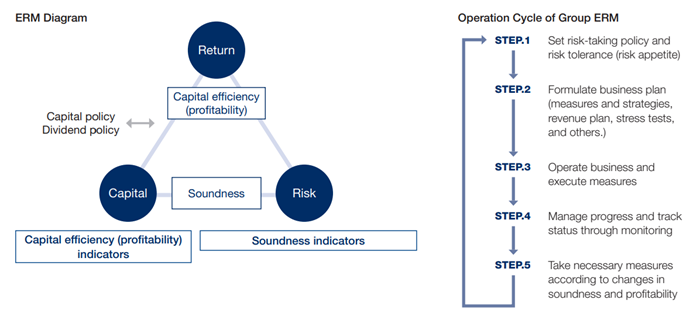
The diagram above shows the interplay between Risk, Return, and Capital. ERM seeks to manage this trio to optimize performance. The operational cycle on the right demonstrates that this isn't a one-time calculation but a continuous process of planning, executing, and monitoring—a process in which economic capital is a key metric.
Defining Economic Capital
At its simplest, economic capital is the amount of financial resources a firm needs to absorb potential losses and remain solvent, given its specific risk profile.
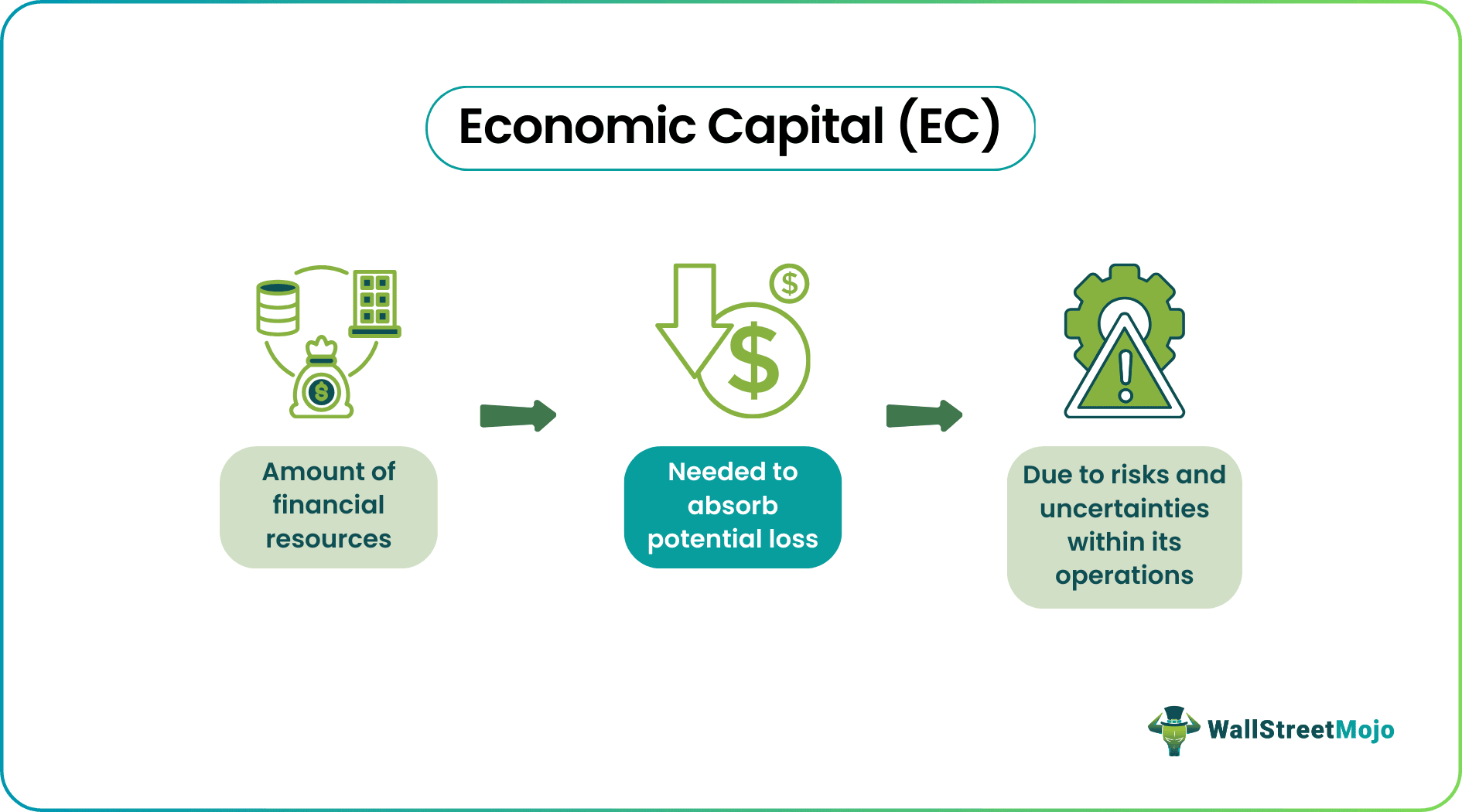
While this graphic gives the general idea, a more formal definition is needed for actuarial practice. The following reading provides a precise and widely accepted definition.
ERM and ORSA 101 for Regulators
This presentation from the American Academy of Actuaries offers a clear, professional definition of Economic Capital (EC) and its primary uses.
Please read the slide titled "Economic Capital Models". Pay close attention to the definition of EC and the subsequent slide, "Uses of EC Models", which lists its key applications.
The key phrase in the definition is that capital is determined for a "given timeframe at a selected confidence level." This directly connects to your expertise in statistics. Unlike the standard formula's prescribed 99.5% Value-at-Risk (VaR), a firm defines its own risk appetite for its economic capital calculation. It might, for example, calculate the capital required to maintain its "AA" credit rating, which corresponds to a certain probability of default (e.g., 0.03%) over one year.
This probabilistic approach is the essence of economic capital modeling.
This video on capital modeling theory explains the foundational concepts behind calculating risk-based capital.
First, watch the basic definition of capital as the difference between assets and liabilities from the beginning. Then, watch the crucial segment from this part, where the presenter introduces a probability-based statement for capital adequacy. Note the term alpha, representing the firm's risk tolerance.
The video introduces the idea that capital adequacy is not a deterministic state but a probabilistic one. The goal is to hold enough capital such that the probability of it being sufficient to cover liabilities, even under stress, is acceptably high (e.g., ).
Building an Economic Capital Model
So, how does a firm build a model to calculate its own economic capital? While the standard formula uses prescribed factors and shocks, an internal EC model is a far more complex and tailored engine, built from the ground up to reflect the company's unique business mix and risk exposures.
The design of an EC model requires making several key methodological choices. The following resource provides an excellent overview of these core design elements.
[PDF] ERM-2: Introduction to Economic Capital Modeling
This presentation by Towers Watson offers a fantastic, structured breakdown of how an EC model is designed and used. It's a key resource for understanding the practical aspects.
First, read the introduction to understand the rationale for EC. Next, study the slides defining available and required EC. Note the concept of stress-testing the economic balance sheet. Then, review the slide "Companies that are implementing EC models..." to see the practical questions these models help answer. Finally, focus on the slides under the heading METHODOLOGIES, starting from "Six Key Methodological Elements". This is the core of your reading. Understand the choices involved in each of the six elements, particularly the Security Standard and Dependency and Aggregation.
As the reading highlights, building an EC model is a sophisticated exercise in stochastic modeling. Let's recap the six key design choices:
- Risk Horizon: Is the firm concerned with remaining solvent over the next year (a one-year horizon), or ensuring it can meet all obligations until the last policy runs off (run-off horizon)? The one-year view is becoming the standard.
- Balance Sheet Valuation: How are assets and liabilities valued? Typically, this is on an economic or market-consistent basis, which may differ from regulatory or accounting valuations.
- Security Standard: This is the statistical heart of the model. It defines the risk appetite. Will the firm use a Value-at-Risk (VaR) measure (e.g., 99.97% confidence, equivalent to an AA rating) or a Tail Value-at-Risk (TVaR) measure, which also considers the average severity of losses in the tail? Your statistical background gives you a clear advantage in appreciating the nuances between these risk measures.
- Risks to Include: The model aims to be comprehensive, including market, credit, insurance (underwriting), and operational risks.
- Dependency and Aggregation: This is where EC models can be far more advanced than the standard formula. Instead of a simple correlation matrix, firms may use copulas to model the dependency structure between risks, allowing for more realistic behavior, especially during extreme events (tail dependence).
- Quantification Methodology: The model is typically powered by Monte Carlo simulation, running thousands or millions of economic scenarios to generate a full probability distribution of outcomes, from which the required capital at the chosen security standard can be derived.
The Role of EC in ERM and the Link to Regulation (ORSA)
We've established that EC is an internal tool. But how does it connect back to the regulator? This happens through the Own Risk and Solvency Assessment (ORSA).
The ORSA is a regulatory requirement for an insurer to conduct and document its own process for assessing its risks and the capital needed to support them, both now and in the future. The firm's economic capital model is the analytical engine at the heart of the ORSA process. In the ORSA report, the company must:
- Describe its ERM framework and risk appetite.
- Detail its own assessment of its risk exposure and the corresponding capital needs (i.e., its economic capital).
- Compare its internal view of capital (EC) with the regulatory requirement (SCR) and explain any material differences.
The ORSA ensures that an EC model isn't just an academic exercise; it forces senior management and the board to formally own their view of risk and demonstrate to the regulator that they are managing their business prudently, going beyond mere compliance with the standard formula.
ERM and ORSA 101 for Regulators
This resource explains the link between internal risk assessment and regulatory reporting.
Read the slide on the global standard for ORSA, which mandates an "insurer's own assessment of... economic capital". Then, review the slides describing the ORSA Summary Report's contents, noting how it requires the insurer to report on its risk exposures and the resulting impact on risk capital. Finally, look at the slide "Assessing Solvency" to see how metrics like VaR/TVaR and the chosen security standard are key components of this assessment.
Cheatsheet: Regulatory Capital vs. Economic Capital
To help you consolidate these concepts for your CP1 exam preparation, here is a comparative framework.
| Feature | Regulatory Capital (Standard Formula) | Economic Capital (Internal Model) |
|---|---|---|
| Perspective | Regulator's view ("outside-in") | Company's internal view ("inside-out") |
| Purpose | Policyholder protection; ensure minimum solvency. | Strategic decision-making; optimize risk-return trade-off; maximize shareholder value. |
| Methodology | Standardized, prescribed formula ("one size fits many"). | Bespoke, tailored to the firm's specific risk profile and business model. |
| Risk Measurement | Prescribed shocks and factors; simple correlation matrix for aggregation. | Internal stochastic models; sophisticated dependency modeling (e.g., copulas) to capture diversification. |
| Risk Appetite | Implicitly defined by the regulator (e.g., 99.5% VaR in Solvency II). | Explicitly defined by the firm (e.g., target credit rating, selected VaR/TVaR confidence level). |
| Key Output | Solvency Capital Requirement (SCR). | Required Economic Capital (EC). |
| Role in ERM | A regulatory constraint; a boundary condition for the business. | A core tool for risk quantification, capital allocation, performance measurement, and strategic planning. |
| Regulatory Link | The mandatory capital level the firm must hold. | The foundation for the Own Risk and Solvency Assessment (ORSA) report submitted to the regulator. |
Conclusion
In this lesson, we have differentiated the internal, strategic perspective of economic capital from the external, compliance-driven view of regulatory capital. We've seen that EC is not just a number, but a risk-based measure of capital tailored to a firm's unique risk profile and strategic objectives. It is the quantitative engine of an Enterprise Risk Management (ERM) framework, enabling a company to move beyond simple risk avoidance to actively manage the trade-off between risk and return. By informing capital allocation, pricing, and strategic planning, EC helps to maximize firm value. Finally, through the ORSA, this internal view is communicated to regulators, demonstrating a sophisticated and forward-looking approach to solvency management.
Having now covered the different purposes and calculations of capital, our next lesson will address a crucial practical question: how does a company actively manage its capital position? We will explore the main tools for capital management, such as reinsurance, subordinated debt, and hedging strategies.