Introduction
In our last lesson, we constructed a comprehensive framework for Strategic Asset Allocation (SAA), which serves as the long-term investment blueprint for an institution. Having designed the blueprint, the next logical question is: how do we build the house? This lesson focuses on the crucial implementation step, exploring the two primary philosophies for managing the assets within your SAA: active and passive management.
We will delve into the heated debate between these two approaches, examining their underlying principles, costs, and risks. Ultimately, the choice of management style and the specific manager to execute it must be formalized. We will therefore explore the investment mandate, the formal contract that governs the relationship between the asset owner (like a pension fund) and the asset manager. This mandate acts as the detailed instruction manual, ensuring the manager's actions are precisely aligned with the SAA's strategic goals.
The Great Debate: Active vs. Passive Management
The choice between active and passive management is one of the most fundamental decisions in investment strategy. It's a debate about philosophy, cost, and the very nature of financial markets. To get a feel for the landscape and the passion this topic ignites, let's start with a short video.
The Active Vs Passive Investing Debate
This video from The Plain Bagel, titled "The Active Vs Passive Investing Debate," provides an excellent and accessible overview of the core arguments.
Please watch the following segments: First, get an introduction to the debate from the beginning. Next, watch the section that defines the main characteristics of each approach. Focus on the concepts of a benchmark, generating "alpha," and mimicking an index. Finally, watch the explanation of the underlying philosophies from this segment. Pay close attention to the role of the Efficient Market Hypothesis (EMH).
As the video explains, the two philosophies can be defined as follows:
-
Passive Management: This approach does not attempt to pick "winners." Instead, it seeks to replicate the performance of a specific market index (the benchmark), such as the FTSE 100 or the S&P 500. The goal is to capture the market's return, often referred to as beta, at the lowest possible cost. The primary strategies are broad diversification and a "buy and hold" mentality.
-
Active Management: This approach is built on the belief that it is possible to "beat the market." Active managers use research, forecasting, and their own judgment to select securities they believe will outperform the benchmark index. Their goal is to generate alpha, which is the excess return earned above the benchmark return.
The fundamental disagreement stems from their views on market efficiency. For you as a statistician, this can be framed as a debate about whether it's possible to consistently find a signal (alpha) within the noise of market prices.
- Passive investors are disciples of the Efficient Market Hypothesis (EMH), which posits that asset prices fully reflect all available information. If this is true, then trying to identify mispriced securities is a futile exercise; the market has already priced everything correctly. The best you can do is own the market.
- Active investors believe markets are not perfectly efficient. They argue that behavioral biases (like investor panic or herd mentality), structural issues, or informational advantages create opportunities to find undervalued or overvalued assets.
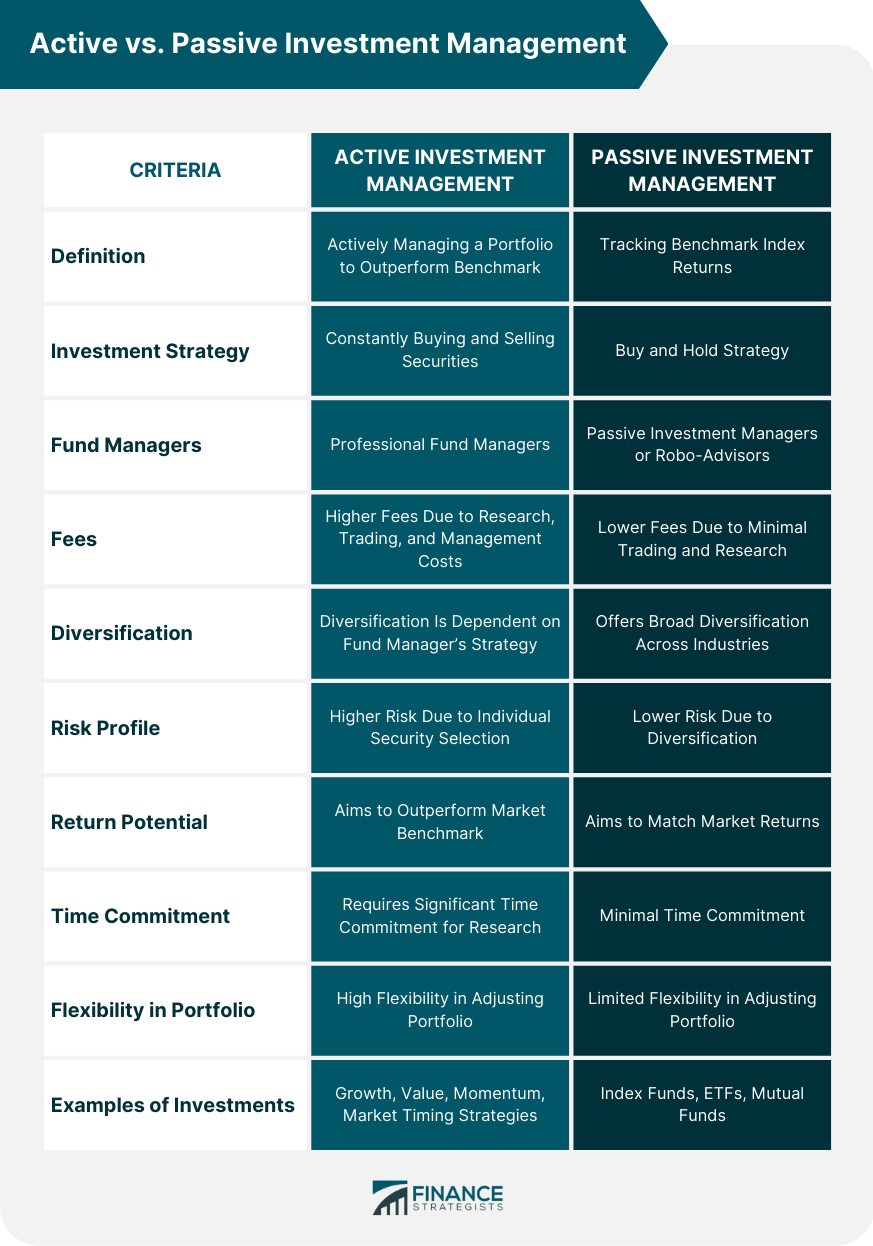
The following table provides a concise summary of the key differences between the two styles.
Beyond the Binary: A Spectrum of Choice
While we often talk about a simple active vs. passive choice, the reality is more of a spectrum. For institutional investors, the decision is more nuanced. A helpful paper from the UK's Institute and Faculty of Actuaries refines these categories.
[PDF] the concept of investment efficiency and its application to
This paper provides a more granular view of manager types, which is highly relevant for actuarial practice.
Please read the following sections to understand the different flavors of investment management: Passive Managers: Note the clear definition and the pros and cons. Active Managers: Understand the objective of outperformance and the arguments for and against. Active Core vs. Satellite: This is a key distinction. "Active Core" managers are large, diversified, and lower-risk, while "Satellite" managers are smaller, more concentrated, and higher-risk, aiming for high alpha.
This "Core-Satellite" approach is a popular hybrid strategy. An institution might place the bulk of its portfolio (the "core") in low-cost passive or low-risk active core funds, and then allocate a smaller portion to specialist "satellite" managers in the hope of generating significant alpha.
The Challenge of Active Management: The Skill Cycle
A key argument against active management is the statistical evidence: a large majority of active funds fail to beat their benchmarks after accounting for their higher fees. One reason for this is a phenomenon that the same actuarial paper calls the "skill cycle."
A skilled active manager who successfully generates high returns will attract a flood of new capital. However, managing a very large fund can be more difficult (diseconomies of scale). It's harder to trade in and out of positions without moving the market price, and the universe of potential investments shrinks. This can erode the manager's initial "skill," leading to a decline in performance. This cycle is a key reason why finding managers who can consistently outperform over the long term is exceptionally difficult.
The Investment Mandate: The Rules of Engagement
Once an institution decides on its mix of active and passive management, it needs to hire managers and provide them with clear instructions. This is done through an investment mandate.
An investment mandate is the formal contract that defines the relationship between the asset owner and the asset manager. It translates the high-level SAA into a concrete set of rules, objectives, and constraints.
Given your background in studying personal relationships, you can think of the investment mandate as being analogous to a relationship agreement. Just as partners might explicitly define expectations, boundaries, communication protocols, and shared goals to ensure mutual understanding and alignment, the mandate does the same for the owner-manager relationship. It's designed to build trust, manage the inherent principal-agent conflict, and provide a stable framework for achieving long-term goals, even through periods of short-term difficulty.
To see how this is formally described, let's watch a brief clip.
Asset Management Industry Overview - Products & Services
This video from Primerli gives a quick, professional definition of how investors delegate decisions to asset managers.
Please watch from this section. Focus on the description of "Separately Managed Accounts" or "Mandate accounts," where the manager operates based on the direction set by the client.
Structuring a Long-Term Mandate
A poorly designed mandate can inadvertently encourage short-term thinking, leading to managers chasing trends or asset owners firing managers at the worst possible time. A well-designed mandate, however, can anchor the relationship in the long term.
A comprehensive report by FCLTGlobal provides an excellent framework for creating these long-term mandates.
[PDF] Institutional Investment Mandates - FCLTGlobal
This report is a practical guide to designing investment mandates that foster long-term success.
First, read the Executive Summary to understand the core problem the mandate is trying to solve: the "time-horizon mismatch" between asset owners and asset managers. Next, carefully study the section Model for Long-Term Contract Provisions. This is the heart of the matter. As you read, focus on how each provision can be structured to encourage a long-term focus, paying particular attention to: Fees: How can fees reward longevity and long-term performance rather than just asset gathering? Contract Term: Why a fixed term (e.g., 3-5 years) might be better than an "at-will" contract. Reporting: How simple changes to reports can shift the focus from quarterly noise to long-term progress. Evaluation Process: How to establish a disciplined process for monitoring and making changes to the manager lineup.
Conclusion
Today, we've moved from the strategic blueprint of the SAA to the practicalities of its execution. We've dissected the active versus passive debate, understanding it as a fundamental disagreement about market efficiency, with significant implications for cost, risk, and potential returns. We also saw that this is not a rigid binary choice, but a spectrum of options, including sophisticated Core-Satellite structures.
Crucially, we established the role of the investment mandate as the binding agreement that brings the investment strategy to life. It is the essential tool for aligning the incentives of the asset manager with the long-term objectives of the asset owner. A well-crafted mandate, focused on long-term provisions for fees, reporting, and evaluation, is vital for navigating market cycles and giving the SAA the best chance of success.
In our next lesson, we will address the final piece of this puzzle: performance measurement and attribution. Having set a strategy and hired a manager with a clear mandate, how do we objectively measure their performance and determine what drove the results?
Key Takeaways & Cheatsheet
Here is a summary of the key comparisons between management styles and the components of a long-term mandate, designed for your CP1 exam revision.
Active vs. Passive Management Cheat Sheet
| Feature | Passive Management | Active Management |
|---|---|---|
| Goal | Match benchmark return (Beta) | Outperform benchmark (Alpha) |
| Philosophy | Markets are efficient (EMH) | Markets have inefficiencies |
| Strategy | Buy & hold; broad diversification | Security selection; market timing |
| Cost | Low fees (e.g., <0.1% for ETFs) | High fees (e.g., >0.5-1% + performance fees) |
| Risk Profile | Market risk only; low tracking error | Market risk + specific risk; higher tracking error |
| Time | Minimal research required | Significant research & monitoring |
| Typical Products | Index funds, ETFs | Most mutual funds, hedge funds |
Long-Term Investment Mandate: Key Provisions
| Provision | Common Short-Term Approach | Long-Term Model |
|---|---|---|
| Fees | Based on % of AUM, declining with size. | AUM fee discounts for longevity; performance fees measured over 3-5 years. |
| Benchmark | Standard market-cap weighted index. | Appropriate benchmark, but how it's used (over long periods) is more important. |
| Contract Term | At-will, terminable at any time. | 3-5 year term with automatic renewals to encourage commitment. |
| Manager Capacity | Often not contractually managed. | Contractually cap a strategy's AUM to prevent diseconomies of scale. |
| Reporting | Focus on quarterly performance. | Reports lead with long-term (5-10yr) returns; commentary focuses on annual results. |
| Evaluation | Triggered by short-term underperformance. | Predetermined review schedule; focus on process and long-term KPIs, not just returns. |
| Disclosures | Major firm changes (ownership). | Disclosure of changes to team, process, KPIs, and succession plans. |