Introduction
In our last lesson, we put Mean-Variance Optimization (MVO) under the microscope. We concluded that while it provides a mathematically rigorous foundation for portfolio construction, its sensitivity to inputs and its simplified view of risk make it more of a useful tool than a definitive answer machine. This naturally leads to the question: if MVO isn't the whole story, what is?
This lesson answers that question by introducing the broader, more practical framework of Strategic Asset Allocation (SAA). SAA is the comprehensive process an institutional investor, like an insurer or pension fund, uses to decide on its long-term investment policy. It's the blueprint that guides investment decisions over a strategic horizon, typically several years. Our goal is to dissect this process, understand its components, and see how it builds upon—and moves beyond—the concepts we explored with MVO.
What is Strategic Asset Allocation?
At its core, SAA is the long-term, target allocation of a portfolio's assets across various categories, such as equities, bonds, property, and alternatives. Unlike market timing, which involves frequent trading based on short-term predictions, SAA is about setting a disciplined, "through-the-cycle" policy.
A key document from Conning, an investment management firm for the insurance industry, provides a precise definition.
[PDF] Strategic Asset Allocation — A Comprehensive Approach - Conning
This white paper offers a practitioner's view on SAA, particularly for insurers.
Please read the section titled Strategic Asset Allocation. As you read, focus on the key characteristics described: It is rules-based and defines long-term goals. It is based on expected risk and reward, informed by history but forward-looking. It is "free from judgments that involve short-term value assessments." It can be based on investment-only considerations or, more importantly for actuaries, can account for a company's liabilities and capital structure.
The distinction between SAA and its counterpart, Tactical Asset Allocation (TAA), is crucial. SAA sets the long-term strategic benchmark. TAA involves making short-term, deliberate deviations from this benchmark to capitalize on perceived market opportunities.
The following video uses a simple analogy to clarify this relationship.
CFA® Level I Portfolio Management - Portfolio Construction: Strategic vs Tactical Asset Allocation
This PrepNuggets video provides a high-level overview of the portfolio construction process.
Watch the introductory segment from the beginning. The football team analogy is helpful: SAA is the overall game strategy you decide on before the match begins (e.g., a 4-4-2 formation). TAA represents the in-game adjustments the coach makes based on how the match is unfolding (e.g., moving a midfielder into a forward position).
The SAA Formulation Process
Formulating an SAA is not a single event but a structured, iterative process. While the details vary between organizations, the core steps are consistent. The diagram below provides an excellent overview of a typical workflow.
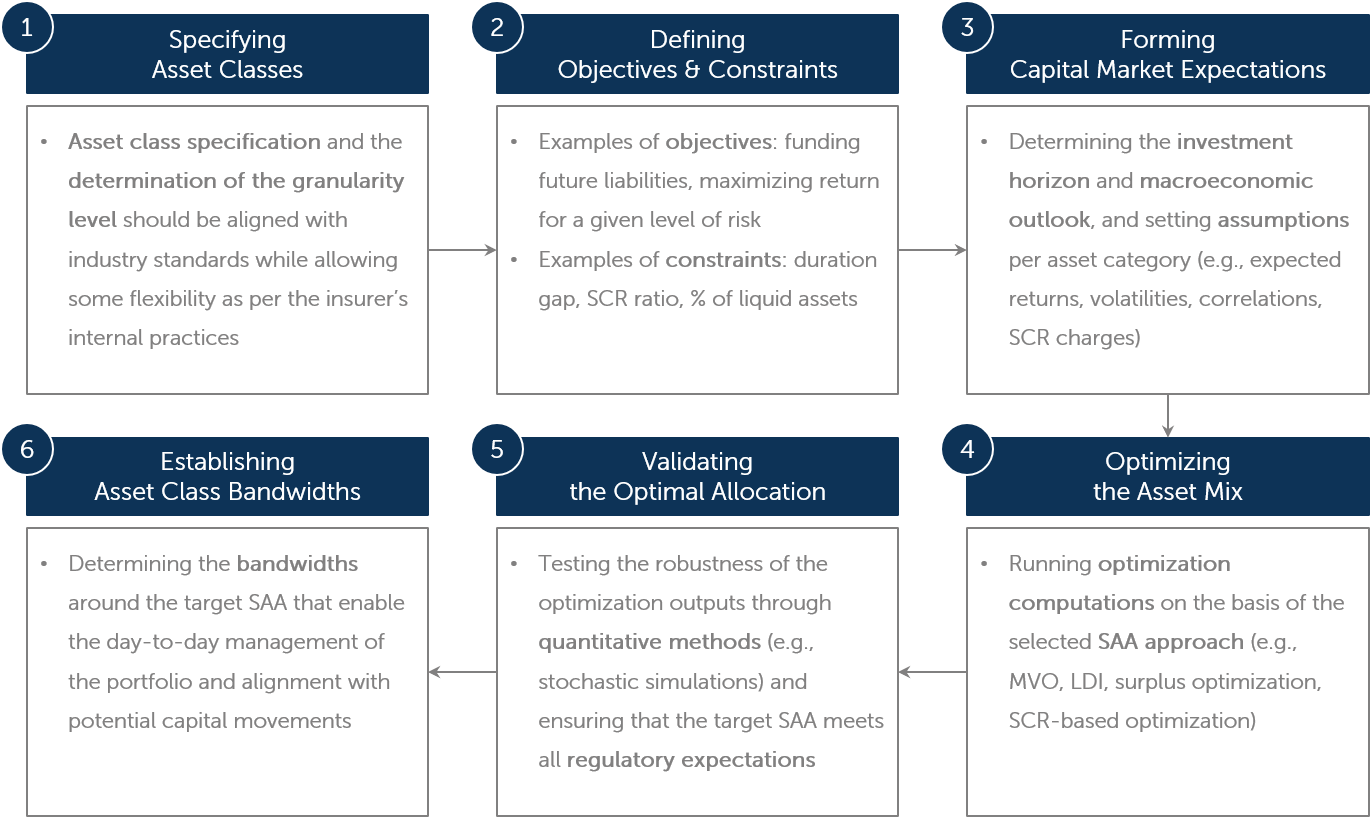
We can group these steps into three logical phases: Setup, Optimization & Analysis, and Implementation.
Phase 1: Setup (Laying the Groundwork)
This phase is arguably the most important, as it defines the entire context for the allocation decision. It combines steps 1 and 2 from the diagram above: "Specifying Asset Classes" and "Defining Objectives & Constraints". It is here that we consider all the factors that will guide the strategy.
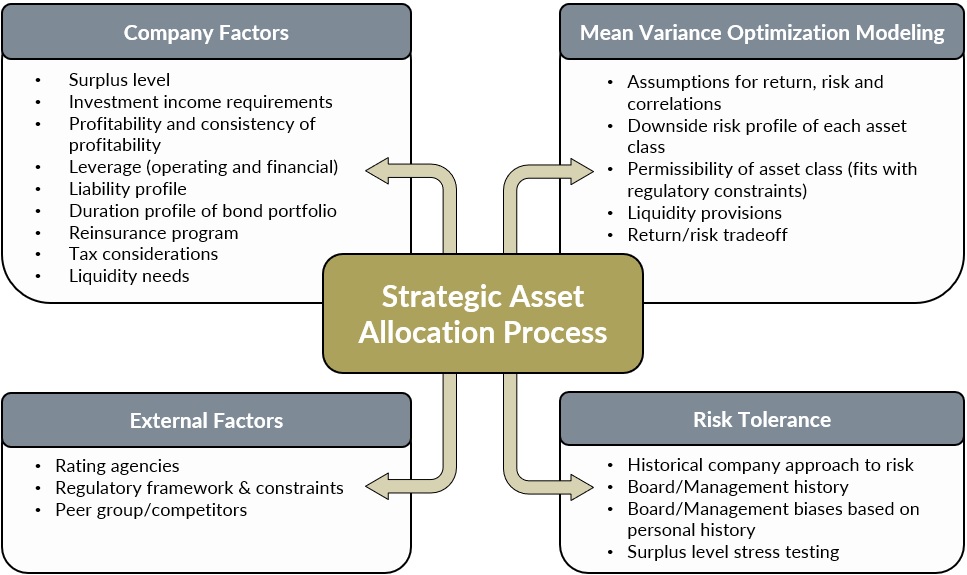
The Conning paper provides an excellent deep-dive into these foundational elements.
[PDF] Strategic Asset Allocation — A Comprehensive Approach - Conning
This section of the Conning paper details the critical inputs for the SAA process.
Please read the entire section titled Time horizon. Pay close attention to the distinctions between the following key inputs: Objectives: What are we trying to achieve? This is the "reward" part of the risk/reward trade-off. For an insurer, this is rarely just "maximize return." More common objectives include maximizing economic value, policyholder surplus, or the present value of future profits. Risk Tolerance: This defines the "risk" part of the trade-off. While standard deviation is a common metric (as we saw in MVO), institutions are also concerned with downside risks, tail events, and impacts on regulatory capital. Constraints: These are hard limits or rules that any proposed strategy must obey. They can be external (regulatory investment limits) or internal (no more than 20% in equities). Strategies that violate a constraint are discarded. Time Horizon: The period over which the strategy is evaluated. A longer horizon generally allows an investor to take on more risk (e.g., in illiquid assets) in pursuit of higher returns. For an insurer or pension fund, this is often linked to the duration of the liabilities.
This phase also involves specifying the asset classes to be considered (e.g., domestic vs. international equity, government vs. corporate bonds, property, infrastructure). The set of permissible asset classes is usually defined in the company's investment policy.
Phase 2: Optimization and Analysis
With the groundwork laid, we move to the analytical core of the SAA process.
1. Forming Capital Market Expectations (CMEs)
This involves developing long-term forecasts for the risk and return characteristics of each asset class. Specifically, you need to estimate:
- Expected returns
- Volatilities (standard deviations)
- Correlations between all pairs of asset classes
Given your background in statistics, you'll recognize this as a significant forecasting challenge. As we learned in the last lesson, these inputs are the Achilles' heel of MVO. In an SAA context, the emphasis is on creating robust, long-term, through-the-cycle estimates, rather than being swayed by recent market fads or "doubling up on tactical views," as the Conning paper wisely cautions.
2. Optimizing the Asset Mix
This is where MVO or, more likely, a more sophisticated Asset-Liability Model (ALM) comes into play. The model takes the CMEs and the defined constraints and generates an efficient frontier—not of assets alone, but of strategies that balance the institution's assets against its liabilities.
The goal is to find portfolios that best meet the stated objectives for a given level of risk. This is a much richer problem than the asset-only MVO we previously discussed. It directly incorporates the institution's primary purpose: to meet its obligations.
3. Validating the Optimal Allocation
The output of an optimizer is not the final answer. It is a candidate strategy that must be rigorously tested. Validation typically involves stochastic modeling (e.g., Monte Carlo simulations) to project the portfolio's performance under thousands of possible future economic scenarios. This helps answer critical questions:
- How does the strategy perform in a severe recession?
- What is the probability of failing to meet liability payments?
- What is the impact on regulatory capital requirements in extreme scenarios?
This step provides a much deeper understanding of the true risk profile of the strategy, far beyond a single variance figure.
Phase 3: Implementation
Once a strategy has been selected and validated, the final phase involves documenting and implementing it.
1. Formulating the SAA and Establishing Bandwidths
The final SAA is documented as a set of target percentages for each asset class (e.g., 50% Equity, 40% Bonds, 10% Property).
Crucially, these targets are accompanied by policy bandwidths or ranges (e.g., Equity: 45%-55%). These bands serve two purposes:
- They allow for practical day-to-day management without triggering a rebalance for every minor market movement.
- They define the "playing field" for any Tactical Asset Allocation (TAA) tilts the investment manager might be permitted to make.
2. Monitoring and Review
An SAA is not static forever. It should be reviewed periodically (e.g., every 1-3 years) or when there is a significant change in the company's objectives, liabilities, risk tolerance, or in the long-term capital market outlook.
SAA in Practice: A Pension Fund Example
To make this process more concrete, let's consider how a modern pension fund might approach SAA. The traditional 60/40 equity/bond portfolio is being replaced by a more sophisticated liability-driven approach. A paper from Vanguard illustrates this well.
[PDF] Revisiting pension asset allocation | Vanguard
This paper details a modern, liability-aware approach to SAA for defined benefit pension plans.
First, read the section Addressing key risks. This introduces the idea that a pension fund's SAA isn't just one number (the equity/bond split) but three distinct targets: Return-seeking asset allocation: The portion of the portfolio in growth assets (like equities) needed to generate returns. Interest rate hedge ratio: The degree to which the asset portfolio is designed to mimic the interest rate sensitivity of the pension liabilities. This is a direct ALM concept. Credit spread hedge ratio: A further refinement to hedge the risk that the credit spreads on the corporate bonds used to value liabilities change. Next, read the section on dynamic SAA, titled Determine when asset allocation should change. This introduces the concept of a glide path, where the SAA targets automatically change as the plan's funding status improves. This is a pre-programmed de-risking strategy, moving from return-seeking to liability-hedging assets over time.
This glide path concept is a powerful example of a "rules-based" SAA that adapts over time based on the evolution of the plan's own financial position, removing emotional or biased decision-making during market fluctuations.
Conclusion
The formulation of a Strategic Asset Allocation is a far-reaching process that sits at the heart of institutional investment management. It transcends the mechanics of an optimizer and embeds the investment strategy within the broader business context of objectives, liabilities, risk tolerance, and constraints.
We've seen that SAA is a disciplined, multi-stage process involving careful setup, sophisticated analysis, and robust validation. While quantitative tools like MVO play a role in the optimization phase, the final allocation is ultimately shaped by the strategic needs of the institution and a deep understanding of the risks it faces, particularly the risk of failing to meet its promises to policyholders or pension members.
In our next lesson, we will explore the decision that follows the establishment of an SAA: how to implement it. We will compare active versus passive investment management and discuss the role of the investment mandate in instructing the managers who will execute the strategy.
Key Takeaways & Cheatsheet
Here is a summary framework of the Strategic Asset Allocation process, designed for your CP1 exam revision.
| Phase | Step | Key Activities & Considerations |
|---|---|---|
| Phase 1: Setup | 1. Define Objectives & Constraints | • Objectives: Specify goals (e.g., maximize surplus, meet liability cashflows, achieve a target return on capital). This is the "reward". • Risk Tolerance: Define risk appetite (e.g., limit on surplus volatility, VaR limits, acceptable probability of ruin). This is the "risk". • Constraints: Identify all hard limits (e.g., regulatory rules, liquidity needs, internal investment policy, ethical considerations). • Time Horizon: Establish the strategic period, often linked to liability duration. |
| 2. Specify Asset Classes | • Define the universe of permissible investments (e.g., equities, bonds, property, alternatives). Determine the required granularity (e.g., domestic vs. foreign). | |
| Phase 2: Analysis | 3. Form Capital Market Expectations (CMEs) | • Develop long-term, forward-looking forecasts for returns, volatilities, and correlations for all asset classes. Avoid being biased by short-term market noise. |
| 4. Model & Optimize | • Use an appropriate model (MVO for asset-only, but more likely a full Asset-Liability Model for an insurer/pension). • Generate an efficient frontier of potential strategies that satisfy all constraints. |
|
| 5. Select & Validate | • Select a candidate strategy from the frontier based on the institution's risk/reward objectives. • Stress-test the selected SAA using stochastic simulations to understand its behavior under a wide range of scenarios (especially adverse ones). |
|
| Phase 3: Implementation | 6. Finalize & Document | • Formally document the target SAA weights. • Establish policy bandwidths (e.g., +/- 5%) around each target to allow for practical management and tactical tilts. • Consider dynamic elements like a glide path to pre-define future SAA changes based on triggers like funding level. |
| 7. Monitor & Review | • Regularly monitor portfolio performance and risk exposure against the SAA. • Schedule periodic reviews (e.g., every 1-3 years) or ad-hoc reviews if major changes occur to the business or markets. |