Introduction
In our last lesson, we established that diversification is the cornerstone of modern portfolio construction. By combining assets that are not perfectly correlated, we can build portfolios that offer a better risk-return trade-off. This principle gives rise to the Efficient Frontier—the set of all portfolios offering the highest possible return for a given level of risk.
Today, we delve into Mean-Variance Optimization (MVO), the Nobel Prize-winning framework developed by Harry Markowitz to mathematically identify the optimal portfolio on that frontier. MVO provides the engine for turning the abstract principle of diversification into a concrete asset allocation.
However, the primary goal of this lesson is not just to understand MVO, but to critique its use in practical asset-liability management. As you know from your background in statistics, a model is only as good as its assumptions and its inputs. We will scrutinize MVO through this lens, exploring why this theoretically elegant framework often falls short in the complex and uncertain world of real-world investing. This critical perspective is essential for any actuary involved in setting investment strategy.
The Theory of Mean-Variance Optimization
At its heart, MVO is a quantitative process that seeks to build the "best" portfolio from a universe of available assets. It takes a set of forecasts as inputs and produces a specific set of asset weights as an output.
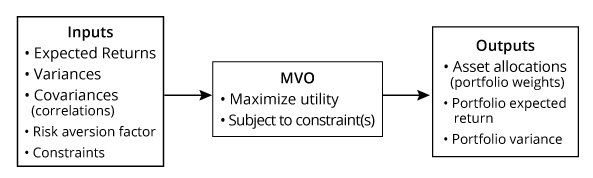
The objective can be framed in several equivalent ways:
- Minimize portfolio variance (risk) for a target level of expected return.
- Maximize expected return for a target level of variance (risk).
- Maximize a utility function that balances expected return and risk, penalized by a specific risk aversion factor.
Your CM-level studies covered the mathematics of this, which involves solving a quadratic programming problem to trace out the efficient frontier. The ultimate goal is to find the single "optimal" portfolio for an investor. If a risk-free asset exists, this is the "tangency portfolio" on the efficient frontier, which can then be combined with the risk-free asset to match the investor's specific risk tolerance.

The theoretical elegance of MVO is undeniable. It provides a rigorous, analytical framework for portfolio construction. But under what conditions is it truly "optimal"? The following video explains the two key theoretical justifications.
This lecture from MIT OpenCourseWare discusses the theoretical underpinnings of MVO in the context of utility theory.
Please watch the segment from this section. The key takeaway is that mean-variance analysis is theoretically justified under two main conditions: The investor has a quadratic utility function. Asset returns follow a Gaussian (normal) distribution. Focus on understanding why these conditions make it sufficient to only consider mean and variance, ignoring all other aspects of the return distribution.
This brings us to our first major point of critique. Do these conditions hold in the real world? For most investors, utility is more complex than a simple quadratic function. More importantly, as you'll appreciate from your statistical background, financial asset returns are famously not normally distributed. They exhibit "fat tails" (kurtosis) and asymmetry (skewness), meaning extreme events are more common than a normal distribution would suggest. When these foundational assumptions are violated, MVO is no longer guaranteed to produce a truly optimal portfolio.
Critique 1: The Input Problem — "Garbage In, Garbage Out"
The most severe practical limitation of MVO is its extreme sensitivity to its inputs. The framework requires three key inputs for every asset: expected return, volatility (variance), and correlation with every other asset. While volatilities and correlations tend to be relatively stable over time, expected returns are notoriously difficult to forecast.
The problem is that MVO treats these inputs, particularly the expected returns, as precise and certain truths. In reality, they are noisy estimates. MVO then acts as an "error maximizer": it will heavily overweight assets with slightly higher estimated returns and underweight or even short those with slightly lower ones, amplifying the impact of small estimation errors.
The following video provides a powerful demonstration of this instability.
Black-Litterman vs. Mean-Variance Portfolio Optimization (MVO) in Python
This video from Roman Paolucci critically examines the practical failures of MVO.
First, watch the segment from this part, where the presenter explains why using historical returns as a proxy for future returns is so problematic. Pay close attention to the experiment where adding a tiny amount of noise to the inputs causes the "optimal" portfolio allocation to change dramatically. Then, watch the very short follow-up from the next segment, which shows how a portfolio optimized on historical data performs poorly out-of-sample. This is a classic symptom of overfitting.
This overfitting to historical noise leads to portfolios that are not robust and often disappoint in the future. The AQR paper, a leading voice in quantitative investing, describes this as a primary pitfall.
[PDF] Alternative Thinking | Strategic Portfolio Construction
This paper from AQR provides a practitioner's critique of MVO.
First, read the paragraph in the introduction starting here. It immediately flags estimation error in expected returns as a serious problem. Then, jump to the Appendix and read the section on Estimation errors. This reinforces the point that portfolio weights are especially sensitive to expected return inputs and that using simple historical averages is a "recipe for trouble."
Critique 2: The Model Problem — An Oversimplified World
Beyond the input problem, the MVO model itself is an oversimplification of reality. This is what the AQR paper refers to as "model error."
Unrealistic Outputs and the Dominance of Constraints
When used without constraints, MVO often produces allocations that are nonsensical or unacceptable for a real-world institutional investor.
- Extreme Concentrations: It might allocate 100% to a single asset class or suggest shorting major asset classes like equities to fund positions in others.
- Love of Illiquidity: MVO can be naively attracted to alternative assets like private equity. These assets often report artificially smooth returns (due to infrequent valuation), which leads to an underestimation of their true volatility and correlation. The optimizer sees a high Sharpe ratio and may suggest extreme allocations.
Let's see an example of this from the AQR paper.
[PDF] Alternative Thinking | Strategic Portfolio Construction
This section of the AQR paper demonstrates how MVO behaves when illiquid "endowment alternatives" are added to the mix.
Read the section titled Choice 3: Liquid vs. Illiquid. Note how the optimizer, for a 10% volatility target, allocates 100% to these alternatives and, when unconstrained, suggests shorting public equities to leverage this position even further. This is a clear example of an impractical and potentially dangerous output.
Because of these unrealistic outputs, practitioners are forced to apply numerous constraints to the optimization process, such as:
- Long-only (no short-selling)
- Maximum and minimum weights for asset classes
- Turnover limits
- Tracking error limits relative to a benchmark
The critique here is subtle but important: the final portfolio is often driven more by the constraints than by the optimization itself. The MVO process becomes less about discovering an optimal allocation and more about finding a portfolio that fits within a pre-defined set of boundaries.
A Narrow View of Risk
The model's reliance on variance as the sole measure of risk is another significant simplification. Institutional investors are concerned with a much broader range of risks that MVO ignores:
- Liquidity Risk: The risk of not being able to sell an asset quickly without a significant price discount.
- Tail Risk: The risk of rare but extreme negative events (as discussed, financial returns have fat tails).
- Regime Changes: The risk that the underlying economic environment changes, altering correlations and returns in ways not captured by historical data.
- Asset-Liability Mismatch: For an insurer or pension fund, the primary risk is often the failure to meet future liabilities. MVO is an asset-only framework; it does not explicitly incorporate the nature of the liabilities.
Making MVO Work: A Tool, Not a Panacea
Despite these severe critiques, MVO is not dismissed in practice. Instead, its role is reframed. It is not a crystal ball that provides a definitive answer, but rather a powerful tool that provides structure and insight within a broader decision-making process.
Strategic Asset Allocation: 6 Practical Frameworks for Better Decisions
This short article provides a balanced perspective on MVO's practical role.
Please read the section on Mean-Variance Optimization. The key message is to focus on MVO's strengths—providing structure and analytical rigor—while being acutely aware of its weaknesses. The final sentence sums it up well: "Used wisely, it can be a powerful guide..."
Practitioners use MVO to:
- Enforce Discipline: It forces a systematic consideration of the trade-offs between risk and return.
- Understand Assumptions: It makes the impact of different capital market assumptions explicit. Running the optimizer with different return forecasts can reveal how sensitive the allocation is to those views.
- Provide a Baseline: The MVO result can serve as a quantitative starting point, which is then adjusted based on qualitative judgment, liability considerations, and risks outside the model.
To address its instability, more advanced techniques like Resampled MVO and the Black-Litterman model have been developed. These methods are beyond the CP1 syllabus, but they exist to make the outputs more stable and to formally incorporate an investor's subjective views, partially mitigating the "garbage in, garbage out" problem.
Conclusion
We have seen that Mean-Variance Optimization is a foundational but flawed framework. Its theoretical elegance, based on simplifying assumptions of normal returns or quadratic utility, clashes with the messy reality of financial markets.
Its primary weaknesses are its extreme sensitivity to input errors (especially expected returns), leading to unstable and non-robust portfolios, and its simplistic model of the world, which ignores crucial risks like illiquidity and produces impractical allocations without heavy-handed constraints.
Therefore, the role of MVO in modern asset-liability management is not as an infallible oracle, but as a disciplined component within a larger, more judgmental process. It provides a valuable starting point for conversation and analysis, but the final strategic asset allocation must be shaped by a broader understanding of liabilities, investor constraints, and the rich tapestry of risks that exist beyond mean and variance.
In our next lesson, we will look at this broader process by examining how a Strategic Asset Allocation (SAA) is formulated, a process in which MVO plays a role but does not have the final word.
Key Takeaways & Cheatsheet
Here is a summary of our critique of Mean-Variance Optimization, structured for your review.
| Aspect | The Promise of MVO | The Practical Critique |
|---|---|---|
| Core Idea | A rigorous, mathematical framework to find the "optimal" portfolio on the efficient frontier. | A model is only as good as its assumptions and inputs. |
| Inputs | Uses expected returns, volatilities, and correlations to make decisions based on data. | Estimation Error: Extremely sensitive to inputs, especially expected returns. Acts as an "error maximizer," amplifying noise and leading to unstable, non-robust portfolios that perform poorly out-of-sample. |
| Assumptions | Theoretically optimal if returns are normally distributed or investors have quadratic utility. | Model Error: Neither assumption holds in reality. Financial returns have "fat tails," and investors care about more than just mean and variance (e.g., liquidity, tail risk). |
| Outputs | Identifies the single best portfolio to hold, maximizing the risk-return trade-off. | Unrealistic Allocations: Unconstrained MVO often produces extreme portfolios (e.g., 100% in one asset, large short positions) that are impractical for institutional investors. |
| Risk | Provides a clear definition of risk as the variance (or standard deviation) of portfolio returns. | Narrow View of Risk: Ignores other critical risks like liquidity risk, tail risk, and the specific nature of an institution's liabilities. |
| Practical Role | A definitive tool for asset allocation. | A tool, not a crystal ball. Used as a disciplined starting point for analysis, to be heavily constrained and supplemented with qualitative judgment. |