Introduction
In our last lesson, we explored immunization, a powerful technique for protecting a fund's surplus against a specific risk: parallel shifts in the interest rate curve. This strategy is precise but narrow, focusing on managing the relationship between assets and liabilities with respect to a single risk factor. Today, we will broaden our perspective to address the multitude of risks inherent in any investment portfolio.
This lesson introduces the principle of diversification, a cornerstone of modern portfolio theory. You likely know the adage, "don't put all your eggs in one basket." We will translate this simple wisdom into a robust framework for portfolio construction. We will explore how combining different assets can reduce overall risk without necessarily sacrificing returns. Your background in probability theory will be especially useful here, as the benefits of diversification are mathematically rooted in the concept of correlation.
By the end of this lesson, you will be able to explain the fundamental role of diversification in building resilient and efficient investment portfolios, setting the stage for our next topic, where we will formalize these ideas into the theory of mean-variance optimization.
Unsystematic vs. Systematic Risk: The Two Faces of Risk
The first crucial step in understanding diversification is to differentiate between two fundamental types of risk. Not all risk is created equal, and not all risk can be managed in the same way.
-
Unsystematic Risk: Also known as specific or idiosyncratic risk, this pertains to a single company, industry, or security. Examples include a key product failing, a factory fire, a management scandal, or a poor earnings report. These events are "specific" to the asset. The key feature of unsystematic risk is that it can be significantly reduced or even eliminated through diversification. By holding a wide variety of assets, the impact of a single negative event becomes negligible for the portfolio as a whole.
-
Systematic Risk: Also known as market risk, this is risk that affects the entire market or a large segment of it. Examples include recessions, changes in interest rates, geopolitical conflicts, or inflation shocks. This type of risk cannot be avoided by adding more assets to your portfolio, because all assets are affected to some degree.
The image below provides a clear summary of the distinctions between these two types of risk.

The core idea of diversification is to eliminate the 'un-rewarded' unsystematic risk. The Capital Asset Pricing Model (CAPM), which you will have studied in CM1, posits that investors are not compensated for taking on unsystematic risk, precisely because it can be easily diversified away. The market only rewards investors for bearing systematic risk, which is unavoidable.
The Mathematics of Diversification: The Power of Correlation
How does adding more assets reduce risk? The answer lies in the statistical relationship between their returns, specifically their correlation.
Let's consider a simple portfolio with two assets, A and B. The variance of the portfolio's return (), which is our measure of risk, is given by the formula:
Where:
- and are the weights of the assets in the portfolio.
- and are the variances of the individual assets.
- is the correlation coefficient between the returns of asset A and asset B.
The crucial term is the last one. The correlation coefficient, , measures how the two assets move together.
- If (perfect positive correlation), the assets move in perfect lockstep. In this case, there is no reduction in risk from diversification. The portfolio's risk is simply the weighted average of the individual asset risks.
- If , the assets do not move perfectly together. The portfolio's variance will be less than the weighted average of the individual variances. This reduction in risk is the diversification benefit.
- The lower the correlation (ideally, negative), the greater the diversification benefit. If (perfect negative correlation), it's theoretically possible to construct a portfolio with zero risk.
The following graph beautifully illustrates this principle. It shows how the proportional reduction in a portfolio's volatility changes as you add more assets, depending on the average correlation between them.
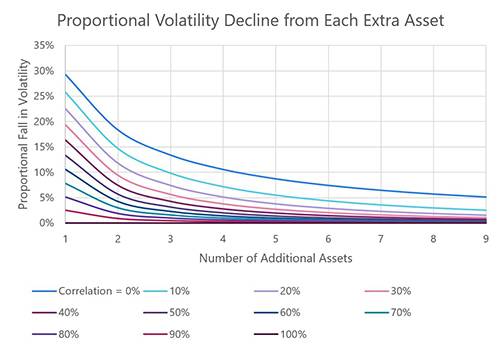
As you can see, the biggest risk reduction comes from the first few assets you add. As you add more and more, the marginal benefit decreases, and the total portfolio risk approaches the level of undiversifiable systematic risk.
From Diversification to the Efficient Frontier
The principle of diversification leads directly to one of the most important concepts in finance: the Efficient Frontier.
When we combine assets with different expected returns, risks (variances), and correlations, we create a universe of possible portfolios. Each point in this universe represents a portfolio with a specific risk and return combination.
The video below offers a simple and clear explanation of how diversification causes the risk-return trade-off to "bend," creating a set of superior portfolios.
Mean Variance Portfolio Theory Simply Explained
This video, "Mean Variance Portfolio Theory Simply Explained" from MJ the Fellow Actuary, provides a high-level introduction to how diversification works.
Please watch from the beginning to the end of the explanation. Focus on the key insight: because assets are not perfectly correlated, combining them reduces portfolio variance, causing the straight line of risk-return possibilities to bend. This bend creates portfolios that offer a better outcome (less risk for the same return, or more return for the same risk).
This "bend" is the diversification benefit in action. The outer edge of this curve of possible portfolios is called the Efficient Frontier. It represents the set of portfolios that are "optimal" in the sense that they offer the highest possible expected return for any given level of risk. A rational investor would only ever choose a portfolio that lies on this frontier.
To see how this frontier is constructed from a set of individual assets, let's watch a more detailed walkthrough.
Efficient Frontier and Portfolio Optimization Explained | The Ultimate Guide
This video, "Efficient Frontier and Portfolio Optimization Explained," by Ryan O'Connell, CFA, FRM, provides a more in-depth look at the concept.
First, watch the two-asset example from this section. It clearly demonstrates how combining two stocks with less-than-perfect correlation allows you to achieve the same return with less risk. Next, watch the segment from this part, which expands the concept to multiple assets. The key takeaway is how thousands of possible portfolio combinations form a "cloud" of possibilities, and the Efficient Frontier is the upper-left boundary of this cloud.
Diversification in Practice
For institutional investors like insurers and pension funds, diversification is not just a theoretical concept; it is a fundamental practice applied at multiple levels.
[PDF] Subject CP1 - CMP Upgrade 2021/22 - Actuarial Education
This document from ActEd provides a practical overview of diversification for institutional investors, directly relevant to the CP1 exam.
First, read the section on <span data-type="resource_reading_textrange" data-resource-subitem-id="e92c700a" data-range-start="Assets are diversified if" data-range-end="reduce overall risk.">diversification for institutions. This summarises why the covariance of a new asset with the existing portfolio is so important. Then, review the question and solution under that section, which provides excellent, concrete examples of diversifying within asset classes such as domestic equities, overseas equities, and fixed-interest bonds.
As the ActEd notes explain, diversification occurs both between and within asset classes:
- Between Asset Classes: A typical institutional portfolio will hold a mix of equities, bonds, property, cash, and alternative assets (like infrastructure or private equity). These broad categories have different risk-return profiles and react differently to economic events.
- Within Asset Classes:
- Equities: Investing in different industries (technology, healthcare, energy), countries (UK, US, emerging markets), and company sizes (large-cap, small-cap).
- Bonds: Holding a mix of government and corporate bonds, with varying maturities and credit qualities.
- Property: Owning different types of property (office, retail, industrial, residential) in various geographic locations.
For an insurer, diversification takes on an even broader meaning. It includes managing the relationship between different types of risk across the entire enterprise.
[PDF] Diversification Consideration on Modelling Aspects & Related ...
This paper from the Chief Risk Officer (CRO) Forum discusses diversification from an insurer's perspective. It's a technical paper, but the introduction contains valuable conceptual points.
Please read the section titled Introduction to diversification. Focus on the different diversifying strategies listed, which go beyond just financial assets.
As highlighted in the CRO Forum paper, an insurer's diversification strategies include:
- Pooling similar risks: The very basis of insurance, aggregating thousands of independent house or car insurance policies.
- Pooling dissimilar risks: Writing different lines of business (e.g., motor, property, liability) in different geographic markets.
- Combining opposite risks: This is a particularly insightful actuarial strategy. For example, an insurer might sell both life annuities (where the risk is people living longer than expected - longevity risk) and term life assurance (where the risk is people dying sooner than expected - mortality risk). These risks act as a natural hedge against each other.
The Limits of Diversification
While powerful, diversification is not a silver bullet. It's crucial to understand its limitations.
The most significant limitation is that correlations are not stable. During periods of extreme market stress, such as the 2008 financial crisis or the COVID-19 crash, correlations between seemingly different asset classes can suddenly increase and converge towards +1. In a crisis, everything tends to fall together. This means that diversification benefits can evaporate precisely when they are needed most.
[PDF] Diversification Consideration on Modelling Aspects & Related ...
Let's revisit the CRO Forum paper to understand the challenges of modeling these dependencies.
Read the section on Modelling dependence. The key takeaway is the discussion on the drawbacks of using a single linear correlation figure and how dependencies can change drastically, especially in "tail events" or stressed market conditions.
Other challenges include:
- Diworsification: Adding more and more assets to a portfolio without a clear understanding of their underlying risk drivers can lead to excessive complexity and costs, without providing meaningful risk reduction. The portfolio may simply end up mimicking a market index but with higher fees.
- Quantification: Reliably estimating future correlations, especially in the "tails" of the distribution (i.e., during extreme events), is exceptionally difficult. This relies heavily on expert judgment and sophisticated modeling, which can itself be a source of risk.
Conclusion
In this lesson, we have unpacked the vital role of diversification in portfolio construction. We moved from the simple idea of not putting all your eggs in one basket to a more structured understanding of risk and return. We saw that the primary function of diversification is to eliminate firm-specific, or unsystematic, risk, for which investors are not rewarded. The residual market-wide, or systematic, risk is the risk that cannot be diversified away.
The "magic" of diversification is unlocked by combining assets with low or negative correlation. This allows for the construction of portfolios that have lower overall risk than the simple sum of their parts, a phenomenon that gives rise to the Efficient Frontier. However, we also noted the practical limitations, chiefly that the benefits of diversification can diminish during severe market crises when correlations spike.
In our next lesson, we will build directly on these concepts. We will explore Mean-Variance Optimization, the mathematical framework developed by Harry Markowitz that uses the principles of diversification to formally identify the optimal portfolio on the Efficient Frontier for a given investor's risk tolerance.
Key Takeaways & Cheatsheet
| Concept | Description | Key Implication |
|---|---|---|
| Unsystematic Risk | Risk specific to an individual asset or company (e.g., poor earnings, factory disaster). | Can be eliminated through diversification. Investors are not compensated for taking this risk. |
| Systematic Risk | Risk that affects the entire market (e.g., recession, interest rate changes). | Cannot be eliminated through diversification. This is the risk that generates expected returns. |
| Correlation | A statistical measure of how two assets' returns move in relation to each other. Ranges from -1 to +1. | The lower the correlation between assets in a portfolio, the greater the risk-reduction benefit from diversification. |
| Efficient Frontier | The set of optimal portfolios that offer the highest expected return for a defined level of risk. | A direct consequence of the diversification benefit. Rational investors should only hold portfolios on the frontier. |
| Practical Diversification | Spreading investments between different asset classes (stocks, bonds) and within asset classes (sectors, geographies). | Reduces exposure to any single source of risk. Insurers also diversify by pooling different types of insurance risk. |
| Limits of Diversification | Correlations tend to increase during market crises, reducing diversification benefits when they are most needed. | Diversification is not a guarantee against losses, especially during systemic events. |