Welcome to your third lesson in the General Insurance and Reinsurance module. In our last session, we explored the world of personal lines, focusing on the features and underwriting of products designed for individuals, like home and auto insurance. We saw how insurers manage large volumes of relatively similar risks through standardized products and increasingly automated underwriting processes.
Today, we pivot to the other side of the market: commercial lines. This is the insurance that protects businesses, from a small local bakery to a multinational corporation. Your task for this lesson is to learn how to describe the key features and underwriting considerations for these products. While the fundamental principles of insurance remain the same, you will see that insuring a business introduces a new level of complexity, diversity, and required expertise. The risks are more varied, the coverages more specialized, and the underwriting process far more hands-on.
From Individuals to Businesses: A Shift in Perspective
The primary difference between personal and commercial lines lies in the nature of the policyholder. A business entity has a far wider and more complex range of potential risks than an individual. These can include everything from a fire destroying a factory, to a lawsuit from a faulty product, to liability for employee injuries.
Because of this diversity, commercial insurance is often structured in a modular way. For smaller, more standard businesses, insurers offer a Business Owner's Policy (BOP), which, much like a homeowners policy, packages property and liability insurance into a single product. For larger or more complex businesses, the insurer will often construct a Commercial Package Policy (CPP), allowing the business to pick and choose from various "coverage parts" or "modules" to create a policy tailored to its specific needs.
Let's begin with a short video that introduces this modular concept.
The video "Commercial Coverage" by instructor Lauren Myers introduces the idea of the Commercial Package Policy and its flexible structure.
Please watch the first minute, from this introduction. Pay attention to the interchangeable terms used: "Commercial Package Policy" (CPP) vs. "commercial modular policy," and "coverage parts" vs. "coverage modules." This highlights how a business can build a custom policy.
Core Commercial Lines Products
While there are countless specialized commercial products, most businesses build their insurance program around three core coverage types: Commercial Property, Commercial General Liability, and Commercial Auto.
1. Commercial Property Insurance
This coverage protects the physical assets of a business against loss or damage from a covered peril. The main components are:
- Building Coverage: Protects the physical structures the business owns.
- Business Personal Property (BPP): Covers property owned by the business that is not part of the building itself. This includes furniture, machinery, inventory, and computers.
- Property of Others: Covers property that is in the business's care, custody, or control.
A key feature of commercial property policies is the use of Cause of Loss forms, which specify the perils the policy covers. There are three standard forms:
- Basic Form: Covers a short list of named perils, such as fire, lightning, and explosion.
- Broad Form: Includes all Basic Form perils plus a few additional ones, like falling objects and weight of ice and snow.
- Special Form: This is an "all-risk" or "open perils" policy. It covers everything except what is specifically excluded. This provides the most comprehensive coverage.
Commercial property policies also often include Business Income and Extra Expense coverage. These are crucial coverages that protect against the consequential financial losses that follow physical damage.
- Business Income Coverage: Replaces lost profits and covers continuing expenses (like payroll) if a business has to shut down due to a covered loss.
- Extra Expense Coverage: Covers additional costs incurred to resume operations as quickly as possible, such as renting a temporary location or equipment.
The following video segment provides a more detailed breakdown of these property coverages.
This segment from "Commercial Coverage" delves into the specifics of commercial property and related income coverages.
Please watch two parts of this video: First, watch the section on property coverage forms. This explains the Basic, Broad, and Special forms and the perils they cover. Then, skip forward and watch the segment on business income and extra expense. Note the distinction between them and the waiting period (deductible) that applies to business income.
2. Commercial General Liability (CGL) Insurance
CGL is the cornerstone of a business's liability protection. It defends the business against claims that its operations, products, or advertising caused bodily injury or property damage to a third party.

The main CGL coverages are:
- Coverage A: Bodily Injury and Property Damage Liability: This is the core of the policy. It covers liability arising from injuries to customers on the premises (e.g., a slip and fall) or damage caused by the company's operations.
- Coverage B: Personal and Advertising Injury Liability: This covers non-physical injuries, such as libel, slander, copyright infringement, or false arrest.
- Coverage C: Medical Payments: Similar to personal lines, this provides small, no-fault payments for medical expenses of people injured on the business's premises, often to prevent larger lawsuits.
For a clear overview of what CGL covers and, just as importantly, what it doesn't, the next video is an excellent resource.
General Liability Insurance Explained in 10 Minutes
The video "General Liability Insurance Explained" from The Coyle Group provides a concise and practical overview of CGL insurance.
Please watch the segment from this detailed explanation. Focus on: The three key areas of protection: bodily injury, property damage, and personal/advertising injury. The examples provided for premises, operations, and completed products liability. The list of common exclusions. Understanding what is not covered (like auto liability or employee injuries) is critical to seeing how different commercial policies fit together.
Occurrence vs. Claims-Made Policies
A critical distinction in liability insurance, especially in commercial lines, is the policy trigger. This determines which policy responds to a claim.
- Occurrence Policy: The policy in effect when the incident occurred pays the claim, regardless of when the claim is filed. This is common for risks where the injury is immediately apparent, like a slip and fall.
- Claims-Made Policy: The policy in effect when the claim is made pays the claim, provided the incident happened after a specified "retroactive date." This form is used for risks where the injury may not be discovered for years, such as in professional liability (e.g., an architect's design flaw) or for certain environmental risks.
From a statistical perspective, the claims-made form helps insurers manage the uncertainty of long reporting lags. It reduces the risk of having to pay a claim many years in the future at a cost determined by unforeseen levels of inflation or legal precedent.
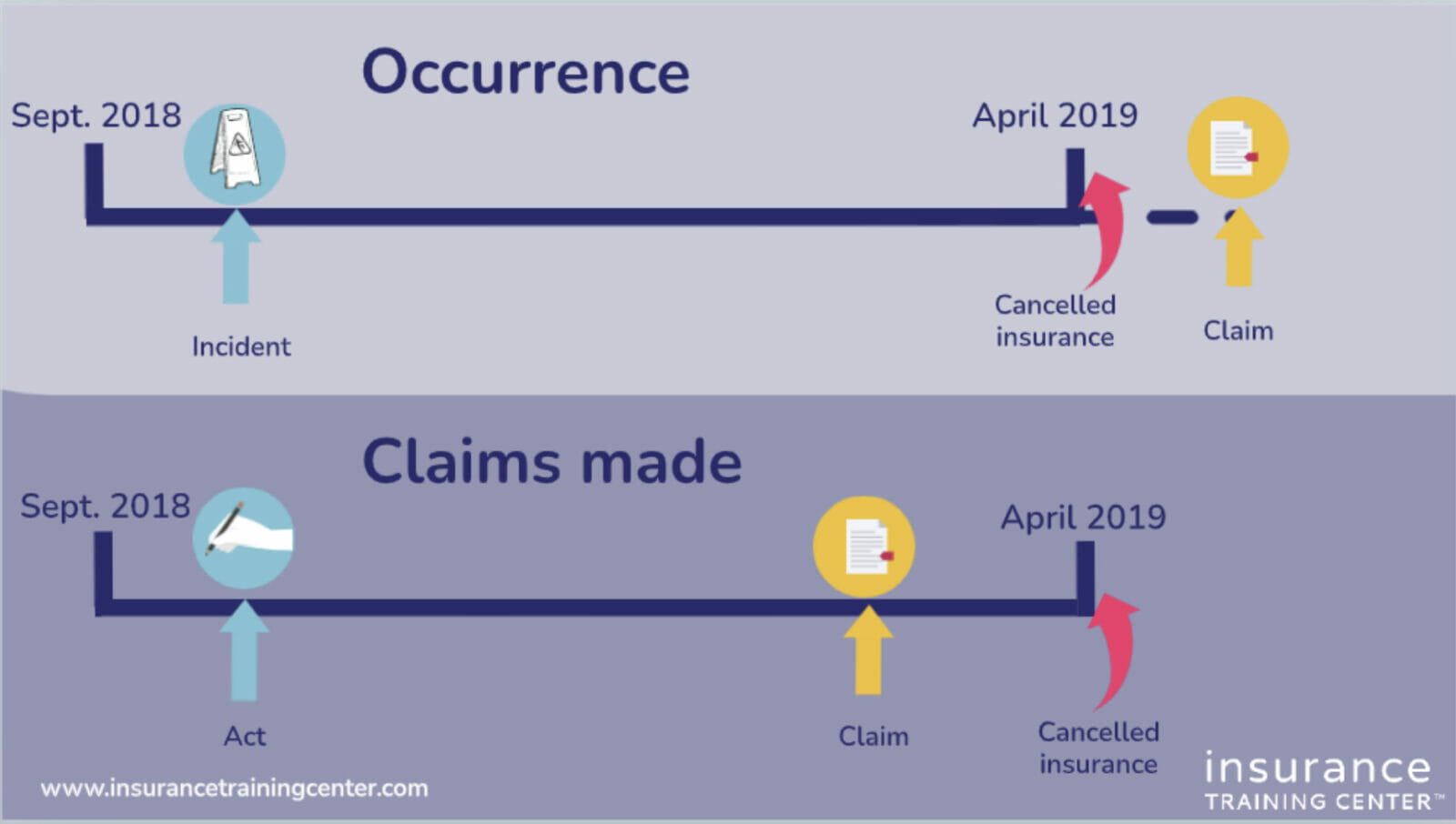
To solidify this concept, let's return to the "Commercial Coverage" video.
This segment explains the structure of a CGL policy and then contrasts the two policy forms.
Please watch the part of the video covering Commercial General Liability. Pay close attention to the explanation of occurrence-made versus claims-made policies.
3. Commercial Auto Insurance
This policy covers vehicles used by the business. Structurally, it is similar to a personal auto policy, providing liability, physical damage, and other coverages. The unique feature of the commercial auto policy is its use of numerical "symbols" to define what types of vehicles are covered. This provides flexibility for businesses with different vehicle ownership and usage patterns.
For example:
- Symbol 1 (Any Auto): Provides the broadest coverage, including vehicles the business owns, hires, or borrows.
- Symbol 7 (Specifically Described Autos): Covers only the vehicles specifically listed in the policy.
- Symbol 8 (Hired Autos): Covers vehicles the business rents, leases, or borrows.
- Symbol 9 (Non-Owned Autos): Covers the business's liability when employees use their own cars for company business (e.g., a salesperson visiting clients).
The video below explains these symbols clearly.
This part of the "Commercial Coverage" video focuses on commercial auto symbols.
Please watch the segment from on auto symbols. The instructor uses helpful mnemonics to remember what each key symbol represents.
The Underwriting of Commercial Lines
Underwriting a commercial risk is a more complex and analytical process than for personal lines. The goal is the same—to select and price risks profitably—but the heterogeneity of businesses means that underwriters must perform a deep, bespoke analysis of each applicant.
An underwriter for a commercial risk acts like a detective, gathering information from multiple sources to build a complete picture of the applicant's potential for loss.
Key Underwriting Considerations & Information Sources:
- Nature of the Business: What does the business do? A software company has very different risks from a construction contractor or a restaurant. Underwriters use classification systems to group businesses into categories with similar risk profiles.
- Loss History: Past claims are a powerful predictor of future claims. A primary tool for this is the loss run, which is a detailed report of the applicant's claims over the past several years. Given your background in statistics, you can think of this as the raw dataset for the underwriting analysis.
- Financial Stability: A financially healthy company is more likely to invest in safety, maintain its premises, and be a stable, long-term partner. Underwriters will often review financial statements.
- Management Quality and Attitude: Does the management team prioritize safety and risk management? Or do they cut corners? This subjective assessment is a key part of the underwriter's judgment.
- Physical Inspections: For property risks, an underwriter or risk engineer will often physically inspect the premises to assess its condition, fire protection, and safety protocols.
To get a sense of how underwriters formally classify and evaluate different types of businesses, we will look at a real-world underwriting guide.
[PDF] Commercial Lines Underwriting Guide & Procedure Manual
This underwriting manual from Utica First Insurance Company shows how an insurer codifies its risk appetite. The Hazard Grades table is a concrete example of risk classification.
Please review the first few pages of the manual, focusing on the table titled "Hazard Grades". Notice how each business class (e.g., "Apartment Buildings," "Bakery," "Barber Shop") is assigned a hazard grade for different types of risk: Fire, Liability (Liab.), Product (Prod.), etc. Compare the grades for "Bakery - No Baking or Cooking" versus "Bakery - With Cooking." You'll see the fire and liability grades jump, demonstrating how a single operational detail dramatically changes the risk profile. Look at the notes, which often point to specific exclusions or requirements (e.g., "Assault & Battery Exclusion applies" for Bars or Taverns). This illustrates how underwriters modify coverage to accept a risk.
Finally, to understand the data an underwriter uses, let's look more closely at the concept of a loss run. The following article from Milliman, a major actuarial consulting firm, provides a professional-level overview of the data actuaries and underwriters use.
A beginners guide to the casualty actuarial language - Milliman
This article explains the fundamental inputs to an actuarial study, which are the same inputs an underwriter uses to evaluate a risk. It's an excellent primer on the language of commercial insurance data.
Please read the first part of the article, from the beginning down to the end of the section on Exposures. Specifically, focus on the sections: Financial Information: This defines key terms you'll see in a loss run, such as paid loss, case reserve, and incurred loss. As a statistician, you'll recognize this as the core data for any claims analysis. Calendar Dates: This reinforces the importance of the date of loss and date of report, tying back to the occurrence vs. claims-made discussion. Exposures: This explains the concept of an exposure base (e.g., revenue for GL, payroll for Workers' Comp), which is the denominator used to normalize losses and calculate a risk rate.
Conclusion
In this lesson, we have detailed the landscape of commercial lines insurance. We've established that it differs from personal lines due to the complexity and diversity of risks posed by businesses. This leads to more specialized, modular products like the Commercial Package Policy (CPP) and a far more hands-on, analytical underwriting process.
Key Takeaways:
- Product Structure: Commercial insurance is often sold as a package policy (CPP or BOP) that bundles core coverages. The main modules are Commercial Property, Commercial General Liability (CGL), and Commercial Auto.
- Key Features: You should be familiar with the core components of each product line, such as the Cause of Loss forms in property, the distinction between Occurrence and Claims-Made forms in liability, and the use of symbols in auto insurance.
- Underwriting Process: Commercial underwriting is a judgment-based process that relies on a deep analysis of the applicant's specific operations, financial health, management quality, and, crucially, their loss history as detailed in loss runs.
- Risk Classification: Underwriters use a combination of formal business classifications and specific hazard analysis to assess risk and determine the terms and price of coverage.
To help you organize these concepts for your exam preparation, here is a summary framework comparing the core commercial lines products.
| Aspect | Commercial Property | Commercial General Liability (CGL) | Commercial Auto |
|---|---|---|---|
| What it Protects | The business's physical assets (buildings, equipment, inventory). | The business from third-party claims of injury or damage. | Vehicles used by the business. |
| Key Coverages | Building, Business Personal Property (BPP), Business Income, Extra Expense. | Bodily Injury & Property Damage, Personal & Advertising Injury, Medical Payments. | Liability, Physical Damage (Collision/Comp), Uninsured Motorist. |
| Unique Structural Feature | Cause of Loss Forms (Basic, Broad, Special) define covered perils. | Policy Trigger (Occurrence vs. Claims-Made) is a critical distinction. | Symbols (1, 7, 8, 9, etc.) define which vehicles are covered. |
| Primary Risk Source | Perils like fire, theft, windstorm, and resulting business shutdown. | Customer injuries, faulty products, operational accidents, libel/slander. | Vehicle accidents, driver behavior, theft of vehicles. |
| Key Underwriting Data | Building construction, fire protection, location, inventory type, security systems. | Nature of operations, safety protocols, product safety, contracts, claims history (loss run). | Driver records, vehicle types and usage, radius of operations, safety programs. |
We have now covered the main products in both personal and commercial general insurance. Our next lesson will delve into a concept that is fundamental to the entire general insurance field: the distinction between short-tail and long-tail business. This will build directly on our discussion of occurrence vs. claims-made policies and explore the profound implications for reserving and investment strategy.