Welcome to your fourth lesson in the General Insurance and Reinsurance module. In our previous lesson, we explored the world of commercial lines insurance, noting how the complexity of business risks leads to specialized products and a more analytical underwriting process. A key distinction we touched upon was the difference between occurrence and claims-made liability policies—a design choice driven by the potential for long delays between an incident and the subsequent claim.
Today, we will generalize that idea into one of the most fundamental concepts in general insurance: the distinction between short-tail and long-tail business. Your goal for this lesson is to be able to distinguish between these two types of business and, crucially, understand their profound implications for two core actuarial functions: reserving and investment strategy. This concept is central to understanding the economics of an insurance company and the specific challenges actuaries face in their work.
Defining the "Tail"
In insurance terminology, the "tail" refers to the time lag between when a loss event occurs and when the resulting claim is fully settled and paid. From your perspective as a statistician, you can think of this duration as a random variable. The shape of this variable's probability distribution—whether it's concentrated near zero or spread out over many years—determines the length of the tail.
A short video from Primerli provides a clear introduction to this concept and its connection to the insurer's business model.
Insurance Companies: How they make money | Primerli
This video, "Insurance Companies: How they make money," introduces the two primary income sources for insurers and defines the insurance "tail."
Please watch two brief segments: The introduction from the beginning, which explains the concept of "float"—the cash available for investment due to collecting premiums before paying claims. The section from defining the tail. Note how it connects the length of the tail to the importance of investment income.
As the video explains, this time lag creates a pool of investable assets known as the float. The longer the tail, the longer the insurer can invest this float, and the more significant investment income becomes to the company's overall profitability.
Short-Tail vs. Long-Tail Business
Let's break down the two categories:
Short-Tail Business
- Definition: Lines of business where claims are typically reported and settled quickly after the loss event. The time lag is short, usually less than a year.
- Examples:
- Property Damage: If a building catches fire, the damage is immediately known, and the claim is usually settled within months.
- Motor Physical Damage: Claims for vehicle repairs or theft are also settled relatively quickly.
- Key Characteristic: The ultimate cost of claims for a given period is known with a high degree of certainty soon after that period ends.
Long-Tail Business
- Definition: Lines of business characterized by a significant delay—often spanning many years or even decades—between the incident, its reporting, and the final settlement of the claim.
- Examples:
- Liability Insurance: A person injured by a faulty product (products liability) or in an on-site accident (public liability) may not sue for years. The legal process itself can then take many more years to resolve.
- Professional Indemnity: A flaw in an architect's building design might not be discovered until a decade after construction.
- Workers' Compensation / Employers' Liability: Claims related to occupational diseases like asbestosis can emerge 30-40 years after the exposure occurred.
- Key Characteristic: The ultimate cost of claims is highly uncertain for a very long time.
The video below gives some concrete examples of long-tail risks within general insurance.
The video "General Insurance 101" provides practical examples of long-tail business.
Please watch the segments discussing motor third-party insurance and crop insurance. Notice how legal proceedings or delayed claim filing create the long tail in these cases.
Implications for Reserving
The length of the tail has enormous consequences for setting loss reserves. At the end of each financial year, an insurer must estimate the total amount it will ultimately pay for claims that have already occurred but are not yet fully settled. This estimate is booked as a liability called the claims reserve.
For short-tail business, this is a relatively simple estimation problem. Most claims have already been reported and many have been paid. The remaining uncertainty is low.
For long-tail business, reserving is a major actuarial challenge dominated by uncertainty. A large portion of the ultimate claims cost is for incidents that have either not yet been reported (Incurred But Not Reported - IBNR) or are reported but whose final cost is far from certain (Incurred But Not Enough Reported - IBNER).
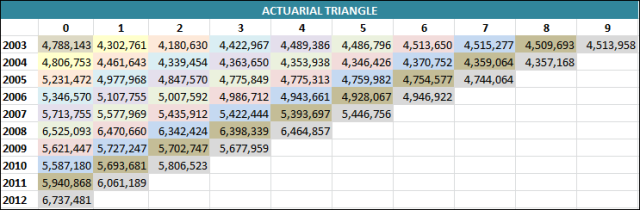
To tackle this, actuaries use statistical projection methods based on historical data arranged in a loss development triangle (or "actuarial triangle"). This table tracks the cumulative development of claims for each accident year over time, allowing the actuary to project how current, immature accident years will develop in the future.
The following video segment provides an excellent explanation of the key reserve components an actuary must consider.
This part of "General Insurance 101" explains the main types of reserves and introduces the loss triangle as a tool for analysis.
Please watch two key sections: First, the detailed explanation of reserves from this timestamp. Focus on the definitions of Unearned Premium Reserve (UPR), Claims Reserve, IBNR, and IBNER. These are the building blocks of an insurer's technical liabilities. Next, watch the introduction to the loss triangle. This explains how this tool is used to assess claim development and the adequacy of initial estimates over time.
A Finer Point: Occurrence vs. Underwriting Year Triangles
When constructing a loss triangle, the data can be grouped in two main ways. This choice is influenced by the business line's tail length.
- Occurrence-Year Basis: Groups claims by the date the loss event occurred. All claims from incidents in 2023 are grouped together, regardless of which policy they fall under.
- Underwriting-Year Basis: Groups claims by the policy's inception date. All claims arising from policies written in 2023 are grouped together, even if the loss events occur in 2023 and 2024.
[PDF] Bridging Perspectives: Understanding the Complementary Role of ...
This presentation from Vivian Canoas at Akad Seguros details the pros and cons of each method.
Please read the sections titled "METHODOLOGIES" and "COMPARING LOSS RATIOS." Focus on the tables and bullets that describe the advantages and limitations of each approach. Note the key takeaway: this comparison shows that the occurrence-based method is generally preferred for long-tail lines, as it provides a clearer picture of claim development without being distorted by changes in underwriting volume.
Implications for Investment Strategy
The different liability structures of short- and long-tail business dictate vastly different investment strategies.
For short-tail business, the insurer needs to pay claims quickly. The float is held for a short duration.
- Investment Strategy: Must prioritize liquidity and low risk. The portfolio will be dominated by cash and short-term, high-quality bonds. The primary goal is to ensure cash is available to pay claims, not to generate high investment returns.
For long-tail business, the insurer holds the float for many years.
- Investment Strategy: Can adopt a long-term investment horizon. The insurer can afford to invest in less liquid, higher-return assets like equities, real estate, and long-duration bonds. Investment income is not just a bonus; it is an essential part of the business model. An insurer might be willing to price a policy to make a small underwriting loss (i.e., a combined ratio over 100%) if it is confident that the long-term investment income generated by the float will deliver a strong overall profit.
Challenging Conventional Wisdom
The traditional view is simple: long-tail lines can afford higher loss ratios because of the substantial investment income they generate. However, modern actuarial practice and financial theory introduce crucial counterpoints.
A paper from the Casualty Actuarial Society (CAS) explores this very question, highlighting real-world forces that complicate the picture. This provides the kind of critical thinking expected in your CP1 exam.
[PDF] Can Long Tailed Lines of Business Really Afford Higher Loss Ratios?
This paper by Jonathan Evans challenges the simple view on long-tail profitability.
Please read the following sections to understand the argument: The introduction on the first page, which lays out the three "real world forces" that challenge the traditional maxim. The section titled Loss Reserves, which explains how holding reserves at their undiscounted nominal value creates a form of "invested capital" that requires a return. The section titled Surplus Capital, which notes that long-tail business requires more surplus capital to be held against its more uncertain reserves. The section titled The Demands of Investors, which argues that investors will demand a competitive return on the total capital base supporting the business.
The key insight from this paper is that while long-tail business generates more investment income, it also "traps" more capital in the form of undiscounted reserves and required surplus. When you demand a market return on this larger capital base, the underwriting profit needed from a long-tail line may be much closer to that of a short-tail line than one might initially think. This is a sophisticated and important point for a practicing actuary.
Conclusion
We have established that the "tail"—the delay between loss occurrence and settlement—is a defining characteristic of a general insurance line of business. This distinction between short- and long-tail risk has fundamental implications for the entire operation of an insurer.
Key Takeaways:
- Short-Tail Business: Characterized by rapid claim settlement, lower reserving uncertainty, and an investment strategy focused on liquidity. Profitability is driven almost entirely by underwriting profit.
- Long-Tail Business: Characterized by long delays in claim settlement, high reserving uncertainty (requiring sophisticated actuarial modeling), and an investment strategy with a long-term horizon. Profitability is a function of both underwriting results and investment income.
- Reserving: Actuaries use loss development triangles to project ultimate claims for long-tail lines, a process fraught with uncertainty over long periods.
- Investment: The "float" from long-tail business allows for investment in higher-return assets, making investment income a critical component of profitability.
- Capital: Long-tail business requires more capital to support its large, uncertain, and often undiscounted reserves, which influences the profitability targets required by investors.
To help you consolidate this for your exam revision, here is a summary framework.
| Feature | Short-Tail Business | Long-Tail Business |
|---|---|---|
| Definition | Claims are reported and settled quickly. | Significant delay between incident and claim settlement. |
| Examples | Property (Fire, Theft), Motor Physical Damage | Liability (Public, Product), Professional Indemnity, Workers' Comp |
| Claim Uncertainty | Resolves quickly (low uncertainty). | Persists for years (high uncertainty). |
| Reserving Focus | Estimating reserves for known claims (case reserves). | Estimating IBNR and future development on known claims. |
| Key Actuarial Tool | Less reliance on complex projection. | Loss Development Triangles. |
| Investment "Float" | Held for a short period. | Held for many years. |
| Investment Strategy | Focus on liquidity and low risk (cash, short-term bonds). | Focus on higher returns with a long horizon (equities, property). |
| Source of Profit | Primarily underwriting profit. | A combination of underwriting results and investment income. |
This lesson has given you a crucial lens through which to view general insurance. The uncertainty inherent in long-tail business is a primary example of insurance risk. In our next lesson, we will broaden this discussion to analyze the key risks to the provider for general insurance products, including the unique challenges posed by catastrophe and accumulation risk.