Welcome to the first lesson of Module 3. In the previous module, we explored the strategic landscape of benefits, culminating in a look at how and why employers design and finance these programs. Now, we shift our focus from the employer's strategy to the products themselves. We will begin to build a detailed catalogue of the financial instruments that meet fundamental human needs for security.
This lesson introduces the three foundational pillars of life insurance: term assurance, whole life assurance, and endowment assurance. Understanding these products is crucial, as they form the basic building blocks for many of the more complex insurance and investment contracts we will encounter later in the course. By the end of this lesson, you will be able to describe the distinct features of each of these core products.
The Two Fundamental Contingencies: Death and Survival
At its core, any life insurance contract is built upon a simple probabilistic foundation contingent on one of two outcomes for the insured person: death or survival. This simple duality gives rise to the entire spectrum of life insurance products.
A contract can be designed to pay out upon death, providing financial protection for dependents. Alternatively, it can be designed to pay out upon survival to a certain date, acting as a savings vehicle. Or, it can combine these features.
The following short video provides a clear, high-level overview of how these two contingencies lead to the four basic contract types that we will explore.
CT5 Chapter 1 Life Assurance Contracts
This video from MJ the Fellow Actuary introduces the core concepts of life assurance contracts.
Watch the first minute of the video, from the introduction, to see how the concepts of survival and death give rise to pure endowment, whole life assurance, term assurance, and endowment assurance.
As the video illustrates, a contract paying on death can either be for a limited period (term assurance) or for the entire duration of life (whole life assurance). A contract paying on survival is a pure endowment. A contract that combines payment on death within a term or survival to the end of that term is an endowment assurance. Let's examine each of these in detail.
1. Term Assurance: Pure Protection for a Fixed Period
Term assurance is the simplest form of life insurance. It is designed to provide a lump sum payment, known as the sum assured or death benefit, only if the life insured dies within a specified period, or "term". If the person survives the term, the policy expires and no payment is made.
Key Features:
- Purpose: Pure financial protection. It is designed to cover temporary needs, such as providing for dependent children or paying off a mortgage in the event of premature death.
- Contingency: Pays on death within the term.
- Value: It has no savings component or "cash value". Its sole purpose is to provide the death benefit.
- Cost: Because a payout is not certain (the insured may survive the term), premiums are significantly lower than for other types of life insurance, making it a cost-effective way to secure a large amount of cover for a specific period.
The following video provides a rigorous explanation of term assurance, including the underlying actuarial principles. Given your background, you will recognize the formulation of the present value random variable and the derivation of its expected value.
Term and endowment insurance, pure endowment
This lecture by Professor Katrien Antonio from KU Leuven provides a detailed mathematical and conceptual explanation of term assurance.
Watch the segment on term insurance, starting from the introduction to continuous time products and continuing through to the end of the discussion on the annual (discrete time) case. Pay attention to how the valuation formula is a summation to n-1 rather than infinity, which distinguishes it from whole life assurance. You will see the standard actuarial notation for this product, A^1_{x:\overline{n}|}.
2. Whole Life Assurance: Lifelong Protection
As its name implies, a whole life assurance policy provides coverage for the entire lifetime of the insured person. It pays out the death benefit whenever death occurs.
Key Features:
- Purpose: Permanent financial protection. It's often used for needs that do not have a time limit, such as covering funeral expenses, providing an inheritance, or for estate planning purposes.
- Contingency: Pays on death, whenever that may be.
- Value: Unlike term assurance, a payout is certain. Because of this, whole life policies build up a "cash value" or "surrender value" over time. This is an amount the policyholder can receive if they decide to terminate the policy before death. This cash value component means it has an embedded savings element.
- Cost: Premiums are significantly higher than for term assurance because the insurer knows it will have to pay the sum assured eventually. These premiums are typically level, meaning they do not increase with age.
The image below provides a clear comparison of the key features of whole life and term life insurance.
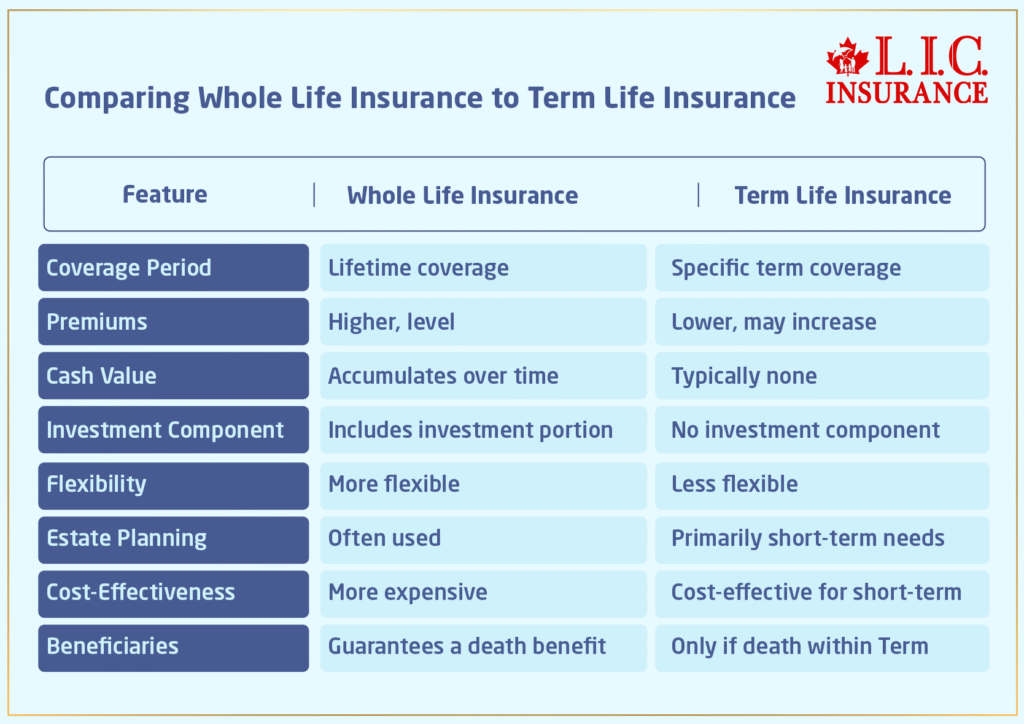
For a more detailed comparison of whole life to endowment policies, the article below is very helpful.
Endowment vs Whole Life Insurance - Difference and Comparison
This article from Diffen provides clear definitions and comparisons of different insurance types.
Please read the following sections: The introductory paragraphs, from the start, to get a high-level overview. The section "What is Whole Life Insurance?" for a clear definition and an explanation of cash value. The section on "Premiums and Payouts" to understand how the cash value and death benefit interact.
3. Endowment Assurance: A Hybrid of Protection and Savings
An endowment assurance policy is a hybrid product. It combines the features of a term assurance with a savings vehicle, guaranteeing a payout under one of two conditions:
- If the insured person dies during the policy term (like term assurance).
- If the insured person survives to the end of the policy term (a feature known as a pure endowment).
To properly understand this, we must first define its savings component.
Building Block: The Pure Endowment
A pure endowment is a contract that pays a specified sum only if the life insured survives to the end of a fixed term. If the insured dies before the term ends, no benefit is paid. Its primary purpose is disciplined saving for a future goal, with the mortality-contingent nature allowing for potentially better returns than a simple bank account (as the funds of those who die are effectively pooled to benefit the survivors).
Professor Antonio's lecture explains this concept very clearly.
Term and endowment insurance, pure endowment
This segment of the lecture introduces pure endowment benefits as a building block for endowment insurance.
Please watch the section on pure endowment, from the start of the topic. Note the key difference in the actuarial notation: the '1' is placed over the term n (A_{x:\overline{n}|}^1) to indicate payment is contingent on surviving the term, not on dying within it. The valuation formula is simply the discounted value of the benefit multiplied by the probability of survival: v^n \cdot {}_n p_x.
Combining the Blocks: Endowment Assurance
Now, we can see that an endowment assurance is simply the sum of its two parts:
- An n-year Term Assurance paying out on death within n years.
- An n-year Pure Endowment paying out on survival at the end of n years.
This structure guarantees a payout of the sum assured, it's just a matter of when (at death during the term, or at maturity).
Key Features:
- Purpose: A combined vehicle for savings and protection. It is often used to save for a specific future event, like a child's university education or retirement, while providing life cover in the interim.
- Contingency: Pays on death within the term OR survival to the end of the term.
- Cost: Premiums are higher than term assurance due to the savings component and the guaranteed payout.
The final segment of the video demonstrates precisely how these two components are added together, both conceptually and mathematically.
Term and endowment insurance, pure endowment
This final segment explains how endowment insurance is constructed from the two products we've already seen.
Watch the section on endowment insurance from this point. The key takeaway is the valuation formula, which is a straightforward addition of the term assurance and pure endowment components: A_{x:\overline{n}|} = A^1_{x:\overline{n}|} + A_{x:\overline{n}|}^1.
The image below gives a useful side-by-side comparison of term and endowment plans.

A Comparative Framework
To consolidate your understanding, here is a summary table that acts as the "cheatsheet" you find helpful for exam preparation. This framework compares the three core products across several key dimensions.
| Feature | Term Assurance | Whole Life Assurance | Endowment Assurance |
|---|---|---|---|
| Primary Purpose | Pure Protection | Permanent Protection & Savings | Goal-oriented Savings & Protection |
| Payout Contingency | On death within a specified term | On death, whenever it occurs | On death within the term OR on survival of the term |
| Policy Duration | Fixed term (e.g., 10, 20, 30 years) | Whole of life | Fixed term (e.g., 10, 20 years) |
| Is a Payout Certain? | No | Yes | Yes |
| Relative Premium | Low | High | High |
| Savings Component | None | Yes (builds cash/surrender value) | Yes (matures at end of term) |
| Actuarial Notation | $A^1_{x:\overline{n} | }$ |
Conclusion
In this lesson, we have dissected the three fundamental life insurance products. We have seen how the simple contingencies of death and survival are used to construct contracts that meet distinct financial needs.
Key Takeaways:
- Term Assurance offers pure, cost-effective protection for a finite period, making it ideal for covering temporary liabilities like a mortgage.
- Whole Life Assurance provides permanent, lifelong protection with an associated savings element (cash value), suitable for estate planning and other perpetual needs.
- Endowment Assurance is a hybrid product that combines term assurance with a pure endowment, guaranteeing a payout either on death within the term or on survival to maturity. It serves as a disciplined savings tool with integrated protection.
These three products are the essential DNA of life insurance. In our next lesson, we will continue building our product catalogue by looking more closely at pure endowments and then introducing their conceptual inverse: annuities, which are products designed to provide an income stream, typically during retirement.