Welcome to the second lesson in our module on life and health insurance products. In our previous discussion, we deconstructed endowment assurance into its two core components: a term assurance and a pure endowment. We saw that a pure endowment provides a lump sum payment contingent on survival, making it a powerful savings tool.
Today, we will examine pure endowments in more detail and then introduce their conceptual counterpart: annuities. While an endowment builds capital, an annuity is designed to liquidate capital, providing a steady stream of income. This makes annuities a cornerstone of retirement planning and a fundamental product in actuarial practice. By the end of this lesson, you will be able to describe the distinct features of both pure endowments and the various types of annuity products.
1. The Pure Endowment: A Closer Look
As we established, a pure endowment is a contract that pays a specified sum at the end of a fixed term, but only if the life insured survives to that date. Its primary function is to facilitate disciplined saving towards a future goal.
While this product has a very specific application, it's worth understanding its characteristics, benefits, and limitations as a standalone contract.
Pure Endowment Plan: Meaning, Features, and Benefits - Tata AIA
This article from Tata AIA provides a clear, non-technical overview of the pure endowment product.
Please read the entire article to understand the product from a consumer's perspective. Pay close attention to these sections: The initial definition. The discussion under "Features", which lists key characteristics like maturity conditions and the absence of a death benefit. The "Benefits", such as guaranteed payout and encouragement of long-term savings. The "Drawbacks", which are crucial for understanding the product's specific niche.
The most striking feature of a pure endowment is that no benefit is paid upon death. This may seem harsh, but it is the key to its design. From a probabilistic viewpoint, the funds from the policies of those who die during the term are used to augment the payout to the survivors. This mortality cross-subsidy allows for a potentially higher return than a simple savings account with a similar risk profile.
In the previous lesson, we saw the actuarial valuation for a pure endowment paying 1 at the end of years to a life aged :
This formula elegantly captures the essence of the product: the benefit is discounted for time () and for the probability of survival ().
2. Annuities: Providing an Income Stream
A pure endowment provides a single lump sum. However, for many financial goals, particularly retirement, a regular income stream is more useful than a single capital payment. This is the purpose of an annuity.
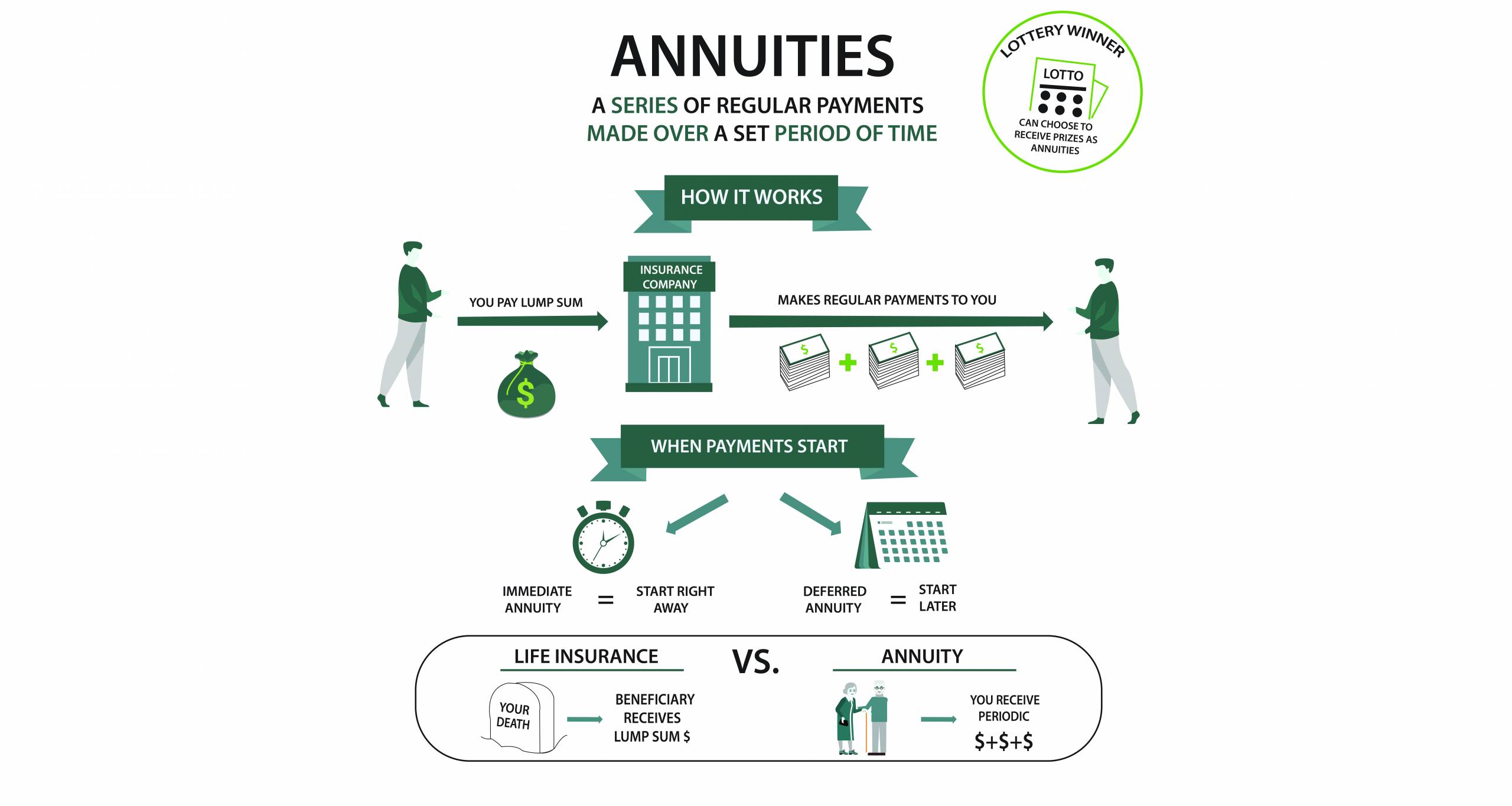
At its simplest, an annuity is a contract where an individual pays a sum of money (a premium, often a lump sum) to an insurance company in return for a series of periodic payments.
To begin, let's watch a short video that introduces the fundamental principles of annuities and the key parties involved.
Annuity Principles And Concepts - Life Insurance Exam Prep
This video from Insurance Exam Prep provides a clear overview of annuity principles and the roles of the different parties.
Watch the first three minutes of the video, covering two key areas: The basic purpose of an annuity as a vehicle to turn a large sum into an income stream. The parties involved: the owner, the annuitant, and the beneficiary. Understanding these roles is crucial for grasping how different annuity features work.
As the video explains, the three key roles are:
- Owner: The person or entity who purchases the contract and has rights to it.
- Annuitant: The person whose life the payments are based on. The annuitant receives the income. Often, the owner and the annuitant are the same person.
- Beneficiary: The person who receives any remaining benefits (if applicable) after the annuitant's death.
3. A Framework for Classifying Annuities
The term "annuity" covers a wide family of products. To understand them, it's best to classify them along several key dimensions. This creates a framework that is invaluable for your exam preparation.
Dimension 1: When do payments start? (Immediate vs. Deferred)
This is the most fundamental classification. It describes the timing relationship between paying the premium and receiving the income.
Annuity Principles And Concepts - Life Insurance Exam Prep
This segment of the video explains the difference between immediate and deferred annuities.
Please watch the section from this point.
- Immediate Annuity: Income payments begin shortly after the premium is paid (typically within one year). This is used to convert an existing lump sum (e.g., a retirement fund) into an immediate income.
- Deferred Annuity: Income payments begin at a specified future date. This type of annuity has two phases:
- Accumulation Phase: The period between paying the premium(s) and the start of income payments, during which the funds grow.
- Payout (Annuitization) Phase: The period during which the income is paid out.
Dimension 2: How are premiums paid? (Single vs. Periodic)
This describes how the annuity is funded during the accumulation phase (this is mainly relevant for deferred annuities).
Annuity Principles And Concepts - Life Insurance Exam Prep
This section covers the two main premium payment methods.
Watch the clip from here.
- Single Premium Annuity: Funded with a single lump-sum payment. This is common for both immediate annuities and deferred annuities (e.g., a 401(k) rollover).
- Periodic Premium Annuity: Funded with a series of payments over time. This allows an individual to gradually build up their annuity fund over many years before retirement.
Dimension 3: How does the fund grow? (Fixed, Variable, or Indexed)
This dimension describes how the investment return is credited to the fund, which in turn determines the level of risk borne by the policyholder.
Annuity Principles And Concepts - Life Insurance Exam Prep
This part of the video is crucial. It details the different investment structures that underpin annuity products.
Please watch the detailed explanation of the investment types from this section.
- Fixed Annuity: The insurance company guarantees a minimum interest rate on the principal. The insurer bears all the investment risk, providing the annuitant with security and predictable payments.
- Variable Annuity: The owner allocates premiums to various investment sub-accounts (similar to mutual funds). The value of the fund and the subsequent income payments fluctuate with the performance of these investments. The annuitant bears the investment risk, but also has the potential for higher returns.
- Indexed Annuity: This is a hybrid. The return is linked to the performance of a market index, like the S&P 500. It offers a balance of risk and reward by providing a guaranteed minimum return (a "floor") but also allowing participation in market gains, often up to a "cap" or at a certain "participation rate."
The following chart provides an excellent comparison of these three investment types against key features.

Dimension 4: How long are payments made? (Certain vs. Life-Contingent)
This final dimension describes the payout phase and is where the actuarial science of longevity comes into play.
[PDF] Dr Hendel's FM Lecture Notes - TigerWeb
This section from Dr. Hendel's notes on Financial Mathematics provides a structured overview of the fundamental types of level-payment annuities, focusing on their evaluation timing and duration.
Please read section 4.4 Six Level Annuity Functions. Focus on the descriptions in the main table, specifically contrasting the "Annuity immediate (certain)" with a life annuity (which is mentioned in the clarifying bullet points at the end of the section). Read the text explaining the difference between level/certain and life annuities.
- Annuity Certain: Payments are made for a fixed number of years. If the annuitant dies before all payments are made, the remaining payments are made to a beneficiary. There is no mortality risk for the insurer. Its value is a straightforward discounted cash flow calculation.
- Life Annuity: Payments are made for as long as the annuitant is alive. This protects against longevity risk—the risk of outliving one's assets.
- Single Life: Payments cease on the death of the annuitant.
- Joint and Survivor: Payments continue as long as at least one of two or more specified annuitants is alive (e.g., a married couple). The payment amount may reduce after the first death.
- Annuities with Guarantees: These are hybrid life annuities that mitigate the "risk" of dying early and forfeiting the premium.
- Life with Period Certain: A life annuity that guarantees payments for a minimum number of years (e.g., "10-year certain and life"). If the annuitant dies in year 4, payments continue to a beneficiary for another 6 years. If the annuitant lives for 20 years, payments continue for all 20 years.
- Refund Annuity: Guarantees that the total payout will be at least equal to the premium paid. If the annuitant dies before receiving payments equal to the premium, the balance is paid to a beneficiary, either as a lump sum (cash refund) or as continued payments (installment refund).
A Consolidated Framework
To help you organize these concepts for revision, here is a summary "cheatsheet" that combines the different dimensions of annuities:
| Dimension | Key Options & Purpose |
|---|---|
| 1. Payout Timing | Immediate: For immediate income needs. Deferred: For future income needs (accumulation + payout). |
| 2. Premium Payment | Single: Funded with one lump sum. Periodic: Funded over time, allows for gradual saving. |
| 3. Investment/Growth | Fixed: Insurer takes risk; offers security. Variable: Annuitant takes risk; offers growth potential. Indexed: A hybrid approach balancing security and growth. |
| 4. Payout Duration | Certain: For a fixed period; no longevity protection. Life-Contingent: For life; protects against outliving assets. With Guarantees: Life-contingent with features to reduce forfeiture risk on early death. |
An actual product is often described by combining these features, for example: a "Single Premium Deferred Variable Annuity" or a "Single Premium Immediate Life Annuity with 10-year period certain."
Conclusion
In this lesson, we have explored products designed to provide capital at a future date. We started with the pure endowment, which provides a single lump sum contingent on survival, and then moved to its more complex and versatile cousins, annuities, which provide an income stream.
Key Takeaways:
- A pure endowment is a savings product that pays a lump sum on survival to a specified date, with no death benefit.
- An annuity is a product that converts a capital sum into a stream of payments.
- Annuities can be classified along four key dimensions: payout timing (immediate/deferred), premium payment (single/periodic), investment basis (fixed/variable/indexed), and payout duration (certain/life-contingent).
- The interplay between these features allows annuities to be tailored to meet a wide range of customer needs, from providing a secure retirement income to offering investment growth opportunities.
In our next lesson, we will continue exploring how investment risk is managed and shared in product design. We will compare with-profits and unit-linked life insurance products, concepts that build directly on the fixed vs. variable distinction we introduced today.