Welcome to the fourth lesson in our module on life and health insurance. In our last session, we contrasted with-profits and unit-linked policies, focusing on how they manage investment risk for long-term savings. We saw two distinct philosophies: sharing risk through smoothing and transferring risk through direct market linkage.
Today, we shift our focus from products that combine savings and protection to those designed primarily for pure protection against morbidity risk—the risk of illness or injury. Specifically, we will examine individual and group health and income protection products. By the end of this lesson, you will be able to describe the key features of these products, distinguishing between how they are distributed (group vs. individual) and the types of financial loss they are designed to cover.
1. The Fundamental Divide: Group vs. Individual Coverage
Before diving into specific product types, it's crucial to understand the primary structural difference in how these benefits are provided: through a group scheme or via an individual policy. Most health and income protection plans are offered through employers as group insurance.
Group insurance operates on a principle of risk pooling across an organization. An insurer issues a single contract, the master policy, to the employer. Employees who participate are not individual policyholders but are instead issued a Certificate of Insurance as evidence of their coverage under the master policy. This structure has profound implications for cost, underwriting, and eligibility.
Let's begin with a video that outlines the foundational differences between group and individual health insurance.
Group Health Insurance - Insurance Exam Prep
The video "Group Health Insurance" from the Insurance Exam Prep channel provides a clear introduction to this topic.
Please watch the following two segments: First, watch the introduction from 00:28 to 01:42. This clip explains the basic concept of group vs. individual policies and highlights the key advantages of group coverage, such as lower cost and the conversion privilege. Next, jump to the section on plan types from 23:19 to 25:25. This part details the difference between contributory and non-contributory plans and the participation rules that insurers use to mitigate adverse selection.
The video introduces two key concepts:
- Contributory Plan: Both the employer and employee contribute to the premium. These plans typically require at least 75% participation from eligible employees.
- Non-Contributory Plan: The employer pays the full premium. These plans must have 100% participation from eligible employees.
These participation rules are a core underwriting control. Since group underwriting doesn't usually involve a detailed medical assessment of each individual, insurers rely on these rules to ensure they get a reasonable cross-section of healthy and less-healthy lives, preventing a situation where only those who expect to claim will join (adverse selection).
The following image provides a quick visual summary of the key differences.
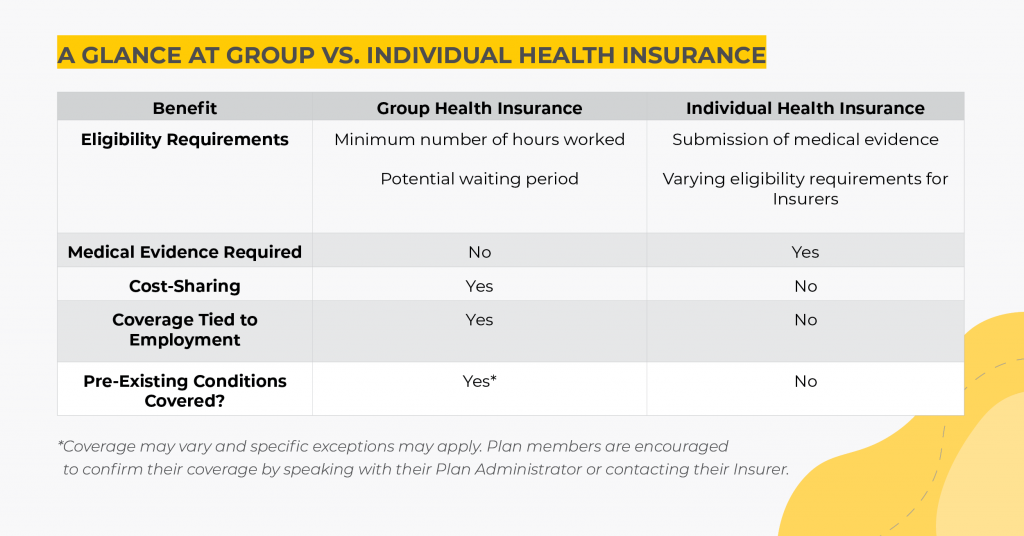
To formalize this, let's turn to a more detailed comparison from the American Academy of Actuaries.
[PDF] Issue Brief - American Academy of Actuaries
This issue brief contains an excellent table that systematically compares group-sponsored and consumer-purchased (individual) health insurance.
Please find the table titled "How does group-sponsored health coverage differ from consumer-purchased health insurance coverage?" on page 6. Study the rows on: Funding (insured vs. self-funded) Regulating authority Underwriting Premium-setting methodology Who pays the premium This provides a robust framework for understanding the structural differences.
The core takeaway is that the group mechanism changes the entire dynamic of the insurance arrangement, shifting from individual risk assessment to managing the risk of a collective.
2. Health Insurance: Covering Medical Expenses
Health insurance (or medical expense insurance) is designed to cover the direct costs associated with healthcare, such as hospital stays, surgery, consultations, and prescription drugs. The vast majority of this coverage is provided on a group basis.
One of the defining features of modern group health plans is the level of choice offered to employees. Many employers use cafeteria plans, which allow employees to select from a menu of benefits.
Let's return to the "Group Health Insurance" video to see how these plans work and explore other key features.
Group Health Insurance - Insurance Exam Prep
This video further details the practical features of group health plans.
Watch these two sections: Health and Accident Cafeteria Plans: This explains how cafeteria plans (also known as Section 125 plans in the US) allow employees to customize their benefit packages and use pre-tax dollars to pay for them. Distinct Features: This section covers the core contractual elements, including the master policy, certificate of coverage, enrollment periods, and the probationary (or waiting) period before a new employee is eligible.
Beyond the structure, health insurance policies are defined by their cost-sharing features and network design. These are levers used to control costs for both the insurer and the policyholder.
-
Cost-Sharing:
- Deductible: The amount the insured must pay out-of-pocket before the insurer starts to pay.
- Co-payment (Co-pay): A fixed amount the insured pays for a covered service (e.g., $30 per doctor's visit).
- Co-insurance: The percentage of costs the insured pays after the deductible is met (e.g., the insurer pays 80%, you pay 20%).
-
Network Design: (As mentioned in the American Academy of Actuaries brief)
- HMO (Health Maintenance Organization): Typically requires you to use doctors and hospitals within its network and get a referral from a primary care physician (PCP) to see a specialist.
- PPO (Preferred Provider Organization): Offers more flexibility to see both in-network and out-of-network providers, usually without a referral. Out-of-network care is more expensive.
Finally, a crucial aspect of health insurance, particularly when changing jobs, is the handling of pre-existing conditions and portability. Regulations like the Health Insurance Portability and Accountability Act (HIPAA) in the US set standards for this. While the specifics are jurisdiction-dependent, the underlying principles are universal for the CP1 exam. A key principle is that group plans generally cannot deny or limit coverage for pre-existing conditions for individuals moving from one group plan to another without a significant break in coverage.
3. Income Protection: Replacing Lost Salary
While health insurance pays the doctors, Income Protection (IP) insurance pays you. It is designed to replace a percentage of your gross income if you are unable to work long-term due to illness or injury. This is also known as Disability Income Insurance.
The distinction is critical: IP covers the consequential financial loss of being unwell (your lost salary), not the direct cost of treatment.
Income protection insurance explained
This video from Money to the Masses provides a concise and clear explanation of the core features of income protection.
Watch the video from the beginning until 02:54. Focus on the three key policy features the presenter explains: The Benefit Amount: The monthly payout, typically limited to 50-70% of your earnings. The Deferred Period: The waiting period before payments begin. The Benefit Period: How long the policy will pay out for (short-term vs. long-term).
The video highlights the key design levers of an IP policy. Let's delve deeper into one of the most important (and most frequently examined) features: the definition of disability. The criteria for what it means to be "unable to work" can vary significantly and has a major impact on the value and cost of the policy.
[PDF] private disability income insurance
This factsheet from the American Council of Life Insurers (ACLI) details the features of individual policies.
Please read the section titled "Individual Coverage". Pay close attention to the explanation of the different definitions of disability: Own Occupation: Pays if you are unable to perform the duties of your specific job. Any Occupation: Pays only if you are unable to perform the duties of any job for which you are reasonably qualified.
These definitions create a spectrum of coverage. "Own occupation" is the most comprehensive and expensive, as it protects your specific career path. Many policies offer a hybrid definition, providing "own occupation" coverage for an initial period (e.g., two years) before switching to an "any suited occupation" definition.
4. Summary Framework for Comparison
As you prepare for CP1, having structured frameworks is essential. Here are two "cheatsheets" to consolidate the concepts from this lesson.
First, a summary of the core principles distinguishing group and individual insurance:
| Feature | Group Insurance | Individual Insurance |
|---|---|---|
| Contract Holder | Employer or scheme sponsor (receives Master Policy) | The individual (receives a Policy Document) |
| Underwriting | Group-level assessment; adverse selection managed via participation rules and eligibility conditions. | Individual assessment of health and lifestyle. |
| Cost | Generally lower due to economies of scale, risk pooling, and employer subsidy. | Generally higher; paid entirely by the individual. |
| Plan Design | Standardized for the group, though cafeteria plans offer some choice. | Can be highly customized to individual needs. |
| Taxation | Premiums paid by employer are often a tax-deductible business expense. Employee contributions may be pre-tax. | Varies by jurisdiction; often less tax-efficient. |
Second, a comparison of the two product categories we covered today:
| Feature | Health Insurance (Medical Expense) | Income Protection (Disability Income) |
|---|---|---|
| Purpose | Covers cost of medical treatment (bills, consultations, drugs). | Replaces a portion of lost earnings during disability. |
| Benefit Paid To | Usually the medical provider or reimbursement to the insured. | The insured individual. |
| Benefit Form | Payment of specific, incurred costs up to a limit. | Regular (usually monthly) income payment. |
| Key Levers | Deductibles, co-payments, co-insurance, network type. | Deferred period, benefit period, benefit amount (% of salary). |
| Core Definition | Definition of covered treatments and procedures. | Definition of disability (e.g., 'own occupation'). |
| Moral Hazard Control | Cost-sharing features to discourage over-utilization. | Limiting benefit to ~60% of income to incentivize return to work. |
Conclusion
Today we have explored products designed to manage morbidity risk. We've seen that the structure—group versus individual—fundamentally alters the underwriting, cost, and design of the insurance contract.
Key Takeaways:
- Group Insurance leverages an employer-employee relationship to pool risk, reduce administrative costs, and simplify underwriting.
- Individual Insurance offers greater customization but involves direct underwriting and is typically more expensive.
- Health Insurance covers the direct costs of medical care and is primarily defined by its cost-sharing features and provider networks.
- Income Protection covers the consequential loss of income from disability and is defined by its benefit amount, deferred period, benefit period, and the crucial definition of disability.
In our next lesson, we will build directly on this foundation. Having described the features of these products, we will move on to analyze the key risks that they pose to the insurance provider.