Welcome to your sixth lesson. In our previous session, we built a comprehensive catalogue of group and individual retirement savings products, mapping them across the critical Defined Benefit (DB) vs. Defined Contribution (DC) and Group vs. Individual axes. We saw the "what"—the specific products available in the market.
Today, we shift our focus from the "what" to the "why" and "how" from the perspective of an employer. This lesson directly addresses the key considerations in designing and financing a holistic employee benefit program. We will explore the strategic thinking that goes into creating a benefits package, how it aligns with business objectives, and the financial structures that underpin it. This provides the crucial context for the specific insurance and investment products we will explore in subsequent modules.
The Strategic Purpose of Employee Benefits
An employer's decision to offer benefits is rarely pure altruism; it is a strategic investment in human capital. A well-designed benefits program serves as a critical link between the company's overarching business objectives and the well-being of its workforce. The goal is to create a symbiotic relationship where supporting employees helps the business thrive.
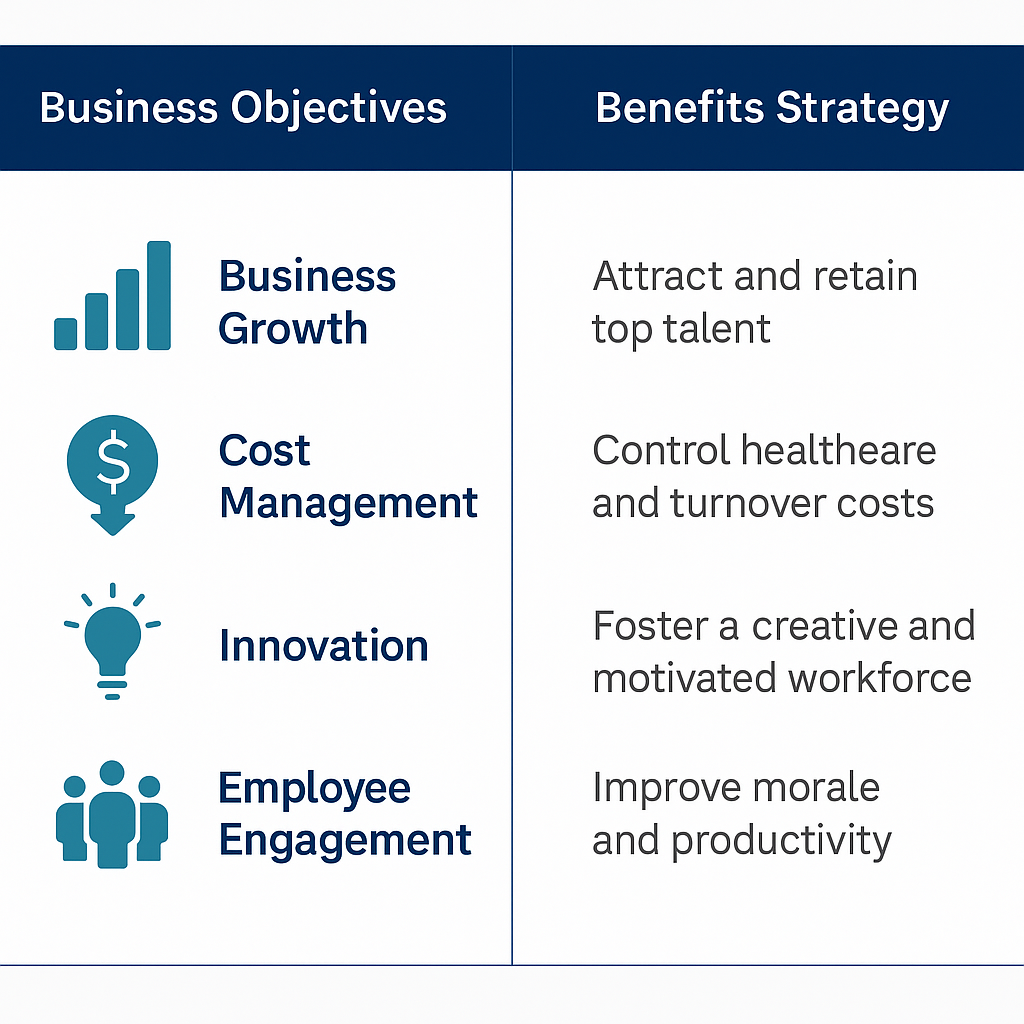
So, what are the primary drivers behind offering benefits? A brief from the American Academy of Actuaries provides an excellent summary.
[PDF] Issue Brief - American Academy of Actuaries
This issue brief outlines the strategic rationale for employee benefits programs.
First, please read the section "Why do employers offer benefits?" to understand the core motivations. It begins with this paragraph and continues through the bulleted list ending with this point. Next, review the section "What are the key priorities for employers when deciding which health benefits to offer?" which recaps these motivations as strategic goals. Focus on the bulleted list from Promote a healthy workforce to supporting DEI.
As you can see, the decision to offer benefits is a blend of several key objectives:
- Talent Management: In a competitive labor market, a strong benefits package is essential to attract and retain skilled employees.
- Workforce Productivity: Healthy, financially secure, and engaged employees are generally more productive and loyal.
- Cost and Risk Management: While benefits are a cost, they can mitigate other expenses, such as high employee turnover, and manage workforce risks.
- Compliance: Certain benefits are mandated by law (e.g., social security contributions, compliance with the UK's auto-enrolment or the US's Affordable Care Act).
The scope of what constitutes "benefits" is broad, extending far beyond just a pension plan.

A Framework for Designing a Benefits Program
Given these competing objectives and the vast array of possible benefits, designing a program requires a structured, strategic approach. It's not a simple one-off decision but a continuous cycle of evaluation and refinement—a real-world application of the Actuarial Control Cycle.
The following article presents a clear, eight-step process that leading organizations use. This serves as an excellent framework for your CP1 exam, providing a structured way to think about the design process.
Employee Benefits Planning: Complete Guide & Examples | Tabulera
This guide from Tabulera provides a practical, step-by-step framework for designing an employee benefits plan.
Please read the section titled "How to Design a Powerful Employee Benefits Plan." Focus on understanding the purpose of each of the eight steps, from defining goals to monitoring and iterating.
Let's summarize this strategic design framework:
- Define Business Goals: Start with the "why." Is the primary goal to reduce staff turnover, compete for top tech talent, or control rising healthcare costs? The objective shapes all subsequent decisions.
- Analyze Workforce Needs: A "one-size-fits-all" approach is rarely optimal. This step involves using surveys and demographic analysis to understand what employees actually value. A workforce of young software developers may prioritize flexible work and mental health support, while a mature workforce in manufacturing may value robust retirement plans and comprehensive health coverage. This is where your background in social research is highly relevant.
- Benchmark Industry Standards: Companies must understand what their competitors are offering to remain attractive.
- Budget & Cost Modeling: This is a crucial step where actuaries play a key role. The company must determine what it can afford. This involves modeling the costs of different plan designs and contribution strategies. We will explore this in more detail shortly.
- Select Providers and Vendors: Choose the insurers, investment managers, and administrators who will deliver the benefits. This decision balances cost with quality of service, network access, and member experience.
- Design a Benefits Roadmap: A multi-year plan avoids a reactive, annual scramble. It maps out which benefits will be introduced or enhanced over time, showing a long-term commitment to employees.
- Communicate to Employees: A benefit that is not understood has no value. Effective communication is essential for employees to appreciate the full value of their total compensation package.
- Monitor and Iterate: The process is a cycle. The company must track benefit utilization, re-survey employees, and monitor costs to ensure the program remains effective and aligned with its goals.
Key Considerations in Financing and Costing
The "Budget & Cost Modeling" step is fundamental to the sustainability of any benefits program. There are two primary models for financing health and welfare benefits, which represent a major risk-transfer decision for the employer.
-
Fully Insured: The employer pays a fixed premium per employee to an insurance company. The insurer takes on the financial risk of claims being higher than expected. This model offers predictable costs but may be more expensive over the long term as the insurer's profit margin and risk premium are built into the price. This is common for small to medium-sized employers.
-
Self-Funded (or Self-Insured): The employer pays for employees' claims directly as they arise, bearing the financial risk themselves. This model offers greater flexibility in plan design and the potential for cost savings if claims are lower than expected. However, it also introduces significant volatility. Large employers often use this model and typically purchase stop-loss insurance to protect themselves from catastrophic individual claims or a high aggregate level of claims.
The choice between these models is a key financing decision, balancing the desire for cost savings against the company's appetite for financial risk. You can find these concepts outlined in the "How does group-sponsored health coverage differ from consumer-purchased health insurance coverage?" table in the American Academy of Actuaries brief you reviewed earlier, under the "Funding: insured vs. self-funded" row.
An Actuarial Deep Dive: Modeling Healthcare Costs
For a self-funded employer, projecting future healthcare costs is a critical actuarial task. It's a complex process that goes far beyond simply looking at last year's spending. The following video provides a fantastic overview of how actuaries model these costs.
How Do Actuaries Model Healthcare Costs?
This video from "AHealthcareZ" explains the step-by-step methodology actuaries use to project healthcare costs for self-funded employers. It brings the "Budget & Cost Modeling" step to life.
Please watch the following segments to understand the core process: Data Gathering: This section explains the starting point: gathering historical claims and enrollment data to calculate a baseline per member per month (PMPM) cost. Trending: This part details how actuaries apply medical inflation (trend) and adjust for factors like changes in utilization or the introduction of new, high-cost drugs. Plan Design & Demographic Adjustments: Watch from plan design changes through to the end of the next segment at demographic changes. This shows how projections are adjusted for changes in deductibles, adding new benefits, or shifts in the age profile of the workforce.
This process demonstrates how actuaries blend historical data with forward-looking assumptions about inflation, technology, plan design, and demographics to produce a robust financial forecast.
The Strategic Shift in Retirement Financing
Another crucial financing consideration, which we touched on in the last lesson, is the widespread shift from Defined Benefit (DB) to Defined Contribution (DC) pension plans. This represents one of the most significant changes in employee benefits over the past few decades.
From a financing perspective, this shift is primarily about risk transfer.
- In a DB plan, the employer bears the investment risk and longevity risk. The costs are uncertain and can be volatile, creating long-term liabilities on the company's balance sheet.
- In a DC plan, the employer's commitment is limited to a known contribution. The investment and longevity risks are transferred to the employee. This provides cost certainty for the employer.
This strategic decision to move from DB to DC plans, as detailed in the video "What Are Defined Contribution and Defined Benefit Pension Plans?" from our last lesson, is a prime example of a design and financing choice aimed at de-risking the business.
Conclusion
In this lesson, we have moved beyond a simple list of products to understand the strategic thinking behind employee benefit programs. We've seen that the design and financing of benefits is a dynamic process aimed at balancing the needs of the business with the needs of its employees.
Key Takeaways:
- Strategic Intent: Employee benefits are a strategic tool for talent management, productivity, risk management, and compliance.
- Design Framework: A robust design process involves a cycle of defining goals, analyzing needs, benchmarking, budgeting, selecting providers, communicating, and monitoring. The eight-step process provides a solid framework for this.
- Financing Models: The choice between a fully insured and a self-funded model is a fundamental risk-financing decision for health and welfare benefits.
- Actuarial Costing: Actuaries are central to the budgeting process, particularly in self-funded plans, where they model future costs by trending historical data and adjusting for a range of factors.
- Risk Transfer: The historic shift from DB to DC retirement plans is a key example of a strategic financing decision designed to transfer risk from the employer to the employee.
In our next lesson, we will begin Module 3 by taking a closer look at the building blocks of insurance. We will start with the fundamental life insurance products—term assurance, whole life, and endowment policies—exploring their features and the needs they are designed to meet.