Welcome to your fifth lesson. In our previous session, we established the critical distinction between Defined Benefit (DB) and Defined Contribution (DC) pension schemes, focusing on how they allocate risk between the employer (sponsor) and the employee (member). This DB/DC framework is the bedrock for understanding retirement benefits.
Today, we will build directly upon that foundation. Our goal is to move from the abstract framework to the concrete by describing the main types of group and individual retirement savings products you will encounter in practice. We will explore the specific "products" that fall into the DB and DC categories, differentiating between those offered by an employer (group schemes) and those set up by an individual. As your CP1 exam is based on the UK system, our primary focus will be on UK products, though we will touch upon international examples to illustrate universal concepts.
Mapping the Pension Landscape: Group vs. Individual
Before diving into specific products, it's essential to establish another fundamental classification: the difference between group and individual schemes.
- Group Schemes: These are typically arranged by an employer for its employees. They are often called workplace or occupational pensions.
- Individual Schemes: These are set up directly by an individual with a pension provider. They are often called personal pensions.
The following video provides a concise introduction to this distinction.
Pensions Explained UK | Pension Basics for everyone
This clip from "Pensions Explained UK" by MeaningfulMoney introduces the primary split between workplace and personal pensions.
Please watch from the start of this segment. This establishes the two main branches of our product tree.
This distinction, combined with the DB vs. DC framework from our last lesson, allows us to categorize nearly any retirement product. The diagram below, from the UK's Office for National statistics, provides an excellent visual map of the UK pension system based on these classifications.
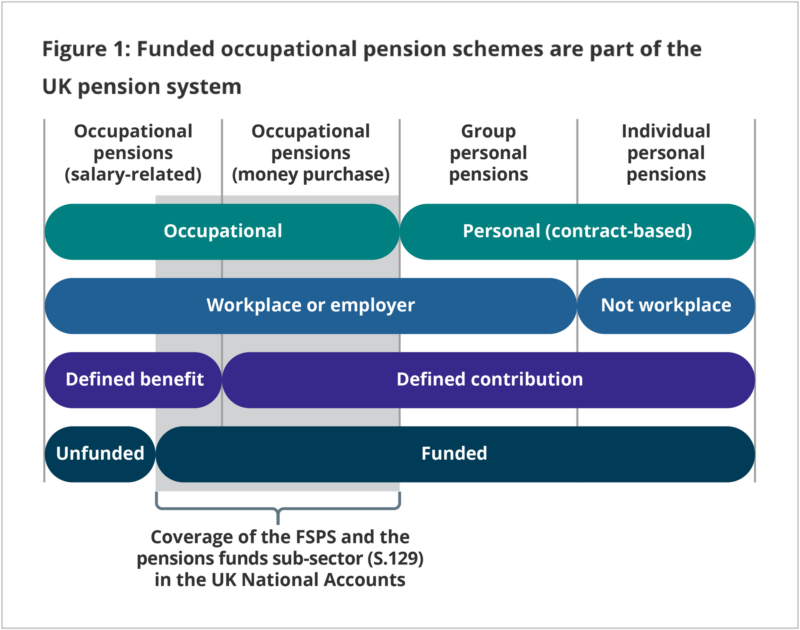
As you can see, group (occupational) schemes can be either DB or DC, whereas individual (personal) schemes are exclusively a feature of the DC world. Let's explore the products within each category.
Group Retirement Savings Products
These are the benefits provided by an employer. The type of scheme offered has significant implications for both the company and its employees.
1. Defined Benefit (DB) Schemes
As we learned, in a DB scheme the employer promises a specific retirement income. While becoming rare in the private sector, they remain common in the public sector (e.g., the NHS Pension Scheme) and in some older, large private-sector schemes. For your exam, you need to know the main sub-types.
A briefing paper from the UK Parliament provides a clear, authoritative summary.
[PDF] Pension FAQs: Occupational and personal pensions - UK Parliament
This document from the House of Commons Library details the main types of pension schemes in the UK. It is an excellent resource for exam-relevant definitions.
Please read section 1.1, "What are the main types of pension schemes?", starting from the two main types. Then, focus on section 1.2, "What are defined benefit pension schemes?". Pay close attention to the descriptions of: Funding types (funded vs. unfunded). Benefit calculation methods (final salary vs. career average).
The key types of DB schemes to remember are:
- Final Salary Schemes: The pension is based on your salary at or near retirement and your years of service. For example, a scheme might promise 1/60th of your final salary for each year you were a member. This structure heavily rewards long-serving employees who see significant salary growth late in their careers.
- Career Average Revalued Earnings (CARE) Schemes: The pension is based on your average earnings over your entire career with the employer. Each year, you build up a "slice" of pension based on that year's salary. These slices are then "revalued" (increased) each year until retirement, typically in line with a measure of inflation. Most public sector schemes and any remaining "open" private sector DB schemes now use a CARE design, as it is less risky for the sponsor than a final salary promise.
2. Defined Contribution (DC) Schemes
This is the dominant form of group pension in the private sector today. The employer's promise is limited to making a specific contribution.
In the UK, the landscape of workplace DC schemes has been transformed by Automatic Enrolment.
[PDF] Pension FAQs: Occupational and personal pensions - UK Parliament
Let's return to the UK Parliament briefing to understand this key policy.
Please read section 1.5, "What is automatic enrolment?". Focus on the eligibility criteria and the minimum contribution levels.
Auto-enrolment mandates that employers enrol eligible employees into a workplace pension, creating a massive new market for group DC products. Employers can fulfill this duty in several ways, most commonly through:
- Group Personal Pensions (GPPs): An employer arranges for a large insurer or investment firm to provide individual DC pension contracts to its employees. While the contract is between the employee and the provider, the employer facilitates contributions.
- Master Trusts: These are large, occupational DC schemes designed to serve multiple, unconnected employers. Each employer effectively has its own section within the trust. Master trusts have become extremely popular for auto-enrolment as they offer economies of scale and professional governance that would be difficult for a small employer to achieve on its own. NEST (National Employment Savings Trust) is a well-known example set up by the UK government.
International Parallel: The 401(k)
The concept of a group DC scheme is global. In the United States, the most common equivalent is the 401(k) plan. For non-profit organisations, a similar plan called a 403(b) exists. While the rules and contribution limits differ, the core principle is identical to a UK workplace DC scheme: the employer and employee contribute to an individual investment account, and the employee bears the investment risk.
Individual Retirement Savings Products
These are plans set up by an individual, independent of any employer. As we've noted, these are always Defined Contribution in nature. The individual is responsible for making contributions and investment decisions.
Pensions Explained UK | Pension Basics for everyone
The "Pensions Explained UK" video provides a good overview of personal pensions.
Please watch the segment on personal pensions from this section. Notice the key point that they are always DC.
The main types of individual pensions are:
- Personal Pensions: This is a broad category for individual DC contracts. In the UK, many older plans fall under this label.
- Stakeholder Pensions: A type of personal pension introduced in the UK with specific minimum standards, such as capped charges and low minimum contributions, designed to be simple and accessible.
- Self-Invested Personal Pensions (SIPPs): A SIPP offers the holder much greater investment freedom than a standard personal pension. Instead of a limited menu of funds chosen by the provider, a SIPP allows you to invest in a wide range of assets, including individual stocks, bonds, and investment trusts. This control makes them popular with financially engaged individuals.
International Parallel: The IRA
In the US, the equivalent of a UK personal pension is the Individual Retirement Account (IRA). A financial advisor explains the main types in the video below. While the tax specifics are US-based, the conceptual difference between "Traditional" and "Roth" is a useful principle to understand.
FINANCIAL ADVISOR Explains: Retirement Plans for Beginners (401k, IRA, Roth 401k/IRA, 403b) 2024
This video by Humphrey Yang explains the main types of US retirement plans. We'll use it to understand the concept of an IRA.
Please watch the following segments to understand the two main variants: Traditional IRA: This section explains the traditional, tax-deferred model. Roth IRA: This section introduces the Roth model, where contributions are made with after-tax money. You can also glance at the "7 Types of Retirement Accounts" infographic, which summarises the US landscape. Note the key difference in the "WHEN ARE YOU TAXED?" column for Traditional vs. Roth accounts.

The core idea is:
- Traditional (Tax-Deferred): You get tax relief on your contributions now, the money grows tax-free, and you pay income tax on withdrawals in retirement. This is the standard model for most UK pensions.
- Roth (Tax-Free Withdrawal): You contribute with money you've already paid tax on (no upfront tax relief), the money grows tax-free, and withdrawals in retirement are also tax-free.
This "tax-prepaid" Roth concept is less common in the UK pension system but is fundamental to personal finance discussions in the US.
Summary Framework: A Product Cheatsheet
As you requested, here is a framework to help you organize these products for revision. It maps the product types against our two key axes: Group vs. Individual and DB vs. DC.
| Category | Defined Benefit (DB) | Defined Contribution (DC) |
|---|---|---|
| Group (Workplace/Occupational) | UK: • Final Salary • Career Average (CARE) US: • Traditional Pension Plan |
UK: • Group Personal Pension (GPP) • Master Trust • Occupational DC Scheme US: • 401(k) • 403(b) |
| Individual (Personal) | (This category does not exist) | UK: • Self-Invested Personal Pension (SIPP) • Stakeholder Pension • Individual Personal Pension US: • Traditional IRA • Roth IRA • SEP IRA (for self-employed) |
Conclusion
In this lesson, we have populated the DB/DC framework with a catalogue of the most common group and individual retirement products. We saw that while the terminology varies between jurisdictions like the UK and the US, the underlying structures are remarkably consistent.
Group schemes can be either DB (like Final Salary or CARE plans) or, more commonly now, DC (like GPPs, Master Trusts, or 401(k)s). Individual schemes (like SIPPs or IRAs) are always DC, placing the full responsibility for funding and investment risk on the individual.
Key Takeaways:
- Retirement products can be classified as Group (Workplace) or Individual (Personal).
- Group schemes can be DB or DC, while individual schemes are always DC.
- UK Group DB schemes are typically Final Salary or CARE.
- UK Group DC schemes are dominated by GPPs and Master Trusts, largely driven by auto-enrolment.
- UK Individual DC products include SIPPs, Stakeholder, and Personal Pensions.
- International parallels like the US 401(k) (group) and IRA (individual) follow the same structural principles.
In our next lesson, we will delve deeper into the sponsor's perspective, exploring the key considerations in the design and financing of these employee benefit programs. We will examine why an employer might choose one structure over another and how they manage the associated costs and risks.