Welcome to our fourth lesson. In our last session, we established the role of the state as the foundational provider of benefits, exploring the mechanics of social security systems. Now, we will move to the next key provider in the benefits landscape: the employer.
Today, we will compare the two main types of employer-sponsored pension schemes: Defined Benefit (DB) and Defined Contribution (DC). Our objective is to analyze their features and, most importantly, the risks they entail from the perspectives of both the employee (the member) and the employer (the sponsor). This is one of the most fundamental distinctions in the world of pensions, and understanding it is critical for an actuary.
Let's begin by establishing clear definitions for these two structures.
Defining the Structures: Benefit vs. Contribution
At their core, the names say it all. A Defined Benefit plan promises a specific, predetermined retirement benefit. A Defined Contribution plan specifies a particular contribution that will be made to an employee's retirement account.
This simple distinction has profound consequences for who bears the risks associated with providing a retirement income. The following infographic provides a high-level summary of the key differences.
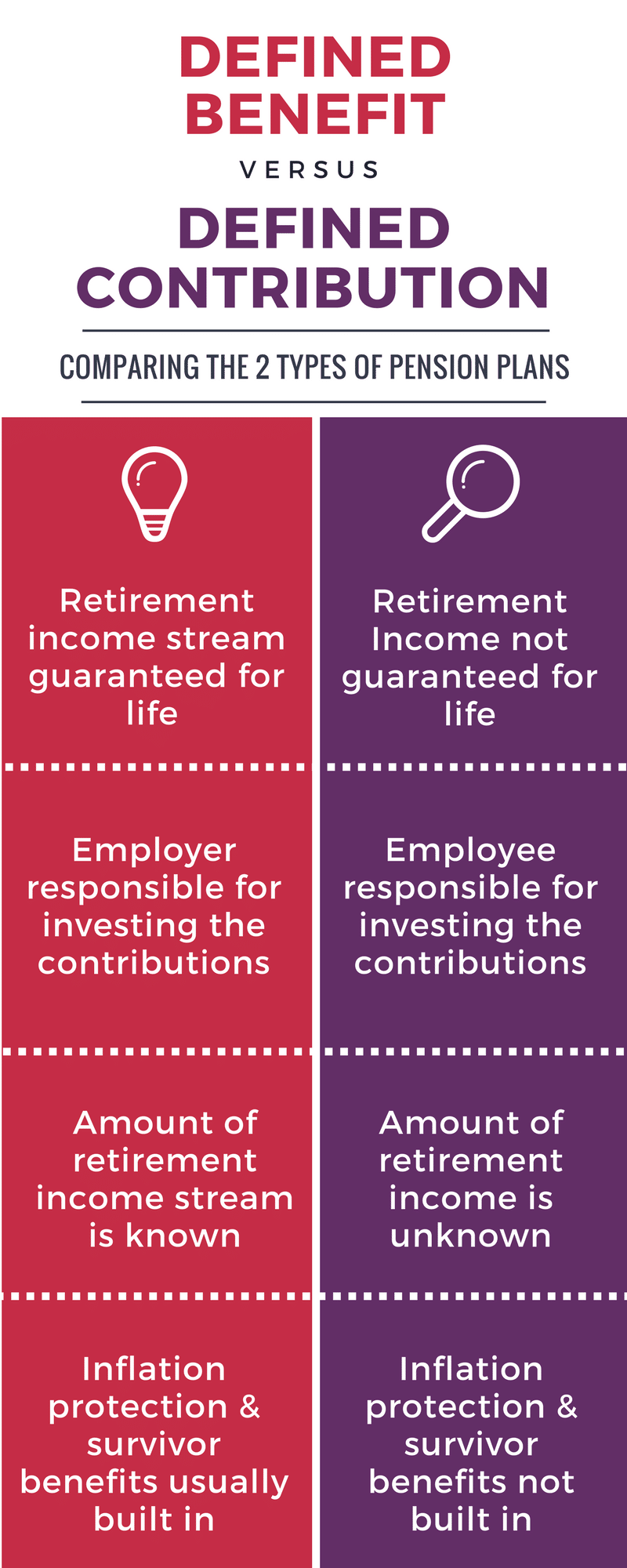
To add more detail to these definitions, let's watch a short video that explains the mechanics of each plan.
What Are Defined Contribution and Defined Benefit Pension Plans?
This video, "What Are Defined Contribution and Defined Benefit Pension Plans?", provides a clear introduction to both schemes, explaining how they work from the employee's point of view.
Please watch the following segments: The brief introduction from the start. The explanation of Defined Contribution (DC) plans from the DC section. Note who makes investment decisions and who bears the risk. The Enron example is a stark illustration of this risk. The explanation of Defined Benefit (DB) plans from the DB section. Pay attention to the benefit formula and how the investment risk shifts to the employer.
As the video illustrates, the key difference lies in the nature of the promise.
- In a DC plan, the employer promises to contribute a certain amount (e.g., 5% of your salary). The final retirement pot depends on the contributions made and the investment returns earned. The benefit is unknown.
- In a DB plan, the employer promises to pay you a certain income in retirement (e.g., 1/60th of your final salary for each year of service). The contribution required to fund this promise is unknown and can vary.
This leads us to the central theme of this lesson: the allocation of risk.
The Great Risk Transfer
The shift from DB to DC plans, a major trend in many countries over the past few decades, is often described as "the great risk transfer." It is a transfer of financial uncertainty from the corporate balance sheet to the individual household.
A comprehensive paper from the Bank for International Settlements (BIS) provides an excellent, in-depth analysis of how different risks are distributed in each type of plan.
[PDF] The shift from defined benefit to defined contribution pension plans - D
This paper provides a detailed breakdown of the features of DB and DC plans, with a specific focus on the distribution of risks between the employer and employee. This is a core reading for your exam preparation on this topic.
Please read the sections titled "A. Defined Benefit Pension Plans" and "B. Defined Contribution Pension Plans". As you read, focus on identifying the different types of risk and who bears them. Pay particular attention to the two summary tables: Table 1, which summarizes the risk allocation in a DB plan. Table 2, which does the same for a DC plan. Look for the definitions of key risks like investment, longevity, inflation, and accrual risk.
The reading makes it clear that in a DB plan, the sponsor bears the most significant financial risks, while in a DC plan, these same risks are borne by the member. Let's break this down from each perspective.
The Sponsor's (Employer's) Perspective
-
Defined Benefit (DB):
- Risks: The sponsor is on the hook for a future promise. This exposes them to several major risks:
- Investment Risk: If the plan's assets underperform, the sponsor must make up the shortfall with higher contributions.
- Longevity Risk: If retirees live longer than expected, the sponsor must pay benefits for longer, increasing the total cost.
- Interest Rate Risk: Liabilities are valued by discounting future promised payments. If interest rates fall, the present value of these liabilities increases, potentially creating a funding deficit.
- Inflation/Salary Risk: If benefits are linked to final salary, higher-than-expected salary growth will increase the liability.
- Advantages: DB plans have historically been seen as a tool to attract and retain employees for the long term, creating a loyal workforce (the "golden handcuffs" effect). The accounting treatment, while complex, sometimes allowed for income smoothing.
- Risks: The sponsor is on the hook for a future promise. This exposes them to several major risks:
-
Defined Contribution (DC):
- Risks: The primary risk for the sponsor is fiduciary/legal risk. If they do not provide appropriate investment options or guidance, they could be sued by employees who experience poor retirement outcomes. Operational risks in administering the plan also exist.
- Advantages: Cost predictability is the main driver. The sponsor's contribution is a fixed, known percentage of payroll, making it a stable operating expense. This eliminates the balance sheet volatility associated with DB plans and transfers the most significant financial risks to the employees.
The complexity of managing a DB plan's liabilities is a major reason for their decline. The following video, though focused on financial reporting, gives a good sense of why sponsors find DB plans so challenging.
CFA Level I FRA - Defined contribution vs Defined benefit plans
This video from PrepNuggets, aimed at CFA candidates, highlights the accounting and reporting differences between the schemes, which directly reflects the sponsor's burden.
Watch the segment from DB plan reporting. Notice the number of actuarial assumptions required (turnover, mortality, discount rates), which gives you a sense of the uncertainty the sponsor must manage.
The Member's (Employee's) Perspective
- Defined Benefit (DB):
- Risks:
- Portability/Accrual Risk: Benefits are typically "back-loaded," meaning they accrue most of their value in the final years of service. If an employee leaves mid-career, the pension they take with them is often worth significantly less than if they had stayed. This lack of portability is a major drawback in a modern, mobile workforce.
- Sponsor Insolvency Risk: If the sponsoring company goes bankrupt and the plan is underfunded, the employee may not receive their full promised benefit. This risk is often partially mitigated by a national protection fund (like the PBGC in the U.S. or the PPF in the U.K.).
- Inflation Risk (Post-Retirement): In many private sector plans, once payments begin, they are not fully indexed to inflation, causing the real value of the pension to decline over time.
- Advantages: The primary advantage is security. The member is promised a specific income for life, protected from investment and longevity risk. It simplifies retirement planning for the individual.
- Risks:
This chart illustrates the concept of "back-loading" in a DB plan. The value of the accrued benefit (blue line) accelerates significantly in the later years of service, making it much more valuable for a long-tenured employee than for someone who leaves early. The DC plan (yellow line) shows a steadier accumulation.

- Defined Contribution (DC):
- Risks: The member essentially runs their own personal pension fund and therefore bears the major risks:
- Investment Risk: Poor investment choices or a market crash just before retirement can devastate the final pension amount. As a statistician, you can think of the member's outcome not as a single number, but as a wide probability distribution that they must manage.
- Longevity Risk: The member may outlive their savings. If they don't purchase an annuity, there's no guarantee of a lifelong income.
- Inflation Risk: The member must manage their investments and withdrawals to keep pace with inflation both before and during retirement.
- Advantages: Portability and control. The funds belong to the employee and can be moved when changing jobs. The employee has control over their contributions (within limits) and investment decisions.
- Risks: The member essentially runs their own personal pension fund and therefore bears the major risks:
Summary Framework: DB vs. DC
As requested, here is a "cheatsheet" to help you organize and recall the key distinctions for your exam.
| Feature / Risk | Defined Benefit (DB) Scheme | Defined Contribution (DC) Scheme |
|---|---|---|
| The Promise | A specific, defined benefit in retirement (e.g., a pension). | A specific, defined contribution to a retirement account. |
| Benefit Amount | Known in advance, based on a formula (e.g., salary, service). | Unknown, depends on contributions and investment returns. |
| Investment Risk | Borne by the Sponsor. | Borne by the Member. |
| Longevity Risk | Borne by the Sponsor. | Borne by the Member (unless they buy an annuity). |
| Inflation Risk | Shared: Sponsor (pre-retirement via salary link), Member (post-retirement). | Borne by the Member. |
| Portability | Low. Benefits are not easily transferred ("accrual risk"). | High. The account balance belongs to the member and is portable. |
| Sponsor Perspective | Pros: Employee retention. Cons: High financial risk & volatility. |
Pros: Predictable costs, low risk. Cons: Fiduciary/legal risk. |
| Member Perspective | Pros: High security, predictable income. Cons: Lack of portability, sponsor insolvency risk. |
Pros: Control, flexibility, portability. Cons: Bears all financial risk, uncertain outcome. |
| Complexity | High for sponsor (actuarial valuations), simple for member. | Simple for sponsor, potentially complex for member (investment choices). |
Conclusion
In this lesson, we have dissected the two primary forms of employer-sponsored pension plans. The distinction hinges on who bears the financial risks of providing a retirement income. In a Defined Benefit scheme, the sponsor guarantees a specific outcome and absorbs the volatility of investment, longevity, and other risks. In a Defined Contribution scheme, the sponsor guarantees only the input, transferring these significant risks to the individual member.
This fundamental difference explains the widespread corporate shift from DB to DC plans: it moves large, uncertain liabilities off the sponsor's balance sheet. For members, this shift means a move from a position of security to one of personal responsibility, requiring a level of financial engagement that was unnecessary under a DB plan.
Key Takeaways:
- DB plans define the ultimate benefit, while DC plans define the contribution.
- The primary difference lies in the allocation of risk: DB places risk on the sponsor, while DC places it on the member.
- Key risks to consider are investment, longevity, inflation, and portability (or accrual) risk.
- From the sponsor's view, the move from DB to DC is a move from financial uncertainty to cost predictability.
- From the member's view, it is a move from security to flexibility, but also from certainty to personal financial risk.
In our next lesson, we will build on this foundation by exploring the specific types of group and individual retirement savings products that exist within these broader DB and DC frameworks.