Welcome to our next lesson. In our previous session, we identified the five main providers of financial benefits, noting that the State often forms the foundational layer of security in a society. Today, we will delve into that foundational role, focusing specifically on social security systems.
Our goal is to explain the role of social security and state-provided benefits in a given market. We'll explore why the state gets involved, the different ways it can participate, and the core principles that shape the design of these large-scale public systems. To make these concepts concrete, we will primarily use the United States' Social Security system as a detailed case study, as its structure and challenges are representative of those faced by many developed nations. Your background as a statistician and social researcher will be valuable here, as we'll be examining the interplay between demographic trends, social objectives, and the financial architecture of these programs.
The State's Multifaceted Role in Benefit Provision
The state’s involvement in benefits is not a simple, one-dimensional activity. It operates on several levels, from directly providing a safety net to shaping the entire private market. A set of flashcards for the CP1 exam provides a useful framework for understanding these roles.
Chapter 5-Benefits overview and providers of benefits Flashcards by ...
This resource from Brainscape outlines the different ways the state can intervene in the provision of benefits. It provides a clear, hierarchical view of the state's potential roles.
First, read the answer to question 3, "In which three main ways can the State play a role in benefit provision?". This gives you the high-level summary. Then, read the more detailed breakdown in the answer to question 4, "Describe the six roles that the State might play".
As you read, you'll see the state's role can be summarized into three main activities:
- Direct Provision: The state itself collects funds (usually through taxes) and pays benefits to citizens. This is what we typically think of as social security.
- Encouragement of Provision: The state uses policy levers, most notably the tax system, to incentivize other providers (like employers and individuals) to set up their own benefit arrangements.
- Regulation of Provision: The state sets the legal and operational rules for other providers to ensure that the benefits promised are secure, fair, and transparent.
These roles are not mutually exclusive. A country will typically engage in all three simultaneously, creating a complex, interwoven system of public and private benefits. The primary motivation for the state's deep involvement, particularly in retirement benefits, is to address market failures (like individual shortsightedness) and to pursue social objectives like poverty reduction among the elderly.
Case Study: The U.S. Social Security System
To understand how these principles work in practice, let's examine one of the world's largest and most influential social security systems. The following video from CNBC provides an excellent overview of its history, structure, and challenges.
This video, "How Social Security Works," explains the system's origins, its financing mechanism, and the current debate surrounding its future.
Please watch the following segments: First, watch the introduction from the beginning to understand the basics of the system and the concerns about its long-term solvency. Next, learn about its history and evolution from the origin segment. Note how the program expanded from its initial, narrow focus. Finally, focus on the financing mechanism explained from the funding section. This part introduces the critical concept of a "pay-as-you-go" program.
Financing: Pay-As-You-Go vs. Fully Funded
As the video explains, Social Security is primarily a Pay-As-You-Go (PAYG) system. This is a crucial concept. In a PAYG system, the contributions from today's workers are not saved and invested for their own retirement; instead, they are used to pay the benefits of current retirees and other beneficiaries. It functions as an inter-generational transfer of wealth, underpinned by a social contract.
This stands in stark contrast to a Fully Funded system, which is the model for most private and employer-sponsored pension plans. In a funded system, your contributions are invested in a personal or collective account, and the accumulated assets (contributions plus investment returns) are used to pay for your future benefits.
The financing model has profound implications for cost and risk. In a PAYG system, the primary risk is demographic: if the ratio of workers to retirees declines, the system will face a funding shortfall. A funded system is more exposed to investment risk.
The following chart illustrates the difference in the contribution rate (as a percentage of payroll) required to support a retirement benefit under these two models, based on a specific set of assumptions.
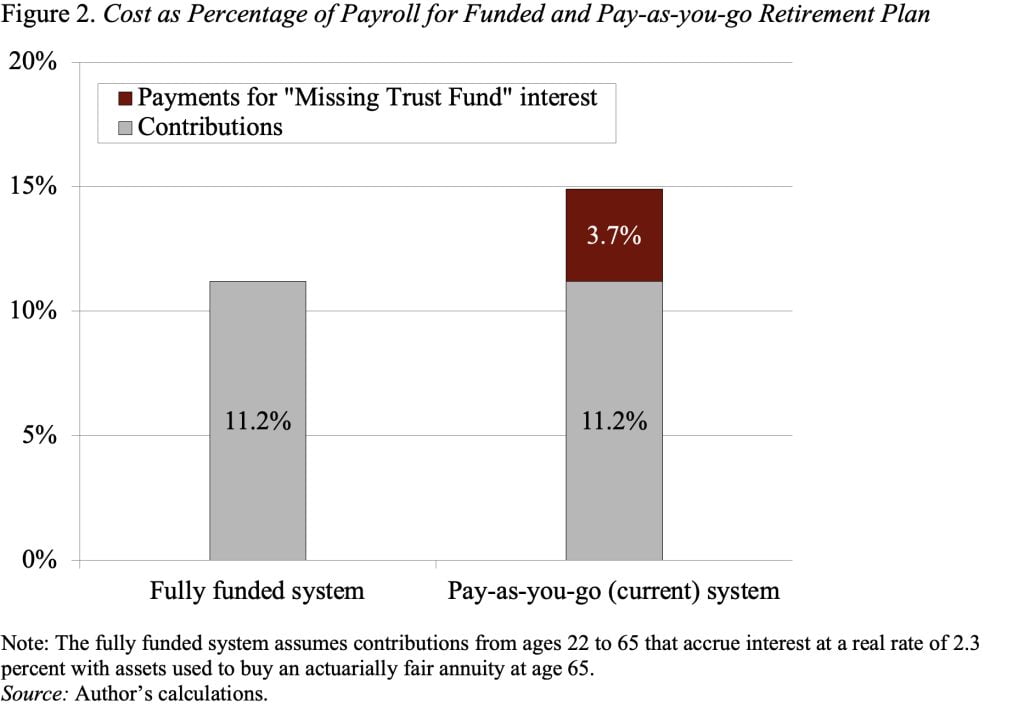
The 11.2% for the fully funded system represents the level contribution needed from age 22 to 65 to build a fund large enough to pay for retirement. The PAYG system has the same 11.2% "normal cost" but adds a 3.7% "legacy cost"—essentially the payment on the unfunded liability created when the system started and paid benefits to early generations who had not contributed for their full careers.
The Two Pillars: Social Adequacy and Individual Equity
State-provided benefit systems are almost always designed around a fundamental tension between two competing principles:
- Social Adequacy: This principle focuses on providing a basic standard of living and preventing poverty. It implies that benefits should be sufficient to meet a person's needs, which may mean redistributing funds from higher earners to lower earners.
- Individual Equity: This principle holds that benefits should be related to the contributions made. It ensures that those who contribute more receive more, maintaining a sense of fairness and a link to personal earnings.
A purely adequate system would provide a flat, universal benefit to everyone, regardless of their past earnings. A purely equitable system would function like a private savings account. Social security systems try to strike a balance between the two.
The U.S. system achieves this balance through its benefit formula, which is progressive. As you heard in the CNBC video, the formula replaces a higher percentage of pre-retirement income for low-wage earners than for high-wage earners through a system of "bend points".
The American Academy of Actuaries provides an excellent discussion of this dual objective.
[PDF] Executive Summary - American Academy of Actuaries
This issue brief delves into the social objectives of Social Security, explaining how the principles of Individual Equity and Social Adequacy interact.
Please read the section titled "Social Security Benefits...". Pay close attention to Figure 1 and the explanation of how the progressive benefit formula works to provide "proportionately more benefits for low-income people".
Earned Benefits vs. Needs-Based Assistance
The principle of social adequacy leads to an important distinction. The core Social Security program provides earned benefits based on your work history. However, the state also provides needs-based benefits for those who do not qualify for adequate earned benefits and have very limited income and assets.
In the U.S., this needs-based program is called Supplemental Security Income (SSI). It is crucial not to confuse the two. SSI is pure social adequacy, funded from general government revenues, not the specific Social Security payroll tax. The following short video makes this distinction very clear.
SSI (Supplemental Security Income) is NOT Social Security
The video "SSI is NOT Social Security" from the Medicare Mindset channel clarifies the critical difference between the two programs.
Watch from the beginning to understand the eligibility criteria for both SSI and Social Security. Then, listen to the concluding summary at the end.
This distinction is common across many countries. There is often a contributory, earnings-related social insurance program (like Social Security) sitting alongside a non-contributory, means-tested social assistance program (like SSI).

A Framework for Social Security Systems
As you prepare for your exam, it's helpful to have a "cheatsheet" to organize these concepts. This framework can be applied to analyze the state benefit system of any country.
| Concept | Description | Key Example (U.S. Context) |
|---|---|---|
| State's Roles | 1. Direct Provision: Paying benefits directly. 2. Encouragement: Incentivizing private provision. 3. Regulation: Setting rules for private providers. |
1. Social Security payments. 2. Tax deductions for 401(k) contributions. 3. ERISA regulations for private pensions. |
| Financing Models | Pay-As-You-Go (PAYG): Current contributions fund current benefits. Vulnerable to demographics. Fully Funded: Contributions are invested to pay for future benefits. |
Social Security is primarily PAYG. A private pension is Fully Funded. |
| Core Principles | Individual Equity: Benefits are linked to contributions. Social Adequacy: A minimum income floor is provided to prevent poverty. |
Equity: Higher earnings lead to higher benefits. Adequacy: Progressive "bend point" formula; SSI. |
| Types of State Benefit | Social Insurance (Earned): Entitlement based on a history of contributions. Social Assistance (Needs-Based): Eligibility based on low income/assets. |
Insurance: Social Security Retirement/Disability. Assistance: Supplemental Security Income (SSI). |
Conclusion
In this lesson, we have explored the fundamental role of the state as a provider of benefits. We established that the state acts not only as a direct provider but also as an enabler and regulator of the private benefits market.
Using the U.S. Social Security system as a case study, we dissected the mechanics of a Pay-As-You-Go system and contrasted it with a fully funded model. We also analyzed the core philosophical tension between social adequacy and individual equity, which is at the heart of public pension design. Finally, we clarified the crucial difference between contributory social insurance (earned benefits) and non-contributory social assistance (needs-based benefits).
Key Takeaways:
- The state plays three key roles in benefit provision: direct provision, encouragement, and regulation.
- Social security systems are often financed on a Pay-As-You-Go (PAYG) basis, creating an inter-generational social contract vulnerable to demographic shifts.
- The design of state benefits involves a trade-off between social adequacy (ensuring a minimum living standard) and individual equity (linking benefits to contributions).
- It's essential to distinguish between earned social insurance benefits (like Social Security) and means-tested social assistance benefits (like SSI).
Having established the foundational layer of state provision, our next lesson will move to the second major provider of benefits: employers. We will compare and contrast the two dominant forms of employer-sponsored retirement plans, Defined Benefit (DB) and Defined Contribution (DC) schemes.