Welcome to the first lesson of Module 2. In our previous module, we examined the external environment shaping the supply of financial products, culminating in a look at the regulatory bodies and the rules they enforce. Now, we pivot to explore the other side of the equation: the demand. This lesson delves into the fundamental human needs that financial products are designed to satisfy.
Your background as a social researcher gives you a unique lens for this topic. You're accustomed to studying human motivations and relationships, and you'll find that financial decisions are rarely driven by pure logic alone. The tension between rational planning and emotional desires is a central theme in understanding why people seek out financial security. Our goal today is to formalize this understanding within an actuarial context by identifying the key customer needs that financial products aim to address.
The Evolution of Financial Needs: A Hierarchy
A person's financial priorities are not static; they evolve throughout life. A useful way to conceptualize this journey is by adapting a well-known psychological model: Maslow's Hierarchy of Needs. Just as we must satisfy basic physiological needs before pursuing self-actualization, our financial needs also follow a progressive path from immediate survival to long-term fulfillment.
The following video introduces this concept, outlining five distinct levels of financial needs. This framework provides a dynamic view of how a customer's focus shifts over their financial lifetime.
The Hierarchy of Financial Needs
The video "The Hierarchy of Financial Needs" by Next Level Life provides an excellent conceptual model for understanding the progression of financial motivations.
Please watch from the introduction of the concept to the summary of the five levels. As you watch, focus on the defining characteristics of each stage: Survival: Covering the absolute essentials. Sustainability: Meeting all ongoing expenses without accumulating new debt. Accumulation: Consistently saving and investing. Independence: Passive income covers all expenses. Utilization: Using wealth to fulfill one's life purpose.
This hierarchy illustrates that the "need" for a financial product depends heavily on an individual's current financial stage. Someone in the Survival stage might need a short-term loan to put food on the table, a decision driven by immediate necessity despite high costs. In contrast, someone reaching Independence needs products that can convert a lifetime of accumulated assets into a secure income stream, addressing a completely different set of risks and goals.
A Framework for Analysing Needs
While the hierarchy provides a dynamic view, actuaries also need a structured way to classify specific needs at any given point in time. The CP1 course material provides a simple but powerful 2x2 matrix for this purpose. This framework is essential for your exam preparation.
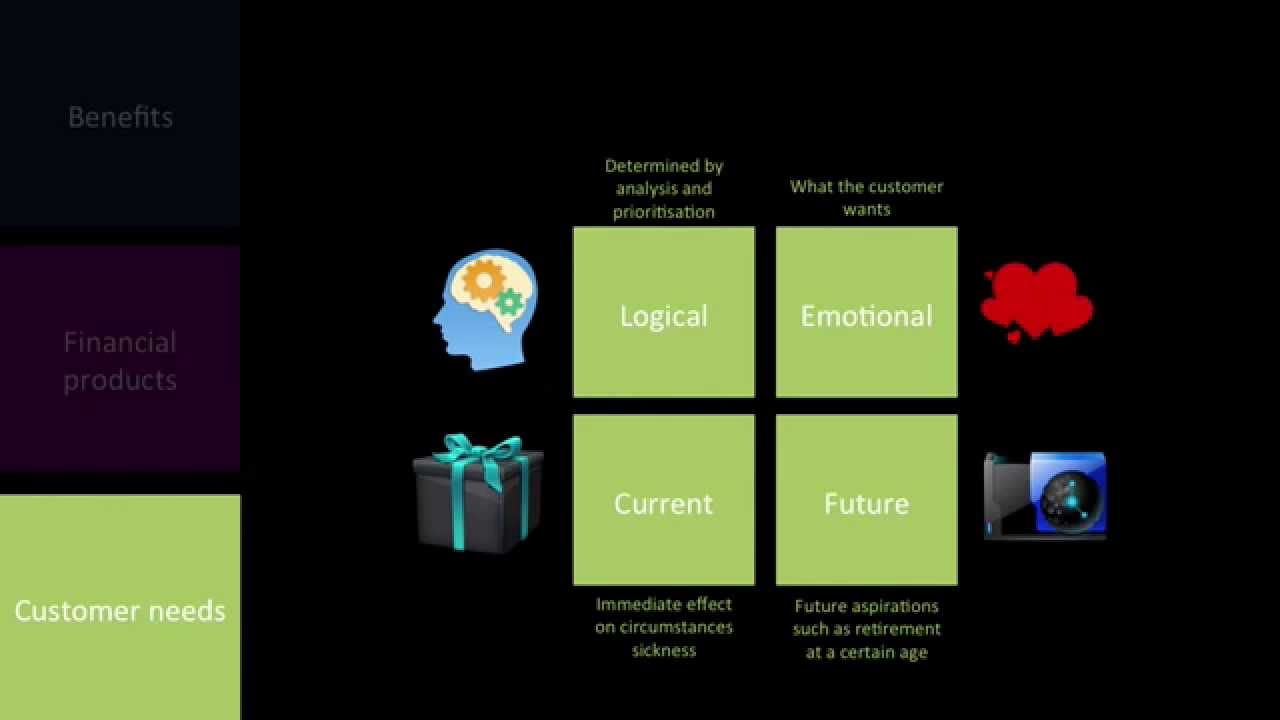
As the diagram shows, needs can be analysed along two dimensions:
- Logical vs. Emotional: A logical need is one determined through objective analysis and prioritisation (e.g., calculating the amount of life insurance needed to cover a mortgage). An emotional need is driven by what a person wants or feels is important, which may differ from a purely logical assessment (e.g., the desire for a lavish wedding).
- Current vs. Future: A current need is triggered by an event with an immediate financial impact (e.g., sickness leading to loss of income). A future need relates to longer-term aspirations (e.g., the desire to retire at age 60).
The core reading for this topic explains this framework in more detail.
[PDF] Subject CP1 - CMP Upgrade 2021/22 - Actuarial Education
This section from the ActEd CP1 notes provides the examinable framework for analysing customer needs.
Please read two parts of this document. First, review the section titled Logical or emotional needs. This explains the distinction and introduces the concept of a "fact find". Then, carefully study the table under the heading Customer needs in the Chapter 4 Summary. This provides concise, examinable definitions for each quadrant of the matrix.
Let's place some examples into this framework:
- Current & Logical: The need for income protection insurance to replace salary during a period of illness. The need is immediate and the amount required can be calculated.
- Current & Emotional: The desire to buy an expensive car or go on a luxury holiday. The need is for immediate gratification and is driven by emotion rather than a calculated financial requirement.
- Future & Logical: The need to accumulate a sufficient fund to provide a target level of income in retirement. The goal is in the future, and the required savings can be modelled actuarially.
- Future & Emotional: The desire to leave a large inheritance for one's children, not just to provide for them, but as a symbol of a successful life. The goal is future-oriented and deeply tied to personal values.
Financial products are primarily designed to meet logical needs. However, the sale of these products often appeals to a customer's emotional needs—the peace of mind that comes from knowing their family is protected, or the excitement of achieving a long-held retirement dream.
Fundamental Risks: The Core of Customer Needs
Drilling deeper, many logical needs can be expressed as the need for protection against specific, fundamental financial risks. A comprehensive study from the Society of Actuaries, Post-Retirement Financial Strategies, highlights three major risks that are particularly relevant for individuals planning for their later years. Understanding these is crucial, as they form the basis for many life insurance and pension products.
-
Longevity Risk: This is the risk of outliving your financial resources. As life expectancies increase, the period of retirement can last for 30 years or more. The fundamental need here is for an income stream that is guaranteed to last for as long as you live. This is the primary problem that annuities are designed to solve.
-
Inflation Risk: This is the risk that the purchasing power of your retirement income will be eroded over time. An income that seems adequate at age 65 may feel insufficient at age 85 if the cost of living has doubled. The need is for income that keeps pace with inflation. This is addressed by inflation-linked annuities and investments in real assets like equities and property.
-
Investment Risk (or Market Risk): This is the risk that poor performance in financial markets depletes your retirement savings, particularly if losses occur just before or early in retirement (a concept known as "sequence of returns risk"). The need is for a degree of certainty or protection from market volatility. This is addressed by products with guarantees, capital protection features, or smoothing mechanisms, such as with-profits funds.
These three risks—outliving your money, your money losing its value, and losing your money in the market—are the fundamental anxieties that drive the demand for a vast range of financial products.
Conclusion
In this lesson, we established a multi-layered understanding of customer needs, moving from the broad and conceptual to the specific and technical.
We began with the Hierarchy of Financial Needs, which illustrates how financial priorities evolve from basic survival to long-term fulfillment. We then introduced the core CP1 Needs Matrix, which provides a practical way to classify needs as Logical or Emotional, and Current or Future. Finally, we identified three Fundamental Risks—longevity, inflation, and investment—that translate into specific needs for protection, which financial products are built to provide.
The actuary's role starts here. Before a single calculation is performed for pricing or reserving, there must be a clear understanding of the human need the product is intended to meet.
Key Takeaways:
- Customer needs evolve through distinct stages, from Survival to Utilization.
- For analysis, needs can be categorised using a 2x2 matrix: Logical/Emotional and Current/Future.
- Financial products are primarily designed to meet logical needs, but their marketing often targets emotional desires like security and peace of mind.
- Many core financial needs can be framed as the need for protection against fundamental risks, especially longevity risk, inflation risk, and investment risk.
- A financial product is ultimately a solution designed to solve a specific customer problem or need.
In our next lesson, we will build on this foundation by examining the different entities that step in to meet these needs: the state, employers, and private financial institutions.