Introduction
In our previous lesson, we delved into the powerful technique of Surplus Analysis, dissecting how an insurer's financial buffer changes over time by comparing expected outcomes with actual experience. This analysis provides the raw diagnostic information. Today, we turn our attention to the formal structures used to document and communicate these insights: key actuarial reports.
This lesson will address the form and content of two pivotal reports under the Solvency II regulatory framework: the internal Actuarial Function Report (AFR) and the public-facing Solvency and Financial Condition Report (SFCR). Understanding these reports is essential, as they are the primary vehicles through which an actuary's work on valuation, risk, and profitability is presented to senior management, boards, and the public. We will explore their distinct purposes, audiences, and the specific information they are required to contain.
The Actuarial Function Report (AFR)
The Actuarial Function Report is a comprehensive, internal document submitted to the firm's board (or a relevant committee) at least annually. Its primary purpose is twofold: to enable the board to make informed decisions and to demonstrate compliance with regulatory requirements. It is not merely a statement of results; it is a detailed narrative that explains the work, judgments, and conclusions of the Actuarial Function.
The regulatory mandate for the AFR comes directly from Article 48 of the Solvency II Directive. This article tasks the Actuarial Function with a range of responsibilities, including coordinating the calculation of technical provisions and expressing opinions on underwriting and reinsurance. The AFR is the written evidence that these tasks have been performed.
The following flowchart provides a high-level view of how various streams of work and analysis culminate in the "wrap up" report from the Actuarial Function.
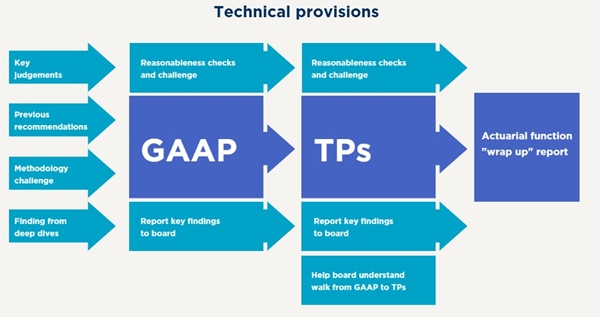
Structure and Content of the AFR
The structure of the AFR must be accessible to its audience—the board—who may not all be actuaries. Therefore, it needs to balance technical robustness with clarity. While the exact format is tailored to the insurer, a typical structure includes several key sections.
[PDF] Application of the Solvency II actuarial function to general insurance ...
This document from the UK's Institute and Faculty of Actuaries (IFoA) provides an excellent practitioner's guide to the AFR. This first reading outlines the purpose, timing, and a suggested structure for the report.
Please read section 5.4, from the heading "Actuarial Function Report" up to the end of the introductory paragraphs for the content sections. Pay close attention to the suggested headings: Executive Summary, Introduction, Technical Provisions, Underwriting, Reinsurance, and Risk Management. This provides the fundamental "form" of the report.
As you've just read, the report is built around the core duties of the Actuarial Function. Let's explore the "content" of the three most significant sections.
-
Technical Provisions (TPs): This is typically the largest and most detailed section. It documents the coordination of the TP calculation, which includes the Best Estimate Liability (BEL) and the Risk Margin (RM). Crucially, this is where the insights from the Analysis of Surplus, which we covered in our last lesson, are formally reported. The regulations require the actuary to:
- Compare best estimates against experience.
- Justify any material differences in the calculation of technical provisions from year to year.
This section essentially provides the narrative behind the numbers, explaining why the liabilities have changed and assessing the reliability of the calculations. Given your background in statistics, you can think of this as the formal report on the central estimate (the BEL) and the sources of variance around it.
-
Opinion on the Overall Underwriting Policy: The Actuarial Function must express a formal view on whether the company's pricing is adequate and sustainable. This is not just about whether last year's prices were right, but whether the forward-looking pricing strategy is sound. The opinion must consider:
- Sufficiency of Premiums: Will future premiums cover future claims and expenses, considering all risks?
- External Factors: The effect of inflation, legal risk, and changes in the portfolio mix.
- Anti-selection: The risk that the pricing and underwriting policy may disproportionately attract or retain higher-risk individuals.
-
Opinion on the Adequacy of Reinsurance Arrangements: The actuary must also opine on the effectiveness of the firm's reinsurance program. This analysis goes beyond simple cost-benefit and looks at how well the reinsurance fits the company's risk profile and strategy. Key considerations include:
- Alignment with the firm's risk appetite and underwriting policy.
- The creditworthiness of the reinsurance companies.
- How the cover is expected to perform under stress scenarios.
- The calculation of amounts recoverable from reinsurers.
To gain a deeper understanding of the specific content requirements for these sections, let's return to the IFoA paper.
[PDF] Application of the Solvency II actuarial function to general insurance ...
These sections provide the detailed regulatory requirements and practical guidance on what to include in the technical provisions and opinion sections of the AFR.
First, read Section 6, "Technical Provisions". This section is extensive; focus on the bulleted lists that specify what the Actuarial Function must explain and assess. Note how many of these points directly relate to assumption-setting and experience monitoring. Next, read Section 7, "Opinions". This explains the nature of the "opinion" and details the content required for the underwriting and reinsurance sections.
The Solvency and Financial Condition Report (SFCR)
Where the AFR is an internal, detailed report for the board, the Solvency and Financial Condition Report (SFCR) is its public-facing counterpart. Its purpose is to provide transparency to the market, including policyholders, investors, and analysts, about the insurer's business, performance, governance, risk profile, and solvency position.
It is a structured, annual disclosure that combines narrative explanations with prescribed quantitative data tables, known as Quantitative Reporting Templates (QRTs).
Form and Content of the SFCR
The best way to understand the form and content of an SFCR is to look at a real one. We will use the 2024 SFCR from Hannover Re, a major global reinsurer.
[PDF] Hannover Re Group 2024 Solvency and Financial Condition Report
This document is a complete, real-world example of an SFCR. The Table of Contents provides a perfect roadmap to the structure of the report.
Review the Table of Contents. Note the five main sections that form the structure of every SFCR: A. Business and Performance B. System of Governance C. Risk Profile D. Valuation for Solvency Purposes E. Capital Management
These five sections are mandated by the regulations. Let's briefly walk through what each contains, using the Hannover Re report as our guide.
- A. Business and Performance: This section provides context. It describes the company's business model, strategy, and summarises its financial performance for the year.
- B. System of Governance: This describes how the company is run. It outlines the board structure, key policies (like remuneration), and, critically, it describes the four key functions under Solvency II: Risk Management, Compliance, Internal Audit, and the Actuarial Function. This section of the SFCR provides a public summary of the role that generates the AFR.
- C. Risk Profile: This section discloses the company's exposure to all material risks—underwriting, market, credit, operational, and others. It explains how these risks are managed and often includes sensitivity analyses showing how the solvency position would change under various stress scenarios.
- D. Valuation for Solvency Purposes: This section presents the full Solvency II balance sheet, detailing the market-consistent value of assets and liabilities. It contains a significant sub-section on Technical Provisions, explaining the value of the BEL and Risk Margin. These are the headline figures that are supported by the detailed analysis within the internal AFR.
- E. Capital Management: This section is the conclusion of the solvency assessment. It details the company's "Own Funds" (the capital available to absorb losses) and compares it to the capital requirements (SCR and MCR) to produce the final solvency ratio. It also includes an analysis of the movement in own funds over the year, linking back to the profits and losses identified in the surplus analysis.
Finally, the report concludes with the Quantitative Reporting Templates (QRTs). These are a series of detailed, standardized spreadsheets containing the core financial data.
[PDF] Hannover Re Group 2024 Solvency and Financial Condition Report
The QRTs are the standardized data backbone of the SFCR. You don't need to memorize the details, but it's important to recognize their format and purpose.
Skim through the section titled "Quantitative Reporting Templates". Look at the templates S.02.01.02 (Balance Sheet), S.23.01.22 (Own Funds), and S.25.05.22 (Solvency Capital Requirement). This will give you a concrete sense of the level of detail and standardization involved.
Conclusion
In this lesson, we have examined the form and content of two of the most important reports in modern actuarial practice. The Actuarial Function Report (AFR) is the detailed, internal report to the board that documents the actuarial team's core work on valuation and provides key opinions on underwriting and reinsurance. The Solvency and Financial Condition Report (SFCR) is the public summary of the company's overall financial health, risk profile, and capital adequacy.
The AFR provides the technical foundation and detailed narrative, while the SFCR presents the polished, public-facing results. The analysis of surplus we studied previously is a critical engine that drives the content of both reports—explaining year-on-year movements in technical provisions for the AFR, and the overall change in own funds for the SFCR.
Now that we understand what is in these reports, our next lesson will focus on how an actuary communicates these complex findings. We will discuss the different needs of various stakeholders—from a highly technical reserving committee to a non-executive director—and the skills required to tailor the message effectively.
Key Takeaways & Cheatsheet
| Feature | Actuarial Function Report (AFR) | Solvency and Financial Condition Report (SFCR) |
|---|---|---|
| Purpose | Enable informed board decisions; demonstrate compliance of the Actuarial Function. | Public disclosure; provide transparency to the market. |
| Audience | Internal: Board of Directors, relevant board sub-committees (e.g., Audit, Risk). | External: Policyholders, investors, analysts, general public. |
| Frequency | At least annually. Can be an aggregate of component reports. | Annually. |
| Regulatory Basis | Solvency II Directive, Article 48. Delegated Regulation, Article 272. | Solvency II Directive, Articles 51-55. Delegated Regulation, Articles 290-298. |
| Key Content | Detailed "How & Why": - Deep dive on Technical Provisions calculation & movements. - Formal opinion on Underwriting Policy. - Formal opinion on Reinsurance Adequacy. - Contribution to risk management (ORSA). - Deficiencies & recommendations. |
Summarised "What": - Business performance & governance summary. - Overview of Risk Profile. - Solvency II Balance Sheet. - Own Funds, SCR, MCR, and Solvency Ratio. - Standardised Quantitative Reporting Templates (QRTs). |
| Nature | Detailed, technical, diagnostic, and forward-looking opinions. Confidential. | High-level, narrative summary combined with standardised data. Public. |