Hello! Welcome to the next lesson in our journey to becoming a systems architect.
In the last lesson, we developed the practical skill of creating Causal Loop Diagrams (CLDs) from a product description. We learned to identify variables, map their relationships, and trace the reinforcing and balancing loops that drive a system's behavior.
Today, we will apply this powerful tool to a system that is central to many modern digital products and aligns with your interest in AI: the AI recommendation engine. Our goal is to analyze a recommendation engine as a system, identifying the key feedback loops that determine its effectiveness and can also lead to unintended negative consequences. For a UX designer and architect, understanding these dynamics is critical, as they directly shape user experience, content discovery, and long-term platform health.
1. The Core of a Recommendation Engine
Before we can map the system, we need a shared understanding of what a recommendation engine does. At its heart, it's an information filtering system that aims to predict a user's preference for an item. You see them everywhere: Netflix suggesting movies, Spotify curating playlists, and Amazon recommending products.
While the underlying algorithms can be complex, the basic system structure is quite intuitive. Let's watch a short video to establish the key phases of a recommendation engine's operation.
What is an AI Recommendation Engine?
This video from IBM Technology provides a clear, high-level overview of how a recommendation engine works. Pay close attention to the five phases it describes, especially the last one.
Watch the segment from 01:11 to 04:32. This covers the five phases: data gathering, storage, analysis, filtering, and the crucial feedback loop.
As the video explained, the system isn't static. It's a learning machine powered by a feedback loop: the recommendations it provides influence user actions, and those actions are fed back into the system as new data to refine future recommendations. This loop is the engine of personalization.
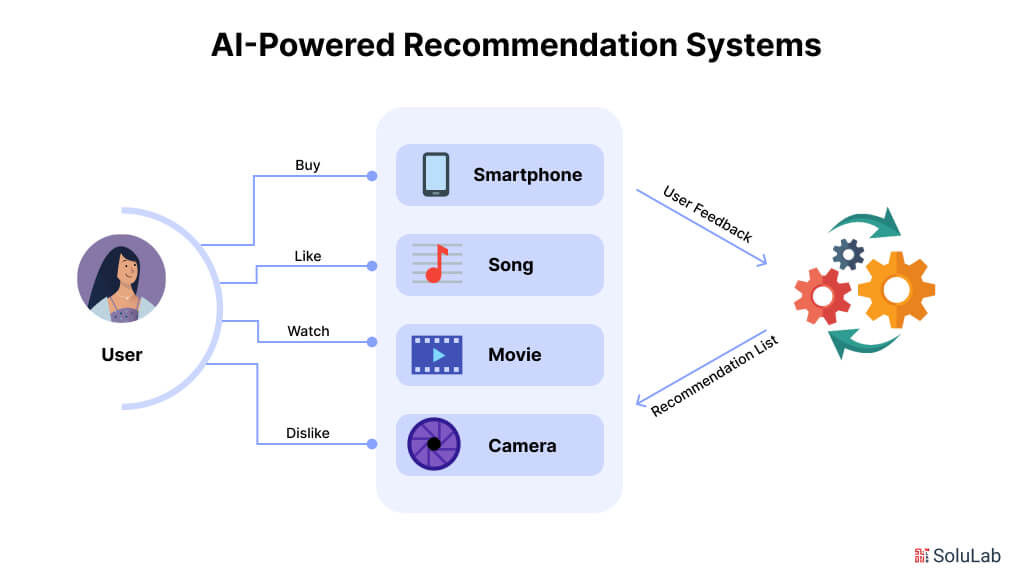
2. The Main Engine: A Powerful Reinforcing Loop
The primary feedback loop in most recommendation systems is a reinforcing one. It's often referred to as a "rich get richer" or "popularity bias" effect. Let's break it down.
Popularity Bias in Recommendation Engines
The article 'Popularity Bias in Recommendation Engines' clearly explains this dynamic. It explicitly frames popularity bias as a feedback loop, which is exactly what we need for our analysis.
Read the first two sections, 'What Is Popularity Bias?' and 'The Feedback Loop Explained'. Notice how the author breaks the loop into four distinct stages.
Based on the article, we can sketch out our first, and most important, feedback loop.
The Popularity Flywheel (R1)
- An item gets a few interactions, making it slightly more popular than others.
- The algorithm sees these interactions and increases the item's Recommendation Score.
- A higher score leads to more Recommendation Exposure (it's shown to more users).
- More exposure leads to more User Interactions.
- These new interactions are fed back into the system, further increasing the item's popularity and its recommendation score.
Let's draw this as a CLD:
A causal loop diagram showing the reinforcing loop of popularity bias. More user interactions lead to higher recommendation scores, which increases exposure, leading to even more interactions.
This is a powerful reinforcing loop (R1). It's the engine that quickly identifies and promotes engaging content. However, what happens if this loop runs unchecked? The system will recommend the same few popular items to everyone, creating a monotonous user experience and preventing new or niche items from ever being discovered.
3. Taming the Beast: Balancing Loops
An unmanaged reinforcing loop inevitably leads to stagnation or collapse. A well-architected system must have balancing loops to counteract this powerful force and maintain long-term health. These loops can be either naturally occurring or intentionally designed.
Natural Balancing Loop: User Boredom (B1)
If the popularity flywheel (R1) runs too hot, it increases Recommendation Homogeneity—everyone sees the same things. Users get tired of this.
- As Recommendation Homogeneity increases, so does User Boredom. (+)
- As User Boredom increases, overall User Interaction with the platform decreases. (-)
- A decrease in User Interaction slightly dampens the fuel for the popularity flywheel.
This is a natural balancing loop (B1) that provides a soft check on the system.
Designed Balancing Loop: Algorithmic Diversity (B2)
More importantly, system architects design balancing loops to explicitly fight popularity bias and promote discovery. These are interventions.
Aman's AI Journal • Recommendation Systems • Bias
The article 'Aman's AI Journal' discusses various biases and, more importantly, the technical solutions to mitigate them. We can think of these solutions as designed balancing loops.
Read the 'Problem' and 'Solution' sections for 'Popularity Bias' and 'Selection Bias/Feedback Loops'. You don't need to master the formulas, but focus on the core idea: the system is being deliberately modified to penalize popular items or up-weight less-exposed items to create balance.
The solutions described in the article, like "Logit Adjustment" or "Inverse Propensity Scoring," are technical implementations of a simple system concept: creating a goal-seeking balancing loop.
Let's model this as Algorithmic Diversification (B2).
- The product team sets a goal for Desired Catalog Coverage (e.g., "we want 20% of recommendations to be from new or niche items").
- The system measures the Actual Catalog Coverage.
- A Gap in Diversity is calculated between the desired and actual coverage.
- If the gap is large, the algorithm increases its Promotion of Niche Items. (+)
- This increases the Recommendation Exposure for those niche items. (+)
- This leads to more User Interactions with niche items, which in turn improves the Actual Catalog Coverage, closing the gap. (+)
This is a classic balancing loop (B2) designed to steer the system toward a specific goal (diversity).
4. The Complete System View
Now, let's put it all together. A recommendation engine is not just one loop, but a system of interacting loops.

Combining our loops gives us a more complete picture of the dynamics at play:
A complete CLD for an AI recommendation engine. R1 is the growth engine. B1 is a natural check from user boredom. B2 is a designed intervention to ensure diversity and system health.
Your analysis as a system architect would be:
- The system is driven by a powerful reinforcing loop (R1) that is essential for personalization but dangerous if unmanaged.
- A natural balancing loop (B1) exists, but it's a weak and lagging one. Relying on users to get bored and leave is not a good strategy.
- Therefore, an explicit, designed balancing loop (B2) is critical for system health. The job of the architect and product team is to define the goal for this loop (how much diversity?) and ensure the algorithm effectively pursues it.
This is a classic example of managing system trade-offs. You want the "Popularity Flywheel" to spin, but you need the "Algorithmic Diversification" brake to keep it from flying off the rails. Your role as a UX-focused architect is to advocate for the user by ensuring these balancing forces are strong enough to foster discovery and prevent a stale, homogeneous experience.
Conclusion
In this lesson, you've applied your systems thinking skills to deconstruct a complex AI system. You can now see a recommendation engine not just as a black box, but as a dynamic system of competing feedback loops.
Key Takeaways:
- AI recommendation engines are powered by a core reinforcing loop where popularity and exposure feed on each other.
- Unchecked, this "popularity bias" loop leads to a poor user experience with low diversity and novelty.
- Well-architected systems counteract this with intentional balancing loops that promote exploration and discovery (e.g., by algorithmically promoting niche content).
- Analyzing a product in terms of its feedback loops allows you to understand its core behavior and identify the key leverage points for ensuring its long-term health.
Next Lesson Preview:
The dynamic we saw today—a powerful reinforcing loop that eventually runs into limits—is a very common pattern. In our next lesson, we will formalize this pattern by studying the "Limits to Growth" system archetype. This will give us a new tool to identify and analyze potential collapse dynamics in the products we build.