Hello! Welcome to your next lesson in the Architect Track.
In our last session, we deconstructed the AI recommendation engine and saw it as a system of competing feedback loops. We identified a powerful reinforcing "popularity" loop and the essential balancing loops (like algorithmic diversity) needed to keep the system healthy. We noted that an unchecked growth loop will eventually run into problems.
Today, we're going to formalize that pattern. We'll explore one of the most fundamental and critical patterns in systems thinking: the 'Limits to Growth' archetype. This pattern explains why so many successful products, companies, and systems eventually falter, and it's a primary cause of what's known as a "collapse dynamic." For an architect, recognizing this pattern early is crucial for building systems that are sustainable, not just fast-growing.
1. From Patterns to Archetypes
As you've seen, similar feedback loop structures appear in many different contexts. Systems thinkers have identified and named these recurring structures, calling them system archetypes. Think of them as common "plots" or "storylines" that systems tend to follow. Learning to spot them is like a doctor learning to recognize the symptoms of a common illness—it drastically speeds up diagnosis and points toward effective treatment.
Let's start with a brief video that introduces this idea.
This video from the Systems Innovation Network gives a concise overview of what system archetypes are and why they are useful.
Please watch from the beginning until 01:39.
2. The 'Limits to Growth' Archetype
The video you just watched mentions the 'Limits to Growth' pattern. Now, let's dive into its specific structure. It describes a situation where a reinforcing process drives a period of accelerating growth, which is fantastic—at first. However, that very growth eventually runs into a limit or constraint, which activates a balancing process that slows, stalls, or even reverses the growth.
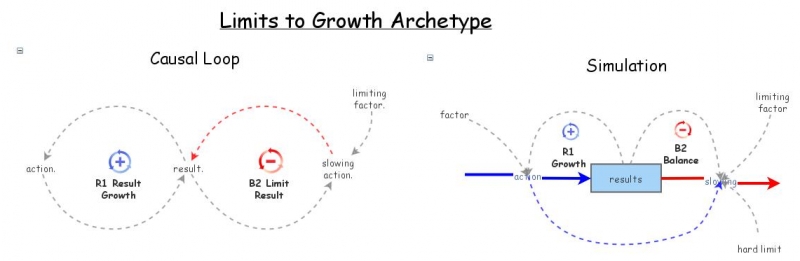
This structure is the formal version of what we observed in the recommendation engine: the 'Popularity Flywheel' (R1) was the engine of growth, but it was eventually constrained by 'User Boredom' or finite 'Catalog Variety', which acted as limiting factors.
Let's see a business-focused example that should feel very familiar from a product development perspective.
In The Loop—Chapter 8: Dealing With Archetypes
The article 'In The Loop—Chapter 8: Dealing With Archetypes' provides an excellent example of this archetype in the context of a growing engineering team.
Please read the section titled 'Limits to Growth'. It begins just after the list of 'garden variety archetypes'. Notice how initial success (a reinforcing loop) creates the conditions for its own slowdown (a balancing loop).
The example is classic:
- Reinforcing Loop: A great product leads to success and funding. With more funding, you hire more engineers, which increases development capacity, leading to a more comprehensive product, more customers, and even more success.
- Balancing Loop: But this growth creates new problems. The platform becomes more complex, coordination becomes harder, and a larger portion of engineering time is spent fixing bugs for the large customer base. These are the limiting factors. They activate a balancing loop that slows down new feature development, choking the very engine that drove the initial growth.
The typical, but incorrect, reaction is to push harder on the reinforcing loop: "Productivity is slowing? Hire more engineers!" This often makes the limiting factors—complexity and coordination overhead—even worse. The real leverage lies in identifying and alleviating the limit (e.g., by refactoring the system into microservices, as the article suggests).
3. The Collapse Dynamic: Overshoot
The 'Limits to Growth' archetype becomes especially dangerous when there are significant delays in the system. When a system grows too fast, it can overshoot its limits before the slowing effects of the balancing loop are even noticed. By the time the problem becomes obvious, the system is so far beyond its sustainable capacity that a gentle correction is impossible, and a rapid decline—a collapse—occurs.
The term 'Limits to Growth' was famously popularized by a 1972 report that used a computer model to simulate the interactions between global population, industrial growth, and Earth's finite resources. One of the report's authors, Dennis Meadows, provides a perfect explanation of this "overshoot and collapse" dynamic.
Dennis Meadows: “Limits to Growth turns 50 - Checking In” | The Great Simplification #12
In this interview, Dennis Meadows discusses the core findings of the original 'Limits to Growth' study. He uses a classic ecological case study to explain the concept of overshoot and collapse.
Watch the segment from 02:35 to 08:12. Pay close attention to his explanation of the Kaibab Plateau deer population. This is the quintessential example of overshoot and collapse.
As Meadows explains, the deer population didn't just stop growing when it reached the plateau's carrying capacity. It grew beyond it. The delay between consuming the food source and the population feeling the effects of starvation led to an overshoot. Once the food source was decimated, the population couldn't just level off; it crashed.
This is the "collapse dynamic" inherent in the archetype. In a business context, a company might aggressively acquire users with unsustainable marketing spend (the R-loop), only to find that its support capacity (the limit) is overwhelmed. By the time the negative effects—bad reviews, customer churn—are widespread, the company's reputation may be so damaged that a collapse in new user signups becomes inevitable.
4. Reading the Signs: Behavior Over Time
Given your engineering background, you'll appreciate that this system structure produces a very distinct signature in data. By plotting key variables over time, we can often see which phase of the archetype we're in and anticipate problems before they become catastrophic.
This next resource provides a more detailed breakdown of the archetype's behavior, using the synonym "Limits to Success."
This document from The Systems Thinker, 'System Archetypes III', provides a fantastic analysis of the 'Limits to Success' (or 'Limits to Growth') archetype by examining its behavior-over-time graphs.
Read the section 'FROM GROWTH TO UNCERTAINTY: THE DYNAMICS OF “LIMITS TO SUCCESS”' (pages 7-9). Focus on the description of the three 'regions' of behavior and the accompanying graphs. This is a powerful diagnostic tool.
To summarize this powerful concept, we can identify three distinct phases by observing the system's data:
- Region I: Unhampered Growth. The reinforcing loop is dominant. Efforts lead directly to results. Metrics like user growth, revenue, and feature output all look fantastic and are accelerating.
- Region II: Diminishing Returns. The balancing loop starts to apply the brakes. You are pushing harder on the growth engine (e.g., increasing marketing spend) but getting progressively less impact on the result (e.g., user growth slows). This is the critical warning sign. When you see the "effort" curve and the "result" curve diverging, you are in Region II and hitting a limit.
- Region III: Uncertain Outcomes. The limit has been hit. The growth engine stalls. The system may plateau, recover if the limit is addressed, or, in the case of a significant overshoot, collapse.
As a system architect, being able to identify the shift from Region I to Region II is a superpower. It allows you to shift the organization's focus from "push the growth engine" to "find and fix the limit" before you enter the danger zone of Region III.
Conclusion
Today we've added a crucial archetype to your systems thinking toolkit. 'Limits to Growth' is everywhere, from the rise and fall of companies to the dynamics of our global economy. Understanding this pattern moves you from simply reacting to problems to proactively managing the long-term health of the systems you design.
Key Takeaways:
- The 'Limits to Growth' archetype describes a system where a reinforcing growth loop is eventually constrained by a balancing loop that emerges as a limit is approached.
- Delays in perceiving the limit can lead to overshoot and collapse, a severe failure dynamic where the system's growth so far exceeds its carrying capacity that a sharp decline becomes unavoidable.
- The wrong intervention is to push harder on the engine of growth. The correct, high-leverage intervention is to identify and address the limiting factor.
- We can diagnose this pattern by looking at behavior-over-time graphs and identifying the shift from unhampered growth to diminishing returns.
Next Lesson Preview:
Now that you have a formal understanding of this critical archetype, the next step is to apply it. In our next lesson, we will practice identifying potential collapse scenarios in the system models you've been developing, using 'Limits to Growth' as our primary analytical lens.