Hello! Welcome back to our module on Strategic Foresight & Failure Analysis.
In our last two lessons, we focused on identifying and mitigating potential failures. We started with inversion to imagine what could go wrong, and then structured that thinking with a pre-mortem to create an actionable plan. These tools help you analyze specific failure modes.
Today, we're going to zoom out. Instead of looking at individual points of failure, we will learn to assess a system's fundamental character and how it responds to stress, randomness, and uncertainty. This is a crucial concept for designing systems that can survive—and even thrive—in a volatile world.
Your learning outcome for this lesson is to classify a system's response to stress as fragile, robust, or antifragile.
1. The Triad: Fragile, Robust, and Antifragile
These concepts were popularized by the author and risk analyst Nassim Nicholas Taleb. Understanding the distinction between them is key.
- Fragile: Hates volatility, randomness, and stressors. It breaks or degrades when exposed to them. Think of a porcelain cup.
- Robust: Resists stressors and remains unchanged. It can withstand a shock up to a point, but it doesn't improve. Think of a solid steel beam.
- Antifragile: Loves volatility and randomness. It gains from disorder and becomes stronger when exposed to stressors (up to a certain point). Think of the human immune system, which gets stronger after being exposed to pathogens.
A common mistake is to think that "robust" is the opposite of "fragile." It's not. The true opposite of a system that is harmed by volatility is one that benefits from it.
To get a clear overview of these ideas, please watch the beginning of the following video summary of Taleb's book, Antifragile.
ANTIFRAGILE SUMMARY (BY NASSIM TALEB)
This video from The Swedish Investor provides an excellent and concise introduction to the 'triad' of fragile, robust, and antifragile.
Please watch from 00:41 to 04:46. Focus on the core definitions and the examples used to illustrate each category (e.g., the mythological figures, the corporate employee vs. the YouTuber).
This table provides another useful way to visualize the differences across various domains.
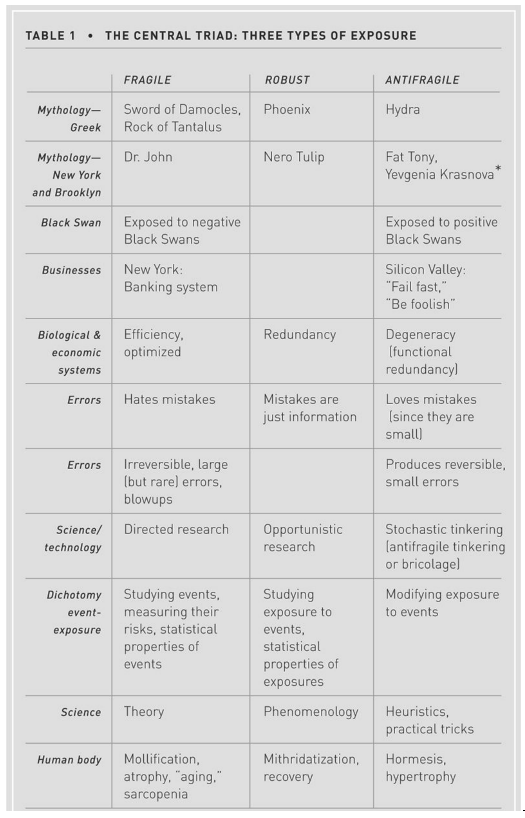
2. The Underlying Principle: Nonlinear Response
This "triad" is more than just a useful metaphor; it describes a fundamental mathematical property of systems. The key is nonlinearity.
From your mechanical engineering background, you'll be familiar with stress-strain curves that show how a material's response to a load is not always linear. Fragility and antifragility follow a similar principle.
- A fragile system has a concave response to stressors. This means the harm from a large shock is disproportionately greater than the sum of harm from many small shocks.
- An antifragile system has a convex response. The benefit from a large stressor is disproportionately greater than the sum of benefits from many small stressors.
The graph below visualizes these different responses to stress. Notice the shape of the curves. The fragile system's curve accelerates downward (concave), while the antifragile system's curve accelerates upward (convex).

To hear this explained by Taleb himself, please watch the following segment from one of his lectures. He uses the examples of a car crash and body temperature to make the concept of nonlinear response very clear.
Dr. Nassim Taleb: Fragility, Robustness, and Antifragility.
In this clip, Dr. Nassim Taleb explains the mathematical foundation of fragility: a nonlinear, concave response to shocks.
Watch from 14:00 to 18:49. Pay close attention to his explanation of how 'acceleration of harm' defines fragility and how you can use variance (like the temperature example) to detect it.
3. Antifragility in Digital and AI Systems
This framework is incredibly relevant to designing digital products, especially those powered by AI. Most current AI systems are optimized for stable, predictable conditions, which makes them inherently fragile.
The goal of a robust system is simply to survive disruption. An antifragile system, however, uses disruption to improve. Let's see how this works in practice.
The "Anti-Fragile" AI Agent: Building Systems That Thrive on ...
The article 'The "Anti-Fragile" AI Agent' provides a clear distinction between robust and antifragile systems in a product context.
Please read the section titled 'Why Robustness Isn't Enough'. Focus on the comparison between a robust and an antifragile recommendation engine during a market disruption.
As the article notes, the robust system survives, but the antifragile system emerges with new competitive advantages. This happens when systems are designed to treat errors and unexpected events as valuable information.
The following resource gives excellent examples of how this is implemented in real-world AI systems at major tech companies.
Taming Chaos with Antifragile GenAI Architecture - O'Reilly Media
This O'Reilly article, 'Taming Chaos with Antifragile GenAI Architecture,' details how companies like Amazon and Netflix build antifragile capabilities into their AI platforms.
Please read the following sections: 'The Antifragility Imperative,' 'Generative AI: Building Antifragile Capabilities,' and 'Error as Information: Learning from Failure.' As you read, notice how these systems are designed with feedback loops that allow them to learn continuously from disorder, such as supply chain chaos or negative user feedback.
The key takeaway is that an antifragile architecture doesn't just handle errors; it learns from them. This is a profound shift from a defensive posture to an offensive one, where volatility becomes a strategic asset.
4. The Limits of Antifragility
It's crucial to understand that no system is antifragile to an infinite amount of stress. Just as a bone gets stronger from the stress of exercise but will break under extreme impact, all antifragile systems have a threshold. Beyond this point, they too become fragile.
Taleb describes this using an "S-curve." A system can be convex (antifragile) at lower levels of stress but becomes concave (fragile) as the stress becomes too great.
Let's hear Taleb explain this important caveat.
Dr. Nassim Taleb: Fragility, Robustness, and Antifragility.
In this final clip from his lecture, Dr. Taleb discusses the natural limits of antifragility.
Watch from 32:06 to 37:28. Focus on his explanation of the 'S-curve' and the weightlifting analogy: lifting 100 kilos strengthens your bones, but 1000 kilos will crush you. This illustrates that antifragility always exists within a specific range.
As a system architect, part of your job is to understand not only how to build for antifragility but also to identify the boundaries where the system's response might flip from beneficial to catastrophic.
5. Practical Exercise: Classifying Systems
Now, let's apply these concepts. Read the three mini-scenarios below. For each one, classify the system's response to the described stressor as Fragile, Robust, or Antifragile, and write a brief (1-2 sentence) justification for your choice.
Scenario 1:
A company launches a new mobile app. The UI was designed and tested on the latest iPhone model. When users with older phones or different Android devices download the app, they find that text overlaps, buttons are unreachable, and the layout is broken, making the app unusable for them.
- Classification:
- Justification:
Scenario 2:
A large e-commerce site uses a Content Delivery Network (CDN) with servers distributed globally. During a flash sale, traffic spikes massively, and the primary server in North America becomes overloaded and fails. The CDN's architecture automatically reroutes all traffic to a secondary cluster of servers. Users experience no downtime or performance degradation.
- Classification:
- Justification:
Scenario 3:
A fintech app uses an AI model to detect fraudulent transactions. A new, sophisticated type of "phishing" attack emerges that the model has never seen before. For the first few hours, several fraudulent transactions are successful. However, the system is designed to flag these high-confidence predictions that result in user-reported chargebacks. This triggers an automated process that uses the data from these failures to retrain a part of the model. Within a day, the AI is not only able to block the new attack vector but has also improved its accuracy in detecting older fraud patterns.
- Classification:
- Justification:
Take about 15 minutes to complete this exercise. This will help solidify your ability to apply the triad to real-world technical systems.
Conclusion
In this lesson, we have moved beyond analyzing specific failures to understanding a system's fundamental character in the face of uncertainty.
Key Takeaways:
- Systems can be classified based on their response to stress: Fragile (breaks), Robust (resists), or Antifragile (improves).
- This distinction is rooted in a mathematical property of nonlinearity. Fragile systems have a concave response to harm, while antifragile systems have a convex response to stress.
- In digital products, antifragility is often achieved through architectures that treat errors, volatility, and user feedback as valuable information for learning and improvement.
- Antifragility is not limitless. Every system has a threshold beyond which a stressor becomes harmful.
Next Lesson Preview:
We have now explored how to identify individual failure modes (pre-mortem) and how to classify a system's general response to stress (the triad). In our next lesson, we will synthesize these skills for the Phase 1 Case Study. You will analyze a real-world trust-collapse scenario on a major platform, using causal loop diagrams to map out how the system's inherent fragilities led to a catastrophic, cascading failure.