Introduction
Hello! Welcome to the first lesson of Module 8, Engineering Trust in AI Systems.
In our previous module, we focused on the technical plumbing of decision systems, culminating in our last lesson where you created a Data Flow Diagram (DFD). That exercise gave you a map of how data moves within the machine. Now, we pivot to an equally critical flow: the one that happens within the user's mind.
Today's lesson addresses the learning outcome: Distinguish between System 1 (intuitive) and System 2 (deliberate) thinking in the context of user interaction with AI. We will explore a foundational concept from cognitive psychology pioneered by Nobel laureate Daniel Kahneman. Understanding this dual-process model of the human mind is essential for designing AI systems that are not just powerful, but also safe, effective, and trustworthy.
For you as a UI/UX designer, this is a natural extension of your work. You already design to manage cognitive load and guide user attention. This lesson will provide a powerful framework to formalize that intuition, especially when the "user" is collaborating with a non-human "agent."
1. The Two Systems of the Mind
Our thinking is governed by two distinct modes of operation. Daniel Kahneman calls them System 1 and System 2.
- System 1 is our fast, automatic, intuitive, and unconscious mode. It's what you use to recognize a friend's face, finish the phrase "salt and...", or get a "gut feeling" about something. It operates effortlessly and is our default state.
- System 2 is our slow, deliberate, analytical, and conscious mode. It's the thinking you engage when solving a complex math problem, comparing two different products, or learning a new skill. It requires effort and attention.
To get a direct introduction to these concepts from the source, please watch this short video featuring Daniel Kahneman.
Daniel Kahneman: Thinking Fast vs. Thinking Slow | Inc. Magazine
In this video, 'Daniel Kahneman: Thinking Fast vs. Thinking Slow,' Kahneman himself provides a clear and concise definition of System 1 and System 2.
Please watch from the beginning until 01:33. Focus on the core distinctions he makes between what is automatic and involuntary (System 1) versus what is effortful and deliberate (System 2).
This mind map provides a helpful visual summary of the characteristics of each system.
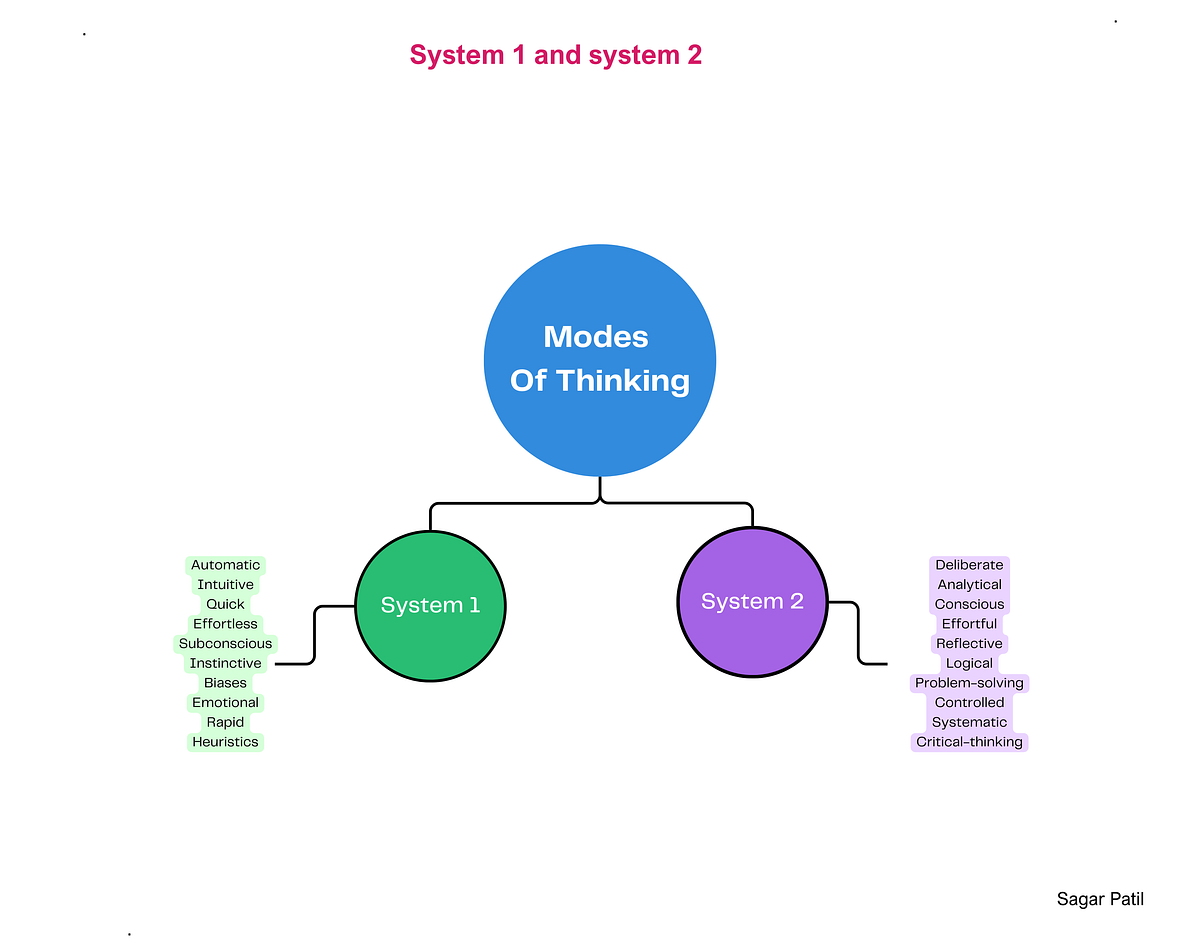
Here is a summary table for quick reference:
| Feature | System 1 (Fast Thinking) | System 2 (Slow Thinking) |
|---|---|---|
| Operation | Automatic, effortless, involuntary | Deliberate, effortful, controlled |
| Speed | Very fast | Slow |
| Driver | Intuition, habit, heuristics | Logic, reason, analysis |
| State | Always on, default mode | Standby, engaged when needed |
| Example | Recognizing an angry tone of voice | Calculating the tip on a restaurant bill |
While System 1 is incredibly efficient for navigating daily life, its reliance on mental shortcuts (heuristics) can lead to systematic errors or biases. System 2 can override these impulses, but it's "lazy" and tires easily. This dynamic is the source of many of our best insights and our worst mistakes.
2. Large Language Models (LLMs) as System 1 Thinkers
Now, let's apply this framework to the AI tools you're familiar with. Where do models like ChatGPT fit in? The prevailing analogy, supported by Kahneman himself, is that current LLMs operate much like a powerful System 1.
Let's hear Kahneman make this connection directly.
Daniel Kahneman: Deep Learning (System 1 and System 2) | AI Podcast Clips
This clip from the Lex Fridman Podcast, 'Daniel Kahneman: Deep Learning (System 1 and System 2),' directly addresses how modern AI relates to his framework.
Please watch from 00:16 to 01:29. Notice how he describes deep learning as a 'System 1 product' that excels at pattern matching and prediction but lacks the ability to reason or understand causality.
LLMs are brilliant pattern-matchers. Trained on vast datasets, they can generate fluent, coherent text almost instantly. This is analogous to System 1's rapid, intuitive responses based on a lifetime of experience. However, they don't "reason" in a deliberate, logical way. They predict the next most probable word.
This leads to several key parallels:
- Speed: LLMs are incredibly fast, just like System 1.
- Heuristics: They operate on learned patterns and correlations, not on logical rules or a model of the world.
- Confidence without Accuracy: They can produce confident-sounding but factually incorrect statements ("hallucinations"), much like System 1 can feel certain about a wrong intuition.
- Lack of Deliberation: They don't "check their work" or reason through steps in the way System 2 does.
To explore this analogy in more detail, the following article provides an excellent breakdown.
The article 'Beyond Pattern Matching' from F'inn offers a great analysis of why LLMs are so similar to System 1 and why they struggle with System 2 tasks.
Please read the sections titled 'LLMs AND SYSTEM 1 THINKING' and 'THE CHALLENGE OF SYSTEM 2 THINKING FOR LLMS'. Focus on how the pattern-matching nature of LLMs mirrors our System 1, and why tasks requiring logical consistency and multi-step reasoning are so difficult for them.
3. The Design Challenge: AI's System 1 Meets the User's System 2
Here is the central problem for a Decision Systems Architect: We often use AI tools (System 1) for tasks that require human deliberation and analysis (System 2).
When an AI provides a fluent, confident answer, our own "lazy" System 2 is tempted to accept it without scrutiny. This creates a significant risk, especially in high-stakes domains like fintech, engineering, or medical diagnosis. The AI's speed and fluency can lull the user into a passive, System 1 mode of thinking when they should be actively engaged in System 2.
So, how do we design interactions that prevent this? The goal is not to eliminate System 1, but to design AI tools that prompt the user to engage their System 2 at the right moments.
Engineering Experience in the Age of AI
This article, 'Engineering Experience in the Age of AI,' provides a fantastic perspective on this very design challenge, particularly in a professional context.
Please read the sections 'Everyday AI' and 'Engineering with AIs'. Pay close attention to the idea that AI can 'draw us into System 1' and the proposed solutions, such as using AI to explore thousands of options rather than providing a single 'best' design. This shifts the human's role from passive acceptance to active, System 2-driven analysis.
As the article suggests, effective AI-human collaboration often involves designing the system to enhance, not replace, human thinking. Instead of having the AI deliver a final answer, we can have it generate possibilities, highlight trade-offs, or provide data-driven insights that require the user to engage their analytical mind to make the final call.
4. Your Turn: Analyzing AI Interactions
Let's apply this framework. Consider two different AI-powered features. Your task is to analyze how each one engages the user's cognitive systems.
Scenario A: "Smart Reply" in a messaging app
An AI suggests three short, one-tap replies to an incoming message (e.g., "Sounds good!", "I'll be there!", "Can't make it").
Scenario B: AI-powered "Portfolio Rebalancer" in a fintech app
A user's investment portfolio has drifted from its target allocation. The AI analyzes the market and suggests a single, optimized trade to rebalance it, presenting it with a "One-Click Rebalance" button.
For each scenario, please reflect on the following questions:
- Which cognitive system (1 or 2) is this feature primarily designed to appeal to? Why?
- What are the benefits of this design choice in this specific context?
- For Scenario B (the high-stakes one), what is the main risk of the user relying solely on their System 1 to interact with this feature?
- Propose one UI/UX change for Scenario B that would encourage the user to engage their System 2 before accepting the AI's suggestion. (e.g., How could you present the information differently?)
Take about 10 minutes to think through your answers. This exercise will help you practice distinguishing between the two systems in the context of real product design.
Conclusion
In this lesson, we've established a critical psychological framework for understanding how users interact with AI.
Key Takeaways:
- Human cognition operates via two modes: System 1 (fast, intuitive) and System 2 (slow, deliberate).
- Current AI, especially LLMs, can be understood as powerful System 1-like engines, excelling at rapid pattern-matching but lacking true reasoning.
- A key design challenge is that AI's System 1 output is often used for tasks requiring the user's System 2 engagement, creating a risk of uncritical acceptance.
- As designers and architects, our goal is to create interactions that prompt the user's System 2 at critical moments, shifting their role from passive consumer to active analyst.
Next Steps
Now that you can distinguish between these two modes of thinking, we can start designing for them. In our next lesson, we will tackle a specific technique to help users navigate this space: Designing a UI component that communicates an AI's confidence level for a recommendation. This is one of the most direct ways to give your user a signal about when they should slow down and engage their System 2.