Introduction
Hello! In our last lesson, we examined model drift, the gradual, unintentional decay of an AI model's performance as the world changes around it. We focused on monitoring for this natural degradation to know when a model needs retraining.
Today, we shift our focus from unintentional decay to intentional sabotage. What happens when a bad actor purposely contaminates the data an AI learns from? This is the risk of data poisoning, an adversarial attack designed to manipulate a model from the inside out.
Our learning outcome for this lesson is to describe data poisoning as a risk and how monitoring can help detect it. Understanding this threat is critical for any architect building robust systems, as a model that can be easily manipulated is a significant security vulnerability and a major threat to user trust.
1. Understanding the Risk of Data Poisoning
Data poisoning is the act of intentionally corrupting a model's training data to cause it to make specific mistakes or to degrade its overall performance.
To build on an analogy from our last lesson, if model drift is like the natural fatigue of a metal component over time, data poisoning is like deliberately introducing a microscopic impurity into the metal alloy during its manufacturing. This hidden flaw can cause the component to fail unexpectedly under specific, attacker-chosen conditions, even while it appears perfectly fine during normal operation.
To begin, please read this short introduction that defines AI poisoning.
What Is AI Poisoning? | Oracle Canada
This article from Oracle provides a concise and clear definition of AI poisoning and the motivations behind such attacks.
Please read the sections 'What Is AI Poisoning?' and 'AI Poisoning Explained'. Focus on the core definition and the different forms of attack mentioned, like 'label flipping' and 'data injection'.
The core idea is that an attacker manipulates the data the model learns from. This causes the model to learn an incorrect "map" of the world.

To explore this concept in more detail, let's watch a video that breaks down the mechanics and objectives of data poisoning.
AI/ML Data Poisoning Attacks Explained and Analyzed-Technical
The video 'AI/ML Data Poisoning Attacks Explained and Analyzed' provides a technical yet accessible overview of these attacks.
Please watch the segments from 01:09 to 01:58 and from 03:55 to 04:54. The first part defines the attack, and the second part explains the crucial difference between two attacker goals: simply degrading performance versus creating a targeted 'backdoor'.
As the video explains, there are two main goals for a data poisoning attack:
- Availability Attack: To cause a general degradation of the model's performance, reducing its accuracy and making it unreliable. This is noisy and often easier to detect.
- Integrity/Backdoor Attack: To cause a specific, targeted misbehavior that only occurs when the model sees a particular input (a "trigger"). This is far more insidious because the model appears to function perfectly normally the rest of the time.
From a systems design perspective, the backdoor attack is the more dangerous risk because it can go undetected while silently undermining the system's integrity.
2. How an Attacker Poisons Your Data
To defend against data poisoning, you first need to understand the attack vectors—the pathways an attacker can use to inject malicious data into your training set. Modern AI systems often learn from a wide variety of sources, each presenting a potential vulnerability.
Let's return to the video to see how attackers can achieve this.
AI/ML Data Poisoning Attacks Explained and Analyzed-Technical
This next segment of the 'AI/ML Data Poisoning Attacks' video details the common entry points for poisoned data.
Please watch from 07:05 to 10:20, and then from 13:56 to 15:10. The first part covers attack vectors like open data repositories, web scraping, and live data ingestion. The second part discusses real-world examples, including the infamous Microsoft Tay chatbot and attacks on Gmail's spam filter.
The key attack vectors mentioned are:
- Public Data Sources: Poisoning data in open repositories or on public websites that are scraped for training data.
- Crowdsourced or User-Generated Content: Malicious users directly providing mislabeled or harmful data (as in the case of the Tay chatbot).
- Live Data Ingestion: Exploiting systems that learn in real-time from user interactions.
- Supply Chain Attacks: Poisoning popular pre-trained models that other developers then download and build upon (a form of "transfer learning").
The Microsoft Tay example is a powerful reminder of how quickly a model that learns from live, unvetted public input can be corrupted. This highlights a fundamental tension for system architects: the desire for a model to continuously learn and improve versus the security risk of opening it up to potentially malicious data streams.
3. How Monitoring Helps Detect Poisoning
Just as we monitor for model drift, we must also monitor for data poisoning. The good news is that many of the same principles apply. We are still looking for unexpected changes in the model's behavior and performance. The key difference is the mindset: with drift, we look for gradual decay; with poisoning, we look for sudden, anomalous spikes or bizarre, targeted failures.
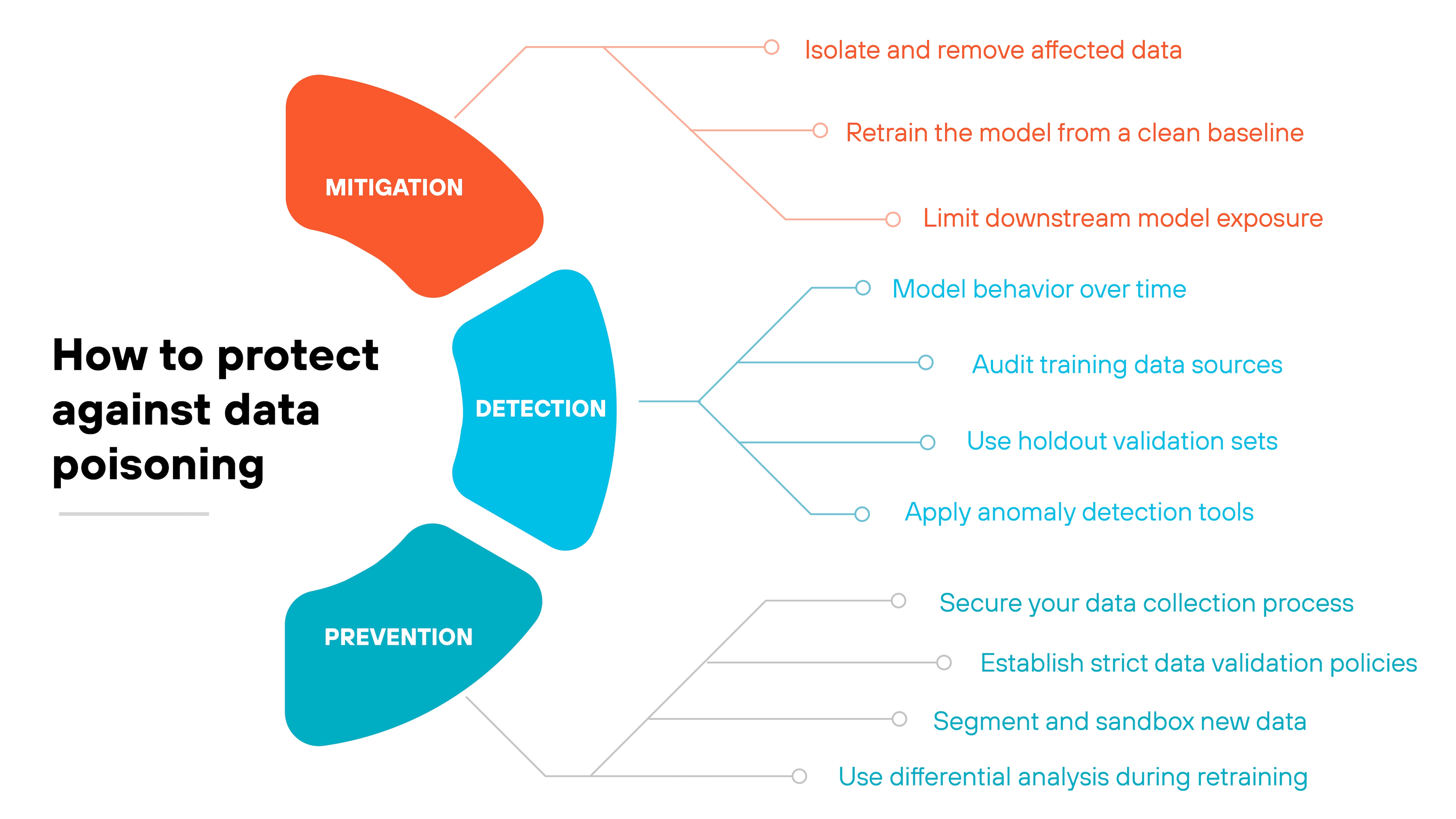
The following article provides a superb list of "symptoms" that can indicate a data poisoning attack. These symptoms are precisely the signals you should be monitoring for.
The CrowdStrike article 'Data Poisoning: The Exploitation of Generative AI' offers practical guidance on what to look for when trying to spot an attack.
Please read the section 'Data poisoning symptoms' and the subsection 'Monitoring, detection, and auditing' under 'Data poisoning defense best practices'. The table of symptoms is especially useful—think of these as the key metrics for an AI Health Dashboard designed to spot adversarial attacks.
To summarize the key monitoring strategies for detecting data poisoning:
- Monitor for Model Degradation: Track core accuracy and performance metrics over time. A sudden, sharp drop is a major red flag. This is similar to drift monitoring but you're looking for abrupt changes, not slow decay.
- Monitor for Unintended Outputs (Anomalies): This is crucial for detecting targeted backdoor attacks. You should implement anomaly detection on the model's outputs. For example:
- Are there sudden spikes in a specific classification for a very specific input?
- Is the model outputting text that is out of character, biased, or nonsensical?
- Is there a sudden change in the distribution of predicted outcomes?
- Monitor Input Data: Before data even enters the training pipeline, it should be monitored for anomalies. Are there strange new data points that don't match the expected distribution? Are there batches of data with unusual labeling patterns?
- Monitor User Behavior: As with drift, your users are often the first to notice a problem. Track:
- A sudden increase in users correcting or overriding the AI's output for a specific task.
- Spikes in negative feedback or reports specifically mentioning bizarre AI behavior.
By implementing continuous monitoring across the data pipeline—from input validation to output analysis—you create a defense-in-depth strategy that makes it much harder for a poisoning attack to go unnoticed.
4. Your Turn: A Fintech Scenario
Let's apply these concepts to a practical scenario relevant to your interests.
Scenario: A fintech company provides an app that helps freelancers categorize their bank transactions as "Personal" or "Business Expense" for tax purposes. The AI model learns from user corrections to improve its classifications. An attacker wants to poison the model so that transactions from a specific luxury watch brand are misclassified as "Business Expense," allowing for fraudulent write-offs.
Your Task (5-10 minutes):
- Attack Vector: Based on the video you watched, what is the most likely attack vector here?
- Monitoring Signal: Imagine you are designing the AI Health Dashboard for this feature. What single metric would be the most effective at flagging this specific, targeted attack? Be precise. (e.g., "Overall accuracy" is too broad).
- UX Risk: From a user experience and trust perspective, what is the primary risk if this attack goes undetected?
Think it through and jot down your answers. This will help solidify the connection between the abstract threat and the concrete monitoring required to stop it.
Conclusion
In this lesson, we've defined data poisoning as a deliberate, adversarial attack on the integrity of an AI model. Unlike model drift, which is a natural process, poisoning is a malicious act that requires a security-oriented monitoring approach.
Key Takeaways:
- Data poisoning is the intentional corruption of training data to manipulate an AI model's behavior, either by degrading its overall performance or creating targeted backdoors.
- Attackers can inject poison through various vectors, including public datasets, user-generated content, and compromised pre-trained models.
- Monitoring is a critical defense. By tracking model performance, looking for anomalies in output behavior, validating input data, and analyzing user feedback, we can detect the symptoms of a poisoning attack.
- Designing systems that are robust against poisoning requires thinking like an adversary and building the instrumentation to catch them.
Next Steps
So far, we have explored how to detect when a model's behavior has degraded, either through natural drift or malicious poisoning. But what happens once you detect an issue? How do you trace the bad decision back to its source and assign responsibility? In our next lesson, we will explore this by learning how to define an accountability chain for an AI-powered decision, a crucial component of building truly trustworthy and governable AI systems.