Introduction
Welcome to your next lesson. In our previous discussion, we traced the East India Company's transformation from a commercial entity into a territorial sovereign, culminating in the 1765 Treaty of Allahabad. That treaty granted the Company the Diwani—the right to collect revenue—from Bengal, Bihar, and Orissa. This fundamentally altered the Company's business model: its primary goal was no longer just profit from trade, but the systematic extraction of wealth from the land itself.
This lesson directly addresses the next logical step in that story. We will explore the answer to the question: How did the British design and implement systems to manage this vast new "asset"? Our learning outcome is to describe the early British revenue systems (Permanent Settlement, Ryotwari, and Mahalwari) and their socio-economic impact.
Given your background in finance, you can view this as the EIC, having completed a hostile takeover, now needing to establish the fiscal architecture to manage its new subsidiary. They experimented with different models of revenue collection, each with its own assumptions, stakeholders, and ultimately, profound consequences for the Indian economy and society.
The Revenue Imperative: Why New Systems?
Upon acquiring the Diwani, the EIC initially tried to continue the existing system of revenue collection, but this proved chaotic and inefficient. The dual system of administration led to rapacious plunder and contributed to the devastating Bengal Famine of 1770. The Company's directors in London demanded a more stable, predictable, and maximized revenue stream to fund its trade, military adventures, and administrative costs.
This led to a profound debate among British officials, influenced by contemporary European economic theories, about the best way to "settle" the land revenue. Their goal was to create a regularized and contractual system, replacing the fluid, custom-based arrangements of the pre-colonial era.
To understand this transition from the pre-British context to the Company's new revenue-focused strategy, let's begin with a video that sets the stage.
L17: Land Reforms by British l Modern Indian History | UPSC CSE 2021 l Dr. Mahipal Rathore
Dr. Mahipal Rathore's lecture on 'Land Reforms by British' provides an excellent starting point. This initial segment explains the Company's motivations for overhauling the revenue system and the financial pressures that drove this imperative.
Please watch from 03:44 to 12:00. The first part (until 07:44) provides a brief overview of the pre-colonial Mughal system for context. The second part (from 07:44) details precisely why the EIC, after gaining Diwani rights, felt compelled to create new systems to fund its purchases, army, and administration, and how their initial mismanagement had catastrophic consequences.
As you saw, the need for a stable revenue source was paramount. The British experimented with three major systems across India, each shaped by the ideology of its creators, the timing of the conquest, and the existing social structures in the region.

Let's examine each system in detail.
1. The Permanent Settlement (Zamindari System)
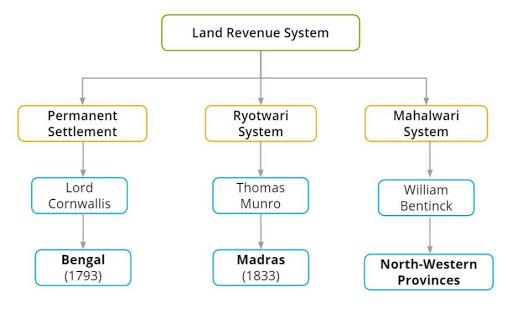
The first major experiment was the Permanent Settlement, introduced in Bengal and Bihar in 1793 by Governor-General Lord Cornwallis. Influenced by the English model of a landed aristocracy, Cornwallis believed that creating a class of private landowners would ensure loyalty to the British and encourage investment in agriculture.
Key Features:
- Landlords as Owners: The system recognized the local tax collectors, or Zamindars, as the owners of the land. This was a radical departure from the pre-colonial system where the state or village community held ultimate ownership.
- Fixed Revenue: The land revenue the Zamindar had to pay to the state was fixed in perpetuity. The British would never increase this amount.
- Zamindar's Role: The Zamindar was responsible for collecting rent from the peasants (
ryots) cultivating the land. The difference between the rent he collected and the fixed revenue he paid to the state was his profit. - "Sunset Law": The revenue payment was subject to a strict deadline. If the Zamindar failed to pay by sunset on the due date, his lands would be auctioned off.
The following video provides a comprehensive explanation of this system's mechanics and its eventual failure.
L17: Land Reforms by British l Modern Indian History | UPSC CSE 2021 l Dr. Mahipal Rathore
Let's return to Dr. Rathore's lecture. This segment provides a deep dive into the Permanent Settlement.
Watch from 12:00 to 25:13. Focus on the features of the system, the British rationale behind it (creating a loyal class, encouraging investment), and the devastating, unintended consequences such as peasant exploitation, the rise of absentee landlordism, and the creation of numerous intermediary rent-collectors.
The system, intended to create agricultural prosperity, largely failed. While it secured a stable income for the Company, it proved disastrous for the peasantry, who were reduced to the status of tenants-at-will with no rights, subject to exorbitant rents and eviction. The Zamindars rarely invested in land improvement; instead, a complex system of sub-letting emerged, with multiple layers of intermediaries, each taking a cut and further impoverishing the actual cultivator.
2. The Ryotwari System
In southern and western India, the British encountered different social structures without a strong Zamindar-like class. The failures of the Permanent Settlement also prompted a different approach. Championed by administrators like Thomas Munro in the Madras Presidency around 1820, the Ryotwari System was born.
Key Features:
- Direct Settlement with the Cultivator: The settlement was made directly with the
ryot(peasant). - Peasant as Owner: The
ryotwas recognized as the proprietor of the land, with the right to sell, mortgage, or transfer it. - Variable Revenue: The revenue was not fixed permanently. It was assessed for a period of 20 to 30 years, based on soil type and the land's estimated potential, and was subject to revision.
3. The Mahalwari System
A third system, the Mahalwari System, was introduced in the North-Western Provinces, Punjab, and parts of Central India by Holt Mackenzie in 1822. It was a compromise between the Zamindari and Ryotwari systems.
Key Features:
- Unit of Settlement: The unit of assessment was the village or a group of villages, known as the
mahal. - Collective Responsibility: The villagers were held jointly responsible for paying the revenue for the
mahal. - Village Headman: The village headman or a committee collected the revenue from individual peasants and paid it to the state.
This next segment from the same video explains both the Ryotwari and Mahalwari systems.
L17: Land Reforms by British l Modern Indian History | UPSC CSE 2021 l Dr. Mahipal Rathore
Continuing with the same lecture, this part covers the other two major systems.
Watch from 25:13 to 31:14. Pay attention to how each system differs from the Permanent Settlement and from each other, particularly in who the British made the settlement with: the Zamindar, the Ryot, or the Mahal.
Socio-Economic Impact: The Enduring Legacy
While the three systems differed in their structure, their net effect on the Indian rural economy was uniformly devastating. They were all designed to maximize revenue extraction, leading to a set of common, long-term socio-economic consequences.
For a summary of these overarching impacts, let's watch the final part of Dr. Rathore's lecture.
L17: Land Reforms by British l Modern Indian History | UPSC CSE 2021 l Dr. Mahipal Rathore
This concluding section of the video synthesizes the negative effects common to all British land revenue systems.
Watch from 31:14 to 35:27. Focus on the key themes of the commodification of land, the problem of high and inflexible revenue demands, and the resulting cycle of rural indebtedness that empowered moneylenders and dispossessed peasants.
These historical systems didn't just disappear at independence; they left a deep structural imprint. Modern economists and historians have empirically studied this legacy. An influential paper by Abhijit Banerjee (a Nobel laureate in Economics) and Lakshmi Iyer does exactly this. It compares post-independence development outcomes in districts that were under different colonial land tenure systems.
This analysis should be particularly interesting as it brings a quantitative, data-driven approach—similar to what you might encounter in economic research or financial analysis—to a historical question.
The Legacy of Colonial Land Tenure Systems in India
The paper 'The Legacy of Colonial Land Tenure Systems in India' by Banerjee and Iyer offers a powerful quantitative analysis of the long-term impact of these systems.
This is an academic paper, so focus on the key arguments and findings rather than every detail: Read the 'Abstract' and the 'Introduction' (Page 4) to understand the central research question: Do these historical institutions have a persistent impact? Skim Section 2.2, 'Pre-British and British Systems of Land Revenue' (Page 6-7), to reinforce your understanding of the three systems. Read Section 3, 'Why Should the Historical Land System Matter?' (Pages 11-14). This is the theoretical heart of the paper, explaining how differences in wealth distribution and political power created divergent paths. Finally, look at the results in Section 6.2, 'Differences in Agricultural Investments and Productivity' (Page 18 and Table 3), and Section 7, 'Human Capital Investments and Outcomes' (Page 22 and Table 7). You don't need to analyze the econometrics, just understand the conclusion: districts that had landlord-based systems historically have lower agricultural productivity, investment, and even lower levels of public goods like schools and health clinics today.
The findings of Banerjee and Iyer are stark: areas that were under Zamindari-style systems systematically lag behind those that were under Ryotwari systems in agricultural productivity, investment in irrigation and fertilizers, and even in public goods like schools. The historical choice of a revenue system over 150 years ago continues to correlate with economic and social outcomes today.
Conclusion
The land revenue systems established by the British were not merely administrative policies; they were instruments of a colonial economic project that fundamentally restructured Indian society.
Key Takeaways:
- The British established three main land revenue systems: the Permanent Settlement (making Zamindars landowners with fixed revenue), the Ryotwari System (direct settlement with peasants and variable revenue), and the Mahalwari System (collective settlement with the village).
- Despite their differences, all systems were designed for maximum, predictable revenue extraction. The revenue demands were excessively high and inflexible, payable in cash and enforced rigidly.
- The primary socio-economic impacts were the commodification of land, widespread rural indebtedness as peasants turned to moneylenders to pay taxes, and the large-scale dispossession of cultivators from their land.
- These policies created new social hierarchies (powerful landlords, dependent tenants) and dismantled traditional village economies, contributing to long-term agricultural stagnation and poverty. As modern research shows, this legacy persists even today.
Preview of the Next Lesson:
The immense pressure of these revenue demands, combined with the destruction of indigenous industries and growing racial arrogance, generated widespread distress and resentment across North India. This simmering discontent would eventually erupt in a massive, violent uprising. In our next lesson, we will analyze the causes, nature, and consequences of the Revolt of 1857, a pivotal event that led to the end of Company rule and the formal beginning of the British Raj.