Introduction
In our last lesson, we examined the profound internal shifts in North Indian society, focusing on the rise of the Bhakti movement and early Sikhism. We saw how figures like Kabir and Guru Nanak challenged existing religious and social structures, advocating for a more personal and egalitarian form of devotion. Today, we turn our attention to an external force that began to arrive on India's shores during this same period of internal transformation—a force that would ultimately reshape the subcontinent's destiny.
This lesson directly addresses the learning outcome: Compare the commercial strategies of European trading companies, from the Portuguese to the British East India Company.
We will analyze these companies not just as merchants, but as complex multinational enterprises with distinct business models, financial structures, and geopolitical objectives. Your background in finance and market analysis will be particularly relevant here as we dissect what made one company succeed where another failed. We will trace the evolution of their strategies, beginning with the Portuguese pioneers, moving to the spectacularly successful Dutch East India Company (VOC), and finally analyzing the rise of its chief rival, the British East India Company (EIC).
The Portuguese Precedent: Armed Maritime Control
The Portuguese were the first to arrive in the Indian Ocean via the direct sea route around Africa at the end of the 15th century. Their primary goal was to break the monopoly that Venetian and Ottoman traders held over the spice trade with Europe.
Their strategy was not based on conquering large swathes of land, but on controlling the sea lanes. Key elements of their approach included:
- State-Controlled Enterprise: The Portuguese venture, the
Casa da Índia, was a crown-controlled entity, not a private joint-stock company. - Fortified Trading Posts (
Feitorias): They established a network of fortified coastal bases at strategic choke points, like Hormuz, Goa, and Malacca. - Naval Force (
CartazSystem): They used their superior naval power to enforce a protection racket. They forced local merchant ships to buy a license, orcartaz, to trade in the Indian Ocean, redirecting trade and revenue towards themselves. - Commodity Focus: Their primary interest was in high-value, low-volume goods, especially spices like pepper and cloves.
While they disrupted existing networks, their system was expensive to maintain and they never fully monopolized the spice trade. Their state-run model lacked the financial flexibility and motivation of the corporations that would follow.
The Dutch Ascendancy: A Capitalist Juggernaut
The Dutch East India Company, or VOC (Vereenigde Oostindische Compagnie), founded in 1602, represented a revolutionary step in global commerce. It was arguably the world's first multinational corporation, and its strategy was far more sophisticated and ruthless than that of the Portuguese.
To understand the VOC's formidable model, which combined financial innovation with military force, let's turn to our first resource.
Capitalism and the Dutch East India Company: Crash Course World History 229
The CrashCourse video, 'Capitalism and the Dutch East India Company,' provides a concise but powerful analysis of the VOC's strategy and what made it so successful.
Please watch the following segments: A State Within a State (04:15 - 05:30): Note the unique powers granted by its charter. Financial Superiority (05:30 - 08:26): Pay close attention to the financial innovations that gave the VOC a decisive edge over its competitors. Monopoly through Force (08:26 - 11:56): Observe how the VOC used centralization and extreme violence to establish and maintain its spice monopoly. Intra-Asian Trade (11:56 - 12:48): Understand that the VOC's profits came not just from Europe, but from a complex trade network within Asia itself.
The video highlights two core pillars of the VOC's strategy:
- Financial Power: The VOC was a permanent joint-stock company, allowing it to raise enormous, long-term capital. It benefited from Amsterdam's advanced financial markets, giving it access to cheaper credit than its rivals. This financial structure allowed it to fund large fleets, sustain losses, and think strategically over decades, not just single voyages.
- Ruthless Monopoly: The VOC's charter gave it the power to wage war, build forts, and govern territories. It used this power to systematically eliminate all competition—local and European—in the lucrative Spice Islands (modern-day Indonesia), culminating in massacres like the one on the Banda Islands to secure an absolute monopoly on nutmeg and mace.

The English East India Company: The Strategic Underdog
Chartered in 1600, the English East India Company (EIC) initially struggled to compete with the financially and militarily superior VOC. This forced the EIC to adopt a different, more adaptive strategy.
The following resource traces the early history of the EIC, showing how it carved out a niche for itself.
How a Private Company, Became a World Power - The British East India Company
The video 'How a Private Company, Became a World Power' details the EIC's origins and early struggles, highlighting its evolving strategy.
Watch from the beginning to 16:45. Focus on: The EIC's initial goal of breaking the Portuguese monopoly. Its early struggles against the dominant Dutch in the Spice Islands. The strategic shift to India, seeking trade concessions (farmans) from the Mughal Empire. The company's use of force when necessary, such as in the capture of Ormuz from the Portuguese.
As the video shows, being pushed out of the Spice Islands by the Dutch was a blessing in disguise for the EIC. It forced the company to focus on the Indian subcontinent, where a different strategy was required. Instead of outright conquest, the EIC's early success in India depended on:
- Diplomacy and Negotiation: Gaining trading rights from the powerful Mughal emperors and other local rulers.
- Building Fortified "Factories": Establishing trading posts like Surat, Madras (Fort St. George), and Calcutta (Fort William).
This leads to a crucial element of the EIC's strategy that is often overlooked. Their choice of where to establish these major centers was not based on taking over the biggest existing ports, but on managing geopolitical risk.
East India Companies and Long-Term Economic Change in India
The academic paper 'East India Companies and Long-Term Economic Change in India' by Nikhar Gaikwad offers a deep analysis of the logic behind the EICs' settlement patterns. It argues that security was as important as commerce.
Please read the section titled 'Addressing Selection Concerns' and the following section, 'Historical Evidence on Settlement Patterns' (from page 22, starting with 'Did the EICs develop economically superior regions...', to the end of page 26). Focus on the core argument: the English EIC often chose commercially undeveloped but strategically secure locations (like Madraspatam) to avoid conflict with stronger European rivals (the Dutch) and powerful local rulers, and then developed these sites into major commercial hubs.
This reading reveals a key strategic difference: while the VOC often used overwhelming force to seize control of the most valuable territories (the Spice Islands), the weaker EIC played a longer game, creating its own centers of power in locations its rivals had overlooked.
The Great Reversal: How the EIC Overtook the VOC
For much of the 17th century, the VOC was the undisputed master of the Asian trade. However, by the mid-18th century, the tables had turned dramatically. This shift was the result of both a convergence and a divergence in their strategies.
This final reading provides an excellent comparative analysis of this strategic evolution.
How different were the strategies of the Dutch and English East India ...
This article, 'How different were the strategies of the Dutch and English East India Companies,' synthesizes the key points of comparison and explains the dynamic shift in power between the two rivals.
Please read the following sections: The first section under the main text (begins 'For most of the 17th century...') to understand the basis of initial Dutch dominance. The sections titled 'By the end of the 17th century...' and 'The Anglo-Dutch merger...' to see how the English caught up financially and how consumer demand shifted. The section 'By the end of the second half...' to understand the final reasons for the VOC's decline and the EIC's triumph.
Let's summarize the key factors that led to the EIC's dominance:
- Financial Convergence: Following the Glorious Revolution of 1688, which brought a Dutch king to the English throne, London's financial system modernized rapidly, adopting many Dutch innovations. This erased the VOC's initial financial advantage.
- A Crucial Market Shift: European consumer demand shifted from spices (a niche, luxury market monopolized by the Dutch) to mass-market goods like Indian textiles (calico, chintz) and Chinese tea. The demand for textiles was highly elastic; lower prices led to a massive increase in volume.
- Strategic Divergence:
- Geographic Focus: The EIC was perfectly positioned in India to dominate the booming textile trade. The VOC, with its focus locked on the Indonesian spice monopoly, was slow to adapt.
- Business Model: The VOC's rigid monopoly and conservatism stifled innovation. The EIC, by contrast, allowed its employees to engage in "private trade," which, while corrupt, created a dynamic and aggressive network of merchants constantly pushing into new markets within India. This decentralized entrepreneurialism fueled the company's rapid expansion.
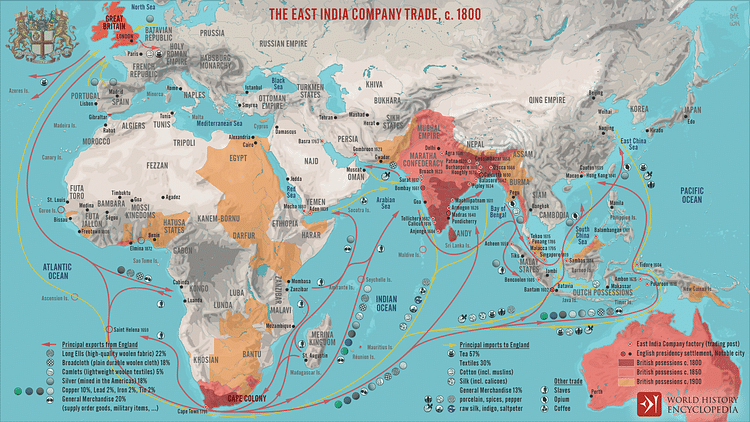
Conclusion
Today, we've compared the commercial strategies of the major European trading companies, seeing their evolution as a dynamic contest of competing business models.
Key Takeaways:
- Portuguese: Pioneered the sea route but relied on a relatively simple, state-run strategy of sea-lane control and fortified posts.
- Dutch (VOC): Created a powerful, innovative model based on private joint-stock funding, long-term capital, and the ruthless, violent enforcement of a high-value spice monopoly. Their intra-Asian trade was a key to their profitability.
- British (EIC): Began as a weaker competitor, adopting a more cautious and adaptive strategy of diplomacy and building up secure but underdeveloped sites in India. Their eventual triumph was due to:
- Catching up financially with the Dutch.
- Capitalizing on a major shift in European consumer demand from spices to textiles and tea.
- A more flexible (if corrupt) business model that encouraged private trade and expansion within India.
Preview of the Next Lesson:
The EIC's success was built on more than just trade. As the company grew, so did its military power, a necessity to protect its vast interests from both Indian rulers and European rivals. In our next lesson, we will examine the critical moment of transformation when the EIC leveraged this power to shift from a commercial enterprise to a territorial sovereign, beginning with the decisive battles of Plassey and Buxar.