Introduction
In our last lesson, we explored the magnificent architectural legacies of the Vijayanagara Empire and the Deccan Sultanates. We saw how, despite their political rivalries, they participated in a shared cultural world, blending indigenous Deccani traditions with a cosmopolitan Persianate aesthetic. This theme of synthesis and reform is central to the period.
Today, we shift our focus from political and architectural developments to a profound socio-religious transformation in North India. This lesson addresses the learning outcome: Explain the key tenets of the North Indian Bhakti movement (Kabir) and the early development of Sikhism under Guru Nanak.
We will investigate the ideas of two of medieval India's most influential spiritual thinkers. These movements did not arise in a vacuum. We will first explore the political and social conditions that created fertile ground for their radical, non-conformist ideas. We will then delve into the core teachings of Kabir, a weaver-saint who fearlessly challenged religious dogma, and Guru Nanak, whose teachings laid the institutional and philosophical foundations of Sikhism. You will see how they offered a path of direct, personal devotion that stood in stark opposition to the rigid hierarchies and ritualism of the established religions of their time.
The Rise of Monotheistic Bhakti in North India
While the Bhakti movement originated in the South centuries earlier, it gained a powerful and distinct momentum in North India during the 15th and 16th centuries. To understand why, we need to consider the unique historical context of the Delhi Sultanate.
The following reading explains the political and socio-economic factors that allowed these movements to flourish. It also introduces the crucial distinction between two strands of Bhakti: Saguna (worshipping God with form) and Nirguna (worshipping a formless God).
aspects of bhakti movement in india
This document from the University of Calcutta, 'Aspects of Bhakti Movement in India,' provides an excellent analysis of the conditions that fostered the Bhakti movement in the North. It will help you understand the 'why' behind the rise of saints like Kabir and Nanak.
Please read the sections titled 'BHAKTI MOVEMENT IN NORTH INDIA', 'POLITICAL FACTORS FOR THE RISE OF THE BHAKTI MOVEMENT', and 'SOCIO-ECONOMIC CHANGES'. Focus on: The distinction between the monotheistic movements (of Kabir, Nanak) and the Vaishnava movements. How the Turkish conquests weakened the traditional Rajput-Brahman alliance, creating an opening for non-conformist ideologies. How the growth of towns and an urban artisan class created a social base for movements that challenged the traditional caste hierarchy.
As the text highlights, the erosion of old power structures and the rise of new social groups created an environment where radical new ideas could take root. People were seeking a more direct, personal, and egalitarian approach to religion.
For a clear visual and auditory explanation of this context and the fundamental difference between Nirguna and Saguna Bhakti, please watch the following video.
Bhakti Movement for UPSC | Saints, Philosophy & Impact on Indian Society | GS Paper 1 History | IAS
This video from Sleepy Classes IAS clearly explains why the Bhakti movement gained prominence in North India and differentiates between its two main branches.
Watch the segment from 00:31:20 to 00:37:21. Pay close attention to the explanation of Nirguna (formless) and Saguna (with form) traditions. This distinction is essential for understanding both Kabir and Guru Nanak.
Kabir and Guru Nanak are the foremost exponents of the Nirguna school of thought. Let's explore their teachings in detail.
Kabir: The Fearless Weaver-Saint
Kabir (c. 1440-1518) is one of the most powerful and uncompromising voices of the Bhakti movement. A weaver (julaha) from Banaras, he launched a relentless attack on what he saw as the hypocrisy and empty ritualism of both Hinduism and Islam.
This next video segment will provide a comprehensive overview of Kabir's life and philosophy.
Bhakti Movement for UPSC | Saints, Philosophy & Impact on Indian Society | GS Paper 1 History | IAS
We'll continue with the Sleepy Classes IAS video, which now focuses specifically on Kabir's teachings.
Watch from 00:40:36 to 00:45:54. Focus on Kabir's core messages: His rejection of idol worship, polytheism, pilgrimages, and fasts. His strong critique of the caste system. His advocacy for Hindu-Muslim unity. His conception of God (formless, accessible by different names like Ram and Allah).
To consolidate, Kabir's key tenets can be summarized as:
- Uncompromising Monotheism: He believed in a single, formless (nirguna), all-pervading reality. He used names like Ram, Hari, Govind, Allah, and Khuda interchangeably, not to refer to specific deities or avatars, but to point towards this single, ultimate God.
- Rejection of External Rituals: Kabir was scathing in his criticism of religious formalism. He dismissed idol worship, pilgrimages to holy sites, ritual bathing, and prescribed prayers as useless without genuine inner devotion.
- Attack on Social Hierarchy: He vehemently denounced the caste system as man-made and contrary to the unity of humanity in the eyes of God. His humble origins as a weaver gave his critique particular force.
- Emphasis on the Guru: For Kabir, a true spiritual guide, or guru, was essential to navigate the path to divine realization.
- Path of Love and Devotion: The only way to connect with God was through a path of personal love and surrender (bhakti).
His powerful and direct teachings, composed in the local vernacular, were compiled by his followers in a collection known as the Bijak. Many of his verses were also later included in the sacred scripture of the Sikhs, the Adi Granth.
Guru Nanak and the Foundations of Sikhism
Guru Nanak (1469-1539), a contemporary of Kabir, was born in Punjab. While his ideas share a strong ideological affinity with the Nirguna Sant tradition, his work was unique in that it led to the formation of a new, institutionalized religion: Sikhism.
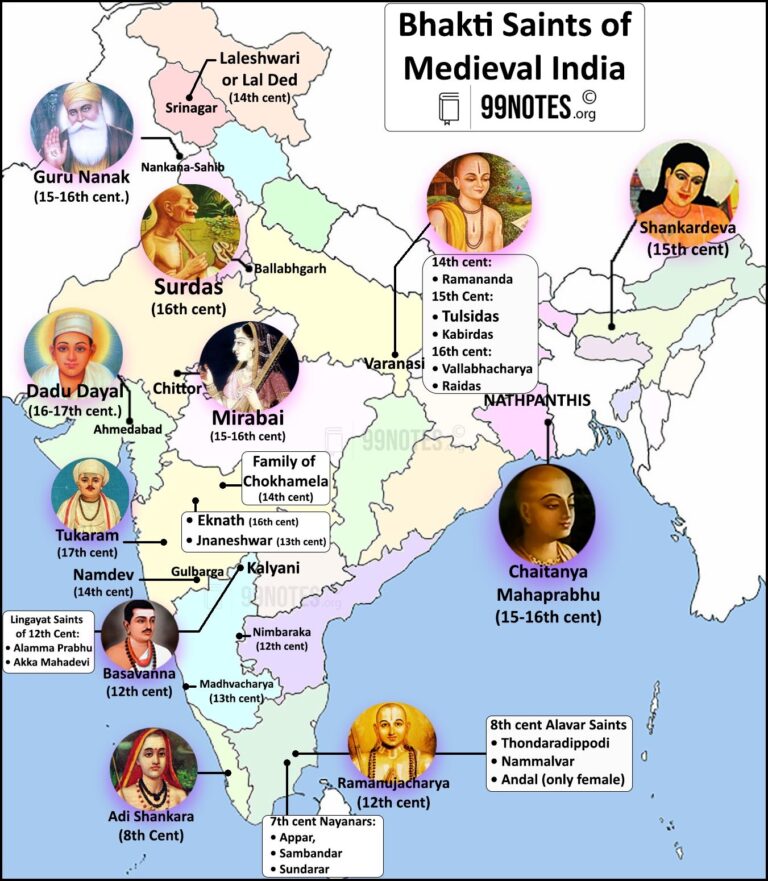
The final segment of the video details Guru Nanak's life, his core teachings, and the key institutions he established.
Bhakti Movement for UPSC | Saints, Philosophy & Impact on Indian Society | GS Paper 1 History | IAS
This last segment of the video will introduce you to Guru Nanak and the birth of Sikhism.
Watch from 00:45:54 to 00:51:05. As you watch, identify: Guru Nanak's concept of God (Ik Onkar). His three core principles: Naam Japna, Kirat Karna, Vand Chakna. The social institutions he established: Langar, Pangat, and Sangat.
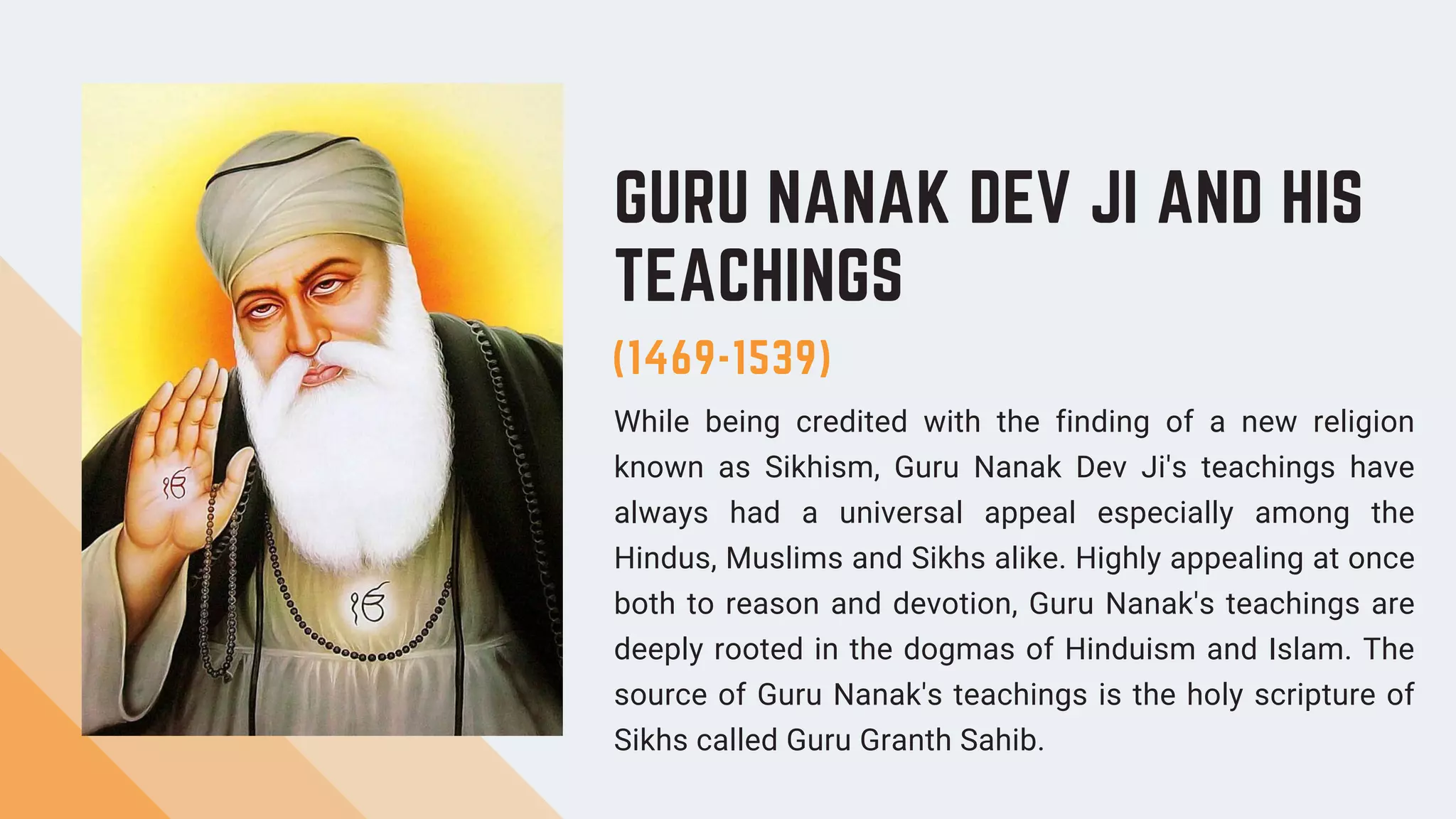
Let's break down the key tenets that define early Sikhism:
- The Concept of God: At the heart of Nanak's philosophy is the belief in one, formless, timeless, and all-creating God, expressed by the phrase Ik Onkar ("There is One God"). This God is beyond human comprehension and cannot be represented by idols.
- Rejection of Ritual and Caste: Like Kabir, Guru Nanak rejected external religious practices such as pilgrimages, ritual bathing, and caste distinctions. He stressed that one's actions, not birth, determine one's spiritual worth.
- An Ethical and Active Life: Nanak did not advocate for asceticism or renouncing the world. Instead, he taught that one could achieve spiritual liberation while living as an active and responsible householder. This is encapsulated in three pillars:
- Naam Japna: Meditating on the divine name.
- Kirat Karna: Earning an honest livelihood.
- Vand Chakna: Sharing one's earnings with others, embodying compassion and service.
- Founding of Key Institutions: Crucially, Nanak established institutions that fostered a distinct community identity and put his egalitarian principles into practice:
- Sangat: The congregation, where followers gathered to sing hymns and listen to teachings.
- Langar (Community Kitchen): The practice of serving a free communal meal. All people, regardless of caste, religion, or social status, sit together in a row (pangat) to eat the same food, a radical act of social equality.
While Guru Nanak's initial aim was reform, the clarity of his teachings and the strength of these institutions provided a solid foundation upon which his successors built Sikhism into a distinct world religion.
Conclusion
In this lesson, we have explored a pivotal moment of religious and social reform in North India. We moved beyond a simple narrative of saints and delved into the political and economic conditions that allowed their ideas to resonate so powerfully with the populace, particularly with urban artisans and other groups marginalized by the traditional order.
Key Takeaways:
- The North Indian Bhakti movement represented a powerful challenge to religious orthodoxy. The Nirguna stream, in particular, advocated for a formless, monotheistic God.
- Kabir was a radical voice who used vernacular poetry to attack the caste system, idol worship, and empty rituals in both Hinduism and Islam, calling for a path of direct personal devotion.
- Guru Nanak shared many of Kabir's Nirguna ideals but was distinct in his establishment of social institutions like the Sangat (congregation) and Langar (community kitchen), which put his principles of equality and service into practice and laid the foundation for Sikhism.
- Both thinkers emphasized an internal, love-based devotion over external formalism and played a crucial role in shaping the cultural and religious landscape of medieval India.
Preview of the Next Lesson:
Having examined the internal dynamics of the subcontinent with the rise of regional powers and new religious movements, our attention now turns to a force that would irrevocably alter India's destiny. In the next lesson, we will begin to compare the commercial strategies of European trading companies, from the Portuguese to the British East India Company, and trace their gradual transition from merchants to masters.