Introduction
Welcome to our next lesson. In our previous session, we analyzed the Revolt of 1857, a pivotal event that culminated in the transfer of power from the East India Company to the British Crown. We saw how this established a new political framework for the British Raj, with direct rule from London.
Today, we delve into the economic architecture of this new imperial structure. Our learning outcome is to analyze the economic impact of colonial rule, including the 'drain of wealth' theory, de-industrialization, and the commercialization of agriculture. These three interconnected processes defined the economic relationship between Britain and India during the high noon of empire and became the primary focus of the nationalist critique of British rule.
Given your background in finance and economics, you'll find this lesson particularly relevant. We will explore how colonial policies systematically restructured the Indian economy to serve the interests of the metropole, a process with striking parallels to the relationship between a parent company and a subsidiary in a corporate structure, but with far-reaching societal consequences.
The 'Drain of Wealth' Theory
The cornerstone of the Indian nationalist economic critique was the idea of a 'Drain of Wealth'. This theory posited a large, one-way transfer of financial resources from India to Britain for which India received no equivalent economic or commercial return. It was, in essence, a national-level accounting of how colonialism was systematically impoverishing India.
The theory was most famously articulated by Dadabhai Naoroji, a prominent early nationalist leader often called the "Grand Old Man of India." To understand the mechanics of his argument, please watch the following video.
Dadabhai Naoroji @200 | Drain of Wealth Theory Explained | UPSC 2025
This video from Vision IAS, 'Dadabhai Naoroji @200', provides a clear and concise explanation of the Drain of Wealth theory. As you watch, focus on the specific components that constituted this 'drain'.
Please watch the segments from 11:21 to 14:06 and 15:43 to 19:02. The first part explains the overall theory and its estimated magnitude. The second, and more crucial part, details the specific constituents of the drain, such as salaries, profits, and the infamous 'Home Charges'.
As the video explained, the drain was not a single transaction but a continuous outflow through several channels. The key components were:
- Home Charges: This was the most significant part of the drain. It was the expenditure incurred in England by the Secretary of State on behalf of the Indian government. This included:
- Salaries and pensions for British civil and military officials working in India.
- Interest on public debt raised in England, including loans for building railways and financing British wars fought using Indian troops.
- Costs of the India Office in London.
- Payments for military and other stores purchased in England.
- Remittances by British Officials: The savings and other private earnings sent home by British nationals working in India.
- Profits of British Capitalists: Profits from British investments in India (e.g., in plantations, mines, and shipping) that were repatriated to Britain rather than being reinvested in India.
The essence of the drain theory is that India's export surplus was not used for its own development or to import bullion (as was the case in pre-colonial times), but was instead used to pay for these unilateral transfers to Britain. In modern financial terms, India was financing its own subjugation, paying for the administration that ruled it and generating profits for foreign investors, all from its own revenue and resources. This continuous capital outflow severely hampered capital formation within India, stunting its economic development.
For a textual summary of these mechanisms, you can review the following resource.
Drain of Wealth Theory, Background, Features, Process, Causes ...
The article 'Drain of Wealth Theory' from Vajiram & Ravi is a well-structured summary that reinforces the concepts from the video.
Briefly read the sections 'Drain of Wealth Theory Features' and 'Drain of Wealth Process'. This will help consolidate your understanding of the different channels through which the drain occurred.
De-industrialization: The Ruin of the Artisan
While the drain siphoned off capital, another process dismantled India's existing industrial base. De-industrialization refers to the decline of traditional handicraft industries, particularly the world-renowned textile sector, and the consequent shift of the workforce from industry back to agriculture.
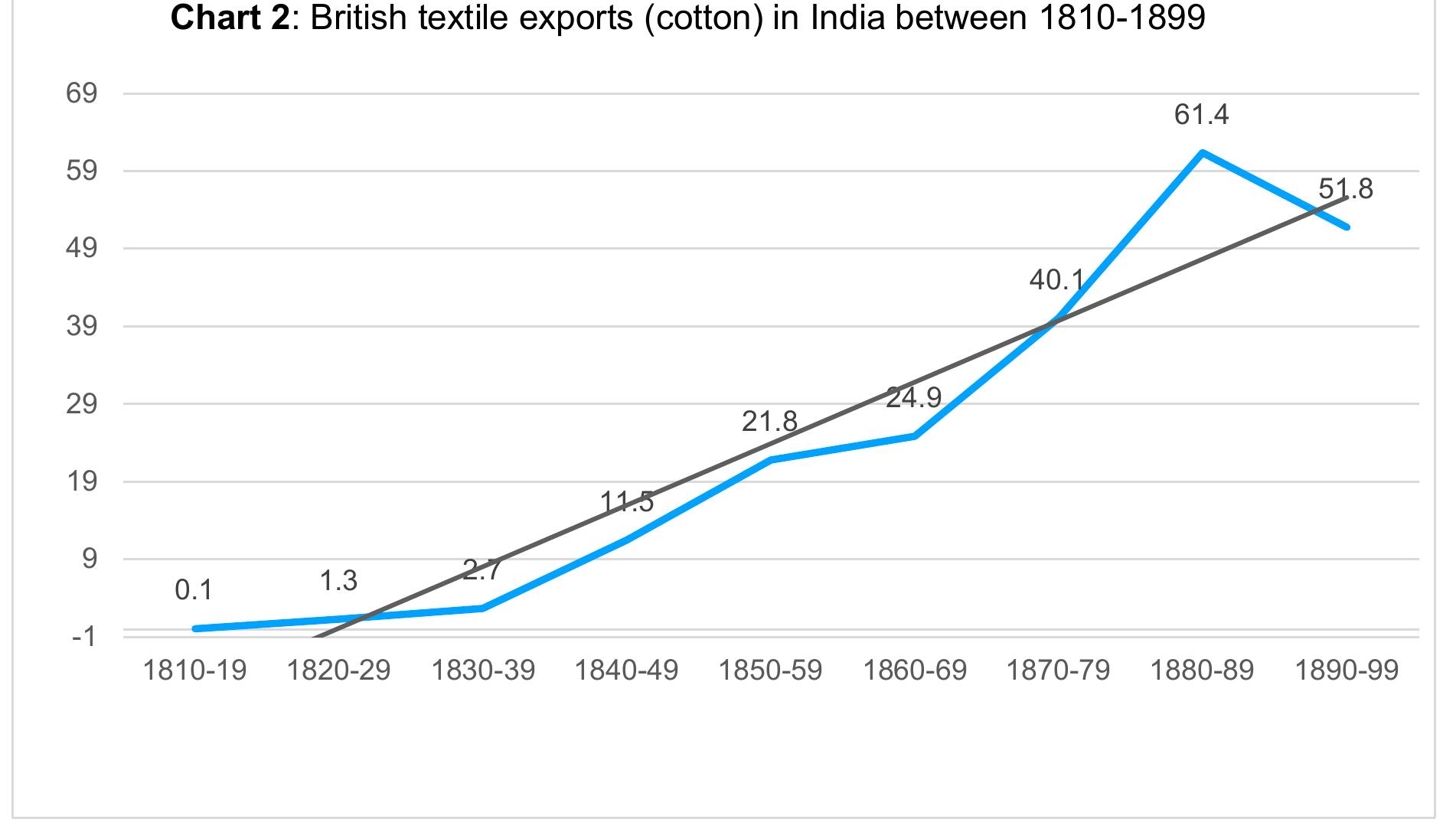
This wasn't a natural evolution but a direct result of British policy and the Industrial Revolution. This chart vividly shows the primary weapon of this process: the flood of British machine-made textiles into the Indian market.
To understand the mechanics and historical context of this process, let's turn to an expert.
The Hidden Truth: How the British Empire Shaped India's Economy
Professor Tirthankar Roy, a leading economic historian of India, discusses the impact of technological divergence on India's textile industry.
Watch the segment from 22:59 to 26:19. Professor Roy explains how machine-made textiles from Britain, being significantly cheaper, destroyed the Indian hand-spinning and hand-weaving industries on a massive scale.
The story is even more complex than just a simple case of technological competition. Recent scholarship, which will appeal to your preference for deep analysis, suggests a two-stage process. For a rigorous academic perspective on this, let's engage with a landmark paper on the subject.
[PDF] India's De-Industrialization Under British Rule - NBER
The NBER working paper 'India’s De-Industrialization Under British Rule' by Clingingsmith and Williamson provides a powerful, data-driven analysis of this phenomenon. We will focus on the core arguments and evidence.
Please read the following parts of the paper: Abstract (Page 1): This provides a concise summary of the paper's entire argument. 'The Measurement of Indian De-Industrialization: Inputs and Outputs' (starts on page 9): Focus on the quantitative evidence presented, especially the data from Paul Bairoch in Table 3, which shows India's share of world manufacturing output plummeting from 24.5% in 1750 to just 2.8% by 1880. 'Conclusions' (Page 21): This section masterfully summarizes the two-epoch theory of de-industrialization. Your goal is to grasp the main evidence for de-industrialization and the two distinct phases the authors identify.
As you've read, the narrative of de-industrialization is twofold:
- Epoch 1 (c. 1750-1810): Loss of Export Markets. Before the British factory system was dominant, India was already losing its competitive edge. The authors argue this was due to internal factors linked to the decline of the Mughal Empire, which led to political instability, falling agricultural productivity, and rising grain prices. This pushed up nominal wages for weavers, eroding their cost advantage in global markets.
- Epoch 2 (c. 1810-1860): Loss of the Domestic Market. This is the classic story. The Industrial Revolution in Britain produced textiles so cheaply that they flooded the Indian market, crushing local producers who couldn't compete. This was a "globalization shock" amplified by colonial policies that ensured free trade for British goods in India.
The human cost of this process was immense, leading to the decline of prosperous urban centers and forcing millions of skilled artisans into agriculture, increasing the pressure on land. This also contributed to a fall in real wages and living standards.

Commercialization of Agriculture
The final pillar of the colonial economic structure was the transformation of the agricultural sector. Commercialization of agriculture refers to the shift from cultivating crops for local/village consumption to producing crops for sale in national and international markets.
Drivers:
- High Revenue Demands: The British land revenue systems, which we discussed previously, demanded payment in cash, forcing peasants to grow crops they could sell.
- Market Integration: Growing demand for industrial raw materials from Britain's factories (e.g., cotton for textile mills, jute for packaging).
- Infrastructure: The development of railways was crucial. It connected agricultural hinterlands to port cities, facilitating the transport of bulk goods for export.
While this may sound like modernization, the consequences for the peasantry were often devastating. Let's return to Professor Roy's analysis, which offers a particularly nuanced view on the role of railways and the link to famines.
The Hidden Truth: How the British Empire Shaped India's Economy
In this segment, Professor Roy discusses agricultural challenges, the role of state-led irrigation, and the complex impact of railways.
Watch from 27:29 to 31:35 and 31:49 to 39:59. Note his points on: The importance and limitations of state-led irrigation. The growth of trade in agricultural goods like cotton. How railways significantly impacted trade but also served as a critical tool for famine mitigation by enabling the movement of food grains from surplus to deficit regions. This challenges the simpler narrative that commercialization uniformly worsened famines.
Consequences of Commercialization:
- Increased Peasant Indebtedness: Peasants were now exposed to the volatility of global markets. A price crash for cotton in Liverpool could mean ruin for a farmer in the Deccan. They became dependent on merchants and moneylenders for credit to buy seeds and pay taxes.
- Famines: The traditional nationalist argument holds that the shift to cash crops at the expense of food crops increased the vulnerability to famine. While this was a factor, Professor Roy's analysis highlights that the story is more complex. Major famines, like the Bengal Famine of 1943, were often failures of policy, governance, and distribution, rather than simply a result of a lack of food. The railway network, a tool of commercialization, could have prevented the famine had the political will and coordination existed.
- No Improvement in Peasant Prosperity: The profits from this new commercial agriculture were largely siphoned off by intermediaries—merchants, moneylenders, and the colonial state itself—leaving the cultivator trapped in a cycle of debt and poverty.
Conclusion
The economic policies of the British Raj fundamentally reshaped India's economy into a colonial one. This transformation rested on three pillars that we've analyzed today.
Key Takeaways:
- The 'Drain of Wealth' theory, articulated by Dadabhai Naoroji, explained how India's capital was systematically transferred to Britain through mechanisms like 'Home Charges', crippling indigenous capital formation.
- De-industrialization destroyed India's traditional industries, especially textiles, through a combination of internal decay in the 18th century and overwhelming competition from British factory goods in the 19th, turning India from a producer into a market.
- The Commercialization of Agriculture, driven by state revenue demands and global market integration, forced peasants into producing cash crops. This exposed them to market volatility and debt, without leading to widespread prosperity, and had a complex relationship with the devastating famines of the era.
Together, these forces subordinated the Indian economy to the needs of the British Empire, making it a supplier of raw materials and a captive market for its manufactured goods. This economic exploitation, coupled with a sense of political powerlessness, would become a powerful catalyst for the next phase of Indian history.
Preview of the Next Lesson:
The deep economic impact and social dislocations caused by British rule did not go unchallenged. They spurred a period of intense introspection and reform among Indians. In our next lesson, we will explore the major 19th-century social and religious reform movements and trace the origins of modern political consciousness, culminating in the formation of the Indian National Congress—the beginning of the organized freedom struggle.