Introduction
Welcome to your next lesson. In our previous discussion, we explored the sophisticated philosophical world of the Upanishads, which emerged as a contemplative reaction to the ritualism of the Later Vedic age. We saw how thinkers turned inward to grapple with concepts like Brahman (ultimate reality) and Atman (the inner self). Now, we will shift our focus from the philosophical to the social structure of the same period.
This lesson addresses the learning outcome: Explain the origins of the varna system and its evolution from the Early to Later Vedic period. We will dissect one of the most enduring and complex social frameworks in Indian history. You already have a foundational understanding of this from your prior studies, so our goal here is to move beyond a simple description and analyze the how and why—the underlying economic drivers, ideological justifications, and the critical evolution of the system from a more fluid classification to a rigid hierarchy.
1. The Meaning and Origins of Varna
The term varna (वर्ण) literally translates to 'colour'. This has led to historical debates, particularly during the colonial era, about whether it was a system of racial segregation based on skin tone—pitting lighter-skinned 'Aryans' against darker-skinned indigenous populations. While early texts do contrast Arya varna with Dasa varna, modern scholarship views this as just one element in a more complex social process, not its sole basis.
The first video provides a critical examination of the term 'varna' and introduces how social divisions began to emerge in what was initially a more egalitarian society.
L13: Varna and Caste | Rig Vedic Period | Ancient India History | NCERT | UPSC | IAS
This video from 'Kaarwan-e-upsc' explores the literal meaning of varna and carefully debunks the simplistic colonial-era racial interpretation. It then explains the socio-economic processes that led to the emergence of social stratification in the Rig Vedic period.
Please watch from the beginning to 19:33. Pay close attention to two key arguments: The critique of interpreting 'varna' purely as skin-colour-based discrimination. The explanation of how an egalitarian, tribal society transitioned towards inequality due to warfare, the unequal distribution of booty (bali), and the emerging alliance between the chieftain (raja) and the priest (purohita).
As the video explains, the initial Rig Vedic society was semi-nomadic and pastoral, with a subsistence economy. This limited the scope for significant wealth accumulation and class division. However, as conflicts over resources grew, the spoils of war created a new source of wealth, and its unequal distribution laid the groundwork for social hierarchy.
The Ideological Blueprint: The Purusha Sukta
This emerging social stratification was given a powerful religious and symbolic justification in a hymn known as the Purusha Sukta, found in the 10th Mandala (or book) of the Rigveda. This hymn is considered by scholars to be a relatively late addition to the text, reflecting a society already in the process of becoming more stratified.
The hymn describes the sacrifice of a primordial cosmic being, the Purusha. From the different parts of his body, the four varnas were created, each with a divinely ordained function.
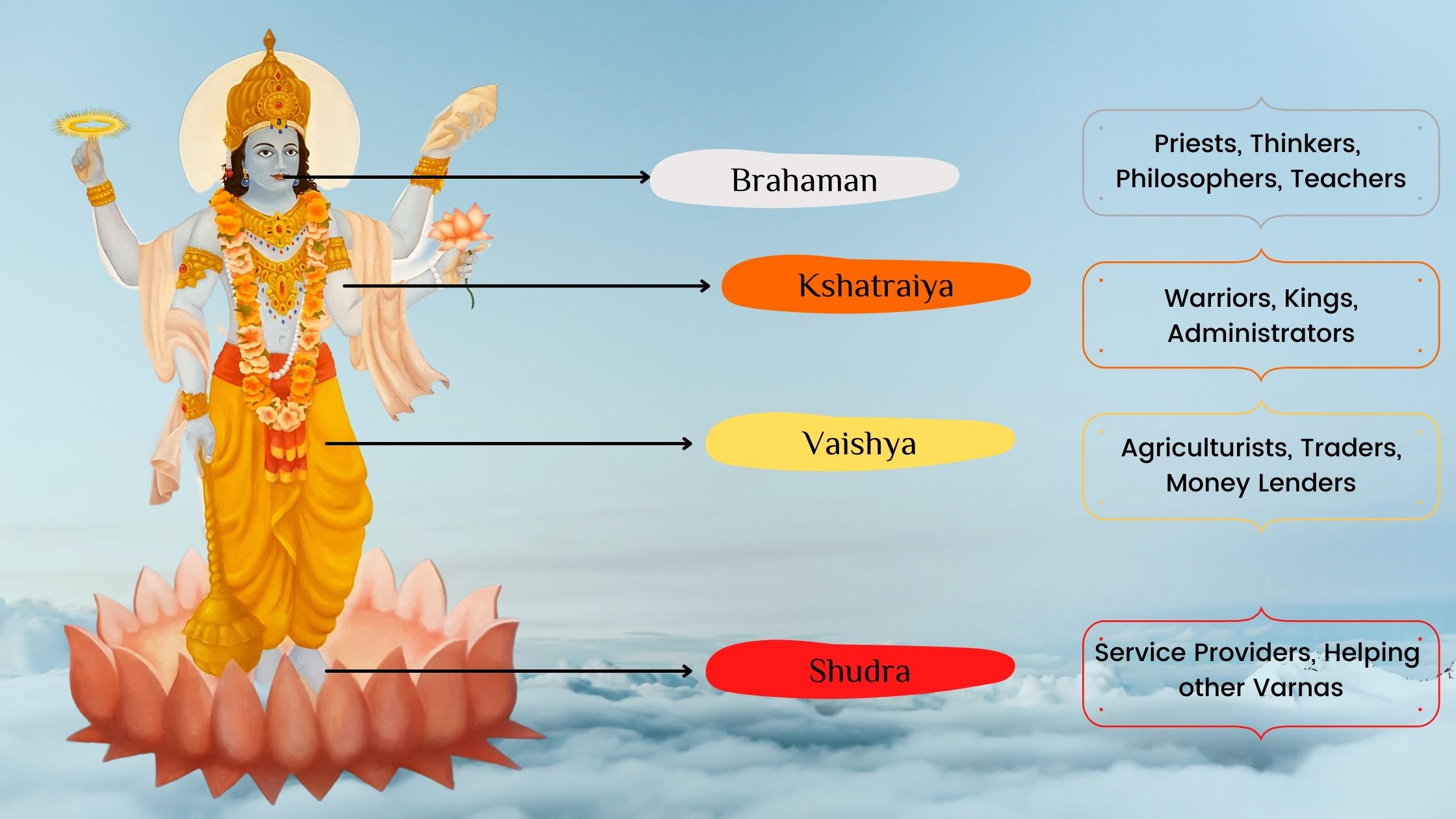
This cosmic sanction served as a foundational ideology for the varna system. However, it's crucial to understand its historical context. The following reading provides a scholarly perspective on the origins and theories behind the varna system, including the Purusha Sukta.
Varna-Jāti Interconnection: Revisiting Indian Caste System
This academic paper, 'Varna-Jāti Interconnection', delves into the various theories explaining the origin of the varna system. It offers concise explanations of the 'divine theory' (Purushasukta), the 'Triguna theory' (based on inherent qualities), and others.
Please read the initial section of the paper, starting from the paragraph 'First of all, varna derives its roots from ‘vri’...' and ending just before the paragraph 'During the post-Vedic period...'. This section covers the key theories on the origin of the varna system.
2. Evolution: From Fluidity to Rigidity
The varna system was not static. It underwent a significant transformation between the Early and Later Vedic periods. The key change was a move away from a more fluid system based on occupation (karma) towards a more rigid one determined by birth (janma).
This table provides a high-level overview of the contrast between the two eras.

Early Vedic Period (c. 1500-1000 BCE)
In the Early Vedic period, the lines between the varnas appear to have been less rigid. Social mobility was possible. A classic example from the Rigveda (Book 9, Hymn 112) illustrates this beautifully, where a poet states:
"I am a poet, my father is a physician, and my mother is a grinder of corn."
This verse strongly suggests that different occupations—and therefore potentially different varna affiliations—could exist within the same family. Varna in this context was more of a functional classification than a hereditary destiny.
Later Vedic Period (c. 1000-600 BCE)
The shift to a more sedentary, agriculture-based society in the Gangetic plains during the Later Vedic period acted as a major catalyst for the rigidification of the varna system.
- Economic Drivers: A larger agricultural surplus and the emergence of territorial kingdoms (janapadas) created a more complex economy that required a more stratified social structure for labour organization and revenue collection.
- Ritual Exclusivity: The rituals and sacrifices (yajnas) became more complex and central to political power. The priestly class (Brahmins) consolidated their position as the exclusive keepers of this sacred knowledge.
- The Concept of Dvija: The idea of the "twice-born" (dvija) became prominent. The upper three varnas—Brahmin, Kshatriya, and Vaishya—were entitled to the upanayana (sacred thread) ceremony, symbolizing a second, spiritual birth that gave them the right to study the Vedas. The Shudras were excluded from this, creating a sharp line of social and religious disability.
The following video discusses this hardening of the system and introduces the crucial distinction between varna and jati.
Understanding Caste in India (Jati & Varna)
This clip from the video 'Understanding Caste in India' explains how the varna system, though embryonic earlier, began to stratify as society shifted from pastoralism to agriculture. It also touches on how the concept was further codified in later texts like the Manusmriti.
Please watch from 28:40 to 31:38, and then from 35:59 to 37:45. The first segment discusses the codification of the hierarchy and the 'dvija' concept. The second segment explains the material reasons—the shift to agriculture and control over resources—that drove the increasing rigidity of the system.
3. Varna vs. Jati: A Critical Distinction
For a precise understanding of Indian social history, it is vital to distinguish between varna and jati. While often used interchangeably, they are distinct concepts.
- Varna: A theoretical, four-fold classification of society, pan-Indian in scope, originally based on function. There are only four varnas.
- Jati: Refers to the thousands of specific endogamous (marrying within the group) communities, often linked to a particular occupation and region. One is born into a jati, and mobility is historically very difficult.
The varna system provided a broad, hierarchical framework, and over centuries, the numerous jatis were fitted into one of the four varna categories. For example, many different jatis of priests and scholars across India would be classified under the Brahmin varna.
This final reading clearly explains this distinction and underscores the original flexibility of the varna system with historical examples.
Varna-Jāti Interconnection: Revisiting Indian Caste System
Let's return to the paper 'Varna-Jāti Interconnection'. This section explicitly lays out the differences between the varna and jati systems, highlighting why the former was considered an 'open' system in its early days.
Please read the section titled 'Caste and Varna' (starting on page 249). Focus on the listed differences, particularly the points about varna being based on occupation ('karma') and being an 'open' system, which allowed for mobility. Note the examples given, such as Vishwamitra.
Conclusion
In this lesson, we have moved beyond a surface-level description of the four varnas to analyze the system's origins and evolution. We have seen how a social structure that began as a functional classification in the Early Vedic period was transformed by economic, political, and religious developments into a rigid, birth-based hierarchy in the Later Vedic period.
Key Takeaways:
- Origins: The varna system emerged from the socio-economic stratification in the Early Vedic period, driven by warfare and the unequal distribution of wealth. It was given ideological legitimacy through religious texts like the Purusha Sukta.
- Early Vedic Fluidity: Initially, the varna system was more of a functional classification (karma) than a rigid, hereditary system. Social mobility, though perhaps not common, was possible.
- Later Vedic Rigidity: The shift to settled agriculture and the rise of territorial states led to the hardening of the varna hierarchy. It became increasingly determined by birth (janma), and the concept of dvija (twice-born) created a sharp division between the top three varnas and the Shudras.
- Varna vs. Jati: It is crucial to distinguish between the four-fold theoretical model of varna and the thousands of localized, endogamous communities known as jati. The varna system provided the overarching framework for the much more complex reality of the jati system.
Preview of the Next Lesson:
The consolidation of the varna system occurred alongside another major development: the expansion of Vedic society. In our next lesson, we will examine the Later Vedic expansion into the Gangetic plains, the full-scale shift to settled agriculture, and the emergence of craft specialization. This will provide the material context for the social and political changes we've begun to explore.