Introduction
In our last lesson, we examined the hardening of the varna system during the Later Vedic period, tracing its evolution from a fluid, occupation-based classification to a rigid, hereditary social hierarchy. We noted that this social transformation was not happening in a vacuum. It was underpinned by profound material changes.
This lesson delves into those very changes, addressing the learning outcome: Describe the Later Vedic expansion into the Gangetic plains, the shift to settled agriculture, and the emergence of craft specialization. We will explore the economic and technological engine that drove the social and political developments of the era. Consider this the "material base" upon which the "superstructure" of Later Vedic society, including its rigid social codes and complex rituals, was built. We will see how geography, technology, and economic activity created a new foundation for civilization in ancient India.
1. The Eastward Expansion: New Lands, New Opportunities
The center of gravity of the Vedic world shifted dramatically between the Early and Later Vedic periods. The heartland of the Rigvedic people was the Sapta Sindhu region (the land of the seven rivers) in the Punjab and its surroundings. By contrast, the Later Vedic period is defined by a great migration eastward into the Gangetic plains.
This map illustrates the eastward movement and the new geographical focus of the Later Vedic culture.
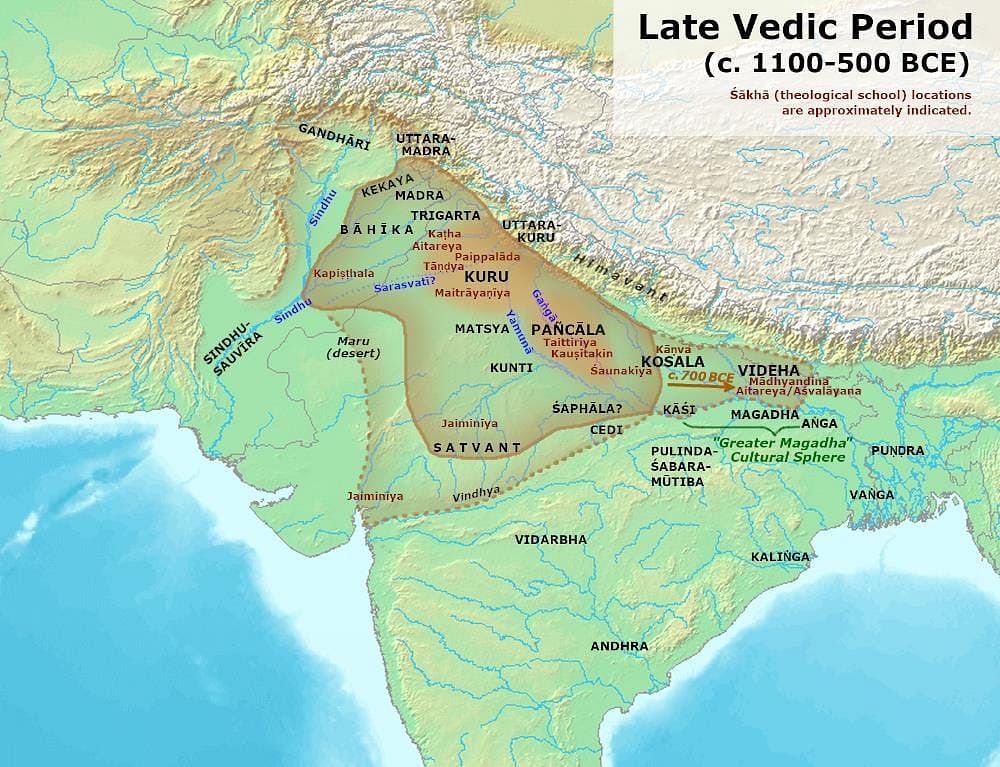
This expansion is not only documented in texts but also clearly visible in the archaeological record.
Textual and Archaeological Evidence
Later Vedic texts, such as the Shatapatha Brahmana, contain narratives that reflect this eastward migration. One famous story tells of the prince Videgha Madhava, who, led by the fire god Agni, travels from the Sarasvati river eastward, burning the forests until he reaches the Sadanira river (modern Gandak river in Bihar), marking the expansion of Aryan culture into the eastern Gangetic plains.
Archaeologically, this period and region are strongly associated with a distinctive ceramic style known as Painted Grey Ware (PGW). For a long time, the period between the decline of the Harappan Civilization (c. 1500 BCE) and the rise of the first cities (c. 600 BCE) was considered a "Dark Age." The discovery of PGW sites across the Gangetic divide provided the crucial evidence of a vibrant, developing culture that filled this gap.
The following video explains the significance of PGW and how it helped historians and archaeologists reconstruct this pivotal era.
Did India have a 'dark age'? Painted Grey Ware from Bareilly holds the key to the question
This video, 'Did India have a 'dark age'?' from ThePrint, introduces the Painted Grey Ware culture and explains its critical role in challenging the 'Dark Age' theory by providing archaeological evidence for a continuous cultural development after the Harappan decline.
Please watch from 03:36 to 05:34 and then from 12:15 to 14:13. The first segment explains why the period was once called a 'Dark Age' and how archaeology began to fill the gap. The second segment discusses the vast geographical spread of PGW sites, highlighting their concentration in the Gangetic plains and their association with key technological advancements.
To get a fuller picture of this expansion, let's turn to a textual resource that synthesizes both the literary and archaeological evidence.
[PDF] Sources for Vedic Culture - Plutus IAS
The following excerpts from 'Sources for Vedic Culture' describe the geographical shift during the Later Vedic period, explicitly linking the literary accounts of expansion with the archaeological findings of PGW sites.
Please read the following three sections: The introductory paragraphs under 'Sources for Vedic Culture' (starts 'North India, especially the Ganga valley...'). This sets the stage by linking the Later Vedic period to the Ganga valley and PGW. The section under 'Later Vedic Phase' on 'Geographical Knowledge' (starts 'The Later Vedic texts cover a wider area...'). This details the directions of expansion. The section 'Geography of the Later Vedic Period (1000–600 BC)' (starts 'Expansion of Aryans'). This specifically mentions the Shatapatha Brahmana story.
2. The Agrarian Transformation: Iron, Ploughs, and Rice
The expansion into the Gangetic plains was not just a change of address; it triggered a fundamental economic revolution. The semi-nomadic, pastoral economy of the Rigvedic period gave way to a more sedentary, agriculture-based society.
Two key factors drove this transformation:
- Iron Technology: The Gangetic plains were densely forested and had hard alluvial soil. Clearing and cultivating this land on a large scale was made possible by the widespread use of iron. Iron axes were used to clear forests, and iron ploughshares allowed for deeper and more efficient tilling. Vedic texts from this period refer to iron as syama ayas or krishna ayas ("dark metal").
- Shift in Crops: While barley (yava) was prominent in the Early Vedic period, the marshy, water-rich environment of the Gangetic plains was ideal for rice (vrihi). The adoption of wet rice cultivation, a highly labor-intensive process, dramatically increased food production. This created a substantial agricultural surplus for the first time.
This surplus was the economic foundation for everything else: population growth, the rise of towns, support for non-farming specialists (priests, artisans, warriors), and the increasing complexity of the state, which we will discuss in the next lesson. The need to organize labor for large-scale agriculture also likely contributed to the hardening of the varna system we discussed previously.
The following readings detail this agricultural revolution and its corroboration at PGW sites.
[PDF] THE PAINTED GREY WARE CULTURE OF THE IRON AGE
This comprehensive paper on 'The Painted Grey Ware Culture of the Iron Age' provides a detailed look at the material life of the people of this era. This section focuses on their agricultural practices.
Please read the section starting with 'The credit of bringing the upper Ganges-Jamuna valley under large-scale cultivation...' and ending just before 'Next to agriculture, the people depended for their subsistence...'. This part explicitly links the PGW people with the large-scale cultivation of the Ganges valley, the use of iron tools, and the cultivation of rice, wheat, and barley.
Now, let's supplement this with a broader overview that connects the agricultural shift to social changes.
[PDF] Sources for Vedic Culture - Plutus IAS
Returning to the 'Sources for Vedic Culture' document, these sections elaborate on the shift away from pastoralism and the social implications of the new, labor-intensive agrarian economy.
Please review the following sections: 'Changes in the Later Vedic Period' (starts 'In the Rigvedic age, society was mainly tribal...'). Focus on the link between settled agriculture, iron, and surplus. 'Economy' under the 'Later Vedic Phase' heading (starts 'Shift from pastoralism to agriculture...'). Note the discussion on wet rice cultivation and social inequality. 'Labour-Intensive Agrarian Economy' (starts 'Agriculture demanded control over land...'). This directly explains the connection between agricultural methods and social hierarchy. The description of agriculture in the later Vedic period under 'Industry in the Vedic Period' (starts 'In the later Vedic period, agriculture became the main occupation...'). This details the improvements like heavier ploughs and new crops.
3. The Emergence of Craft Specialization
An agricultural surplus is a prerequisite for significant craft specialization. When a society can reliably produce more food than it needs for subsistence, it can support a class of people who do not farm: artisans, smiths, weavers, potters, and more. The archaeological evidence from PGW sites reveals a remarkable flourishing of specialized crafts.
Key Crafts of the PGW Culture:
-
Pottery: The Painted Grey Ware itself is the most obvious example. It is a high-quality ceramic, made of well-levigated clay, wheel-thrown, and fired at high temperatures in a controlled (reducing) atmosphere to achieve its characteristic grey color. The fine fabric and painted geometric or floral designs indicate a high level of skill and standardized production, far beyond simple household pottery.
-
Metallurgy: The period saw significant advances in working with metals.
- Iron: As discussed, iron was crucial for agriculture but was also used for weapons (arrowheads, spearheads) and household tools (nails, hooks, knives).
- Copper: Remained in use for tools, toilet objects (antimony rods), and ornaments (bangles, rings).
- Other Metals: Texts and finds suggest knowledge of gold, silver, tin, and lead.
-
Glass Technology: One of the most notable innovations of this period is the appearance of glass. Glass beads and bangles have been found at several PGW sites, indicating a new and sophisticated technological knowledge.
-
Other Crafts: Evidence for carpentry, weaving, basket-making, and the working of bone and antler into tools and ornaments is widespread.
This diversification of crafts points to a more complex economy with emerging networks of production and exchange, even if it was primarily based on barter rather than coinage.
[PDF] THE PAINTED GREY WARE CULTURE OF THE IRON AGE
The paper on the PGW culture provides a rich catalogue of the crafts and technologies from this period. This section serves as a detailed inventory of their material production.
Please read the extensive section that begins 'The most distinctive pottery of the period is the very one...' and continues through the discussion of iron, copper, glass, and bone objects, ending just before the terracotta figurines are discussed. This provides a thorough look at the craft specialization of the era.
Conclusion
In this lesson, we have charted the material transformation of North India during the Later Vedic period. This era was not a "Dark Age" but a dynamic period of expansion, innovation, and growth.
Key Takeaways:
- Geographical Expansion: Vedic culture expanded from the Sapta Sindhu region eastward into the Gangetic plains, a move evidenced by both literary texts and the archaeological spread of the Painted Grey Ware (PGW) culture.
- Agricultural Revolution: This expansion was powered by iron technology, which enabled the clearing of forests and the ploughing of hard alluvial soil. This led to a fundamental shift from a pastoral to a settled agricultural economy, with wet rice cultivation creating a significant food surplus.
- Emergence of Crafts: The agricultural surplus supported a growing population and the rise of specialized artisans. The era saw advanced technologies in pottery (PGW), metallurgy (iron and copper), and glass-making, indicating a new level of economic complexity.
These developments—expansion, agricultural surplus, and craft specialization—created the necessary conditions for the next major stage in India's political evolution.
Preview of the Next Lesson:
The growing, settled, and increasingly complex societies of the Gangetic plains could no longer be managed by the old tribal structures of the Early Vedic age. In our next lesson, we will explore the political consequences of these material changes: the formation of janapadas and the transition toward territorial states in the Later Vedic period.