Introduction
In our previous lesson, we explored the Later Vedic period, a time dominated by complex, expensive, and highly elaborate rituals (yajnas). We saw how these ceremonies, codified in the Brahmanas, became central to legitimizing kings, structuring the economy through a "gift system," and solidifying the varna hierarchy. Religion was largely an external affair, a matter of precise action (karma) performed by a specialized priestly class to secure worldly and otherworldly rewards.
This lesson examines a profound intellectual and spiritual counter-current that arose in response to this very system. We will explore the emergence of Upanishadic philosophy, a contemplative movement that turned the focus from the outer world of ritual to the inner world of the self. This aligns with the learning outcome: Describe the emergence of Upanishadic philosophy, focusing on concepts like Brahman and Atman, as a contemplative reaction to ritualism.
We will trace this pivotal shift in Indian thought, analyzing why it happened and what core philosophical concepts it produced. This marks the transition from the Karma Kanda (the portion of the Vedas dealing with action and ritual) to the Jñāna Kanda (the portion dealing with knowledge and wisdom).
From Ritual to Contemplation: A Reactionary Shift
The sheer complexity, expense, and exclusivity of the later yajnas prompted some thinkers to question their ultimate efficacy. Was salvation truly a matter of performing the correct external rite, or was there a deeper, more direct path to ultimate truth? This questioning spirit gave birth to the Upanishads.
The very word Upanishad—from upa (near), ni (down), and sad (to sit)—suggests an intimate transmission of knowledge, a "sitting down near" a teacher to learn a secret doctrine. These texts are not ritual manuals but philosophical dialogues, exploring the "truth behind the truth" (satyasya satyam).
This image provides a concise summary of the philosophical pivot from the Vedas and Brahmanas to the Upanishads.
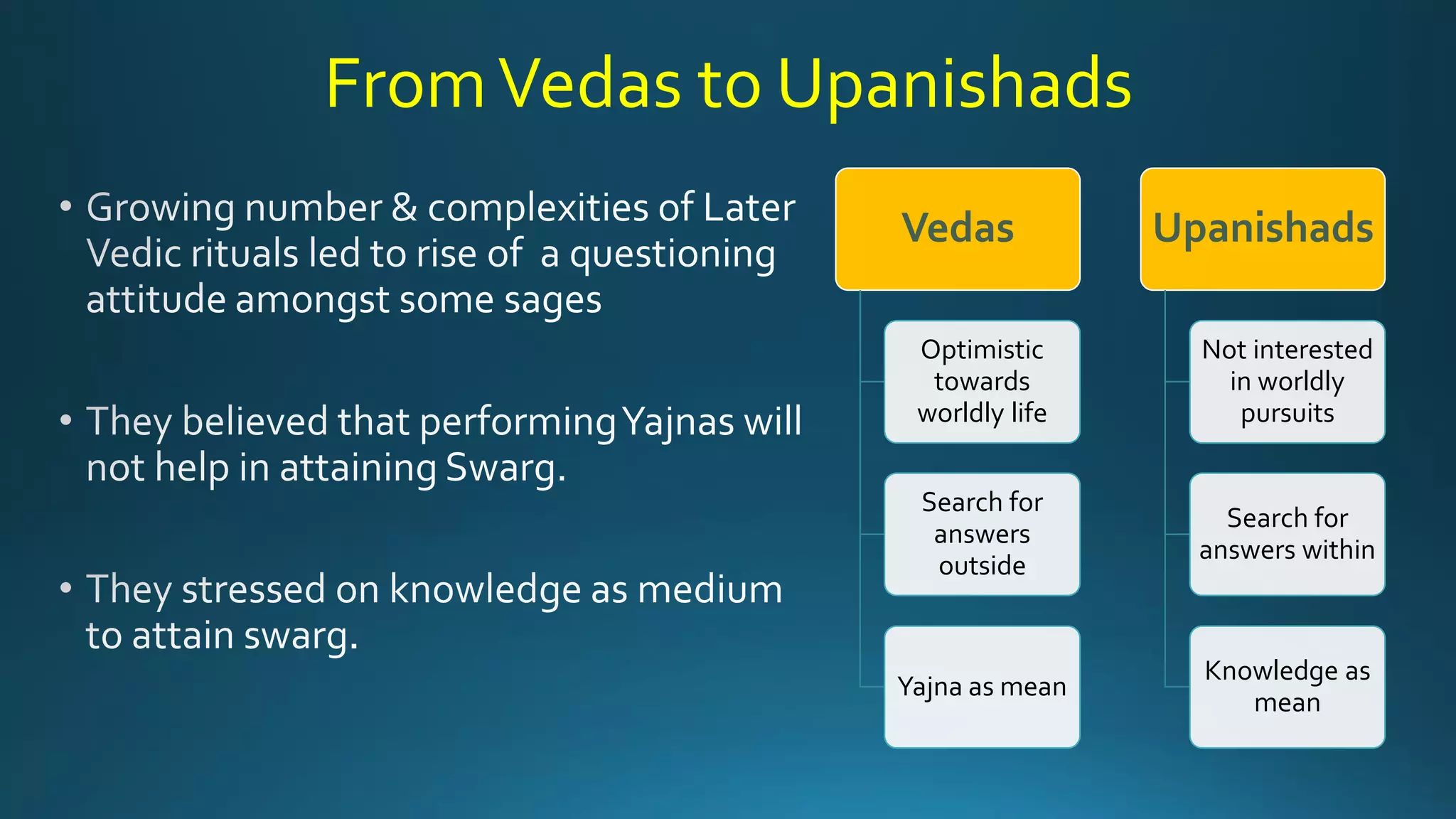
To understand the context and spirit of this reaction, the following video explains how the Upanishads fostered a new culture of questioning.
Class 12 History | Ancient India | 600 BCE- Role of Upanishads in development of New Philosophies
This lecture, from the channel 'Let's Crack UPSC CSE', explains how the Upanishads developed as a reaction against the excessive ritualism of the Later Vedic period and introduced a new emphasis on philosophical inquiry.
Please watch from 11:20 to 20:50. The lecture is in a mix of Hindi and English. Focus on the core argument: how a reaction against sacrifice led to a new era of philosophical questioning, the hierarchy of Vedic literature, and the introduction of the central Upanishadic questions about the meaning of life, the self (Atman), and the ultimate reality (Brahman).
This intellectual turn inward led to a search for the single, unifying principle behind the diversity of the cosmos and the individual. This quest crystalized around two central concepts: Brahman and Atman.
Brahman: The Ultimate Reality
The term Brahman evolved significantly over time. In the Rigveda, it often referred to the sacred power within a hymn or prayer. In the Upanishads, this idea of an underlying power was expanded into a profound philosophical concept: Brahman became the name for the ultimate, all-pervading, and fundamental reality of the universe.
Thinkers grappled with defining this concept, moving from concrete ideas to increasingly abstract ones. Early on, they identified Brahman with physical elements like water or space, but these were found to be inadequate. The following reading traces this intellectual journey.
The essay 'Upanishads and Philosophy' by the renowned Indologist Robert Ernest Hume provides a classic and detailed account of the development of Upanishadic thought. We will read two key chapters.
First, please read Chapter IV, 'THE DEVELOPMENT OF THE CONCEPTION OF BRAHMA'. This chapter explains how the concept of Brahman evolved from its ritualistic origins to become the central philosophical idea of a universal world-ground. Pay attention to the dialogue between Gārgya Bālāki and King Ajātaśatru, which perfectly illustrates the process of moving from limited, physical definitions of Brahman to a more abstract, all-encompassing one.
As you've read, the Upanishadic sages concluded that Brahman could not be limited to any single part of creation; it had to be the source and substance of all creation. It is the uncaused cause, the ground of all being.
This next video provides a structured explanation of Brahman and its attributes.
Mod-01 Lec-02 A Brief Discussion on the Vedas & the Upanishads
This NPTEL lecture by Prof. S.K. Singh from IIT Kharagpur, titled 'A Brief Discussion on the Vedas & the Upanishads,' offers a clear, academic breakdown of the key concepts.
Watch the segment from 25:07 to 39:19. This portion explains: How the Upanishads conceive of the universe's creation from an ultimate source. The concept of Brahman as the absolute, eternal being. The role of Māyā (creative energy/illusion) in the manifestation of the world. The key attributes of Brahman, including Satchitananda (existence, consciousness, bliss) and its indescribable nature (Nirguna).
Atman: The Inner Self
While the search for Brahman was a quest to understand the ultimate reality of the outer world (the macrocosm), a parallel inquiry was directed at the inner world (the microcosm). What is the true nature of the individual? Beyond the body, the senses, and the thinking mind, what is the essential "self"? This essence was termed Atman.
Initially understood as 'breath' or 'life-force', Atman in the Upanishads came to mean the immortal, pure consciousness that is the true identity of an individual.
Let's return to Robert Hume's essay, 'Upanishads and Philosophy,' to trace the development of this parallel concept.
Please read Chapter V, 'THE DEVELOPMENT OF THE CONCEPTION OF THE ATMAN AND ITS UNION WITH BRAHMA'. This chapter describes how the concept of a cosmic person evolved into the idea of a universal soul (Atman) and how this concept was eventually identified with Brahman.
The Great Realization: Tat Tvam Asi (That Art Thou)
The most profound insight of Upanishadic philosophy is the identification of these two seemingly distinct concepts. The ultimate reality of the universe (Brahman) is one and the same as the inmost essence of the individual (Atman). The macrocosm and the microcosm are identical.

This identity is the central message of the Mahāvākyas, or "Great Sayings," of the Upanishads, the most famous of which is Tat Tvam Asi—"That Art Thou." This is the core teaching given by the sage Uddālaka Āruṇi to his son Śvetaketu in the Chāndogya Upanishad. After demonstrating that the same subtle essence pervades everything in the universe, Uddālaka declares that Śvetaketu's own true self, his Atman, is that very essence.
The following video segment uses powerful analogies to make this abstract concept more tangible.
Mod-01 Lec-02 A Brief Discussion on the Vedas & the Upanishads
We'll conclude our viewing with the final segment of the NPTEL lecture, which beautifully explains the relationship between Brahman and Atman.
Please watch from 39:19 to 42:02. This crucial part uses two famous analogies from the Upanishads to explain the identity of Atman and Brahman: The two birds on a tree: one (the individual soul, Jiva) eats the fruits of action, while the other (the supreme soul, Paramatma) simply watches. The ocean and the drop: the individual soul (Atman) is like a drop of water, which is part of and of the same substance as the entire ocean (Brahman).
This realization—that one's true self is the eternal, universal consciousness—fundamentally changed the goal of religious life. Liberation (moksha) was no longer about securing a place in heaven through ritual. It was about attaining the liberating knowledge (jñāna) of one's true identity, thereby freeing oneself from the cycle of birth, death, and rebirth (samsara). This marked the definitive turn from external action (karma) to internal wisdom (jñāna) as the highest spiritual path.
Conclusion
The emergence of Upanishadic philosophy represents one of the most significant intellectual shifts in Indian history. It was a direct contemplative reaction to the increasingly mechanical and externalized ritualism of the Later Vedic period.
Key Takeaways:
- A Reaction to Ritualism: The Upanishads moved away from the external actions (karma) of yajnas, championing instead the internal path of knowledge (jñāna) as the means to ultimate truth.
- The Concept of Brahman: The search for a unitary world-ground led to the concept of Brahman, the single, all-pervading, ultimate reality of the universe.
- The Concept of Atman: The inward search for the essence of the individual led to the concept of Atman, the immortal, conscious self, distinct from the body and mind.
- The Ultimate Identity: The crowning achievement of Upanishadic thought was the realization that Atman and Brahman are one and the same. This is famously expressed in the phrase Tat Tvam Asi ("That Art Thou").
- A New Path to Liberation: True liberation (moksha) is achieved not through rituals, but through the intuitive realization of the identity between one's own self and the universal reality.
Preview of the Next Lesson:
The philosophical inquiries of the Upanishads, and the societal shifts occurring around the 6th century BCE, created a vibrant intellectual landscape. This period, known as the "Second Urbanization," saw the rise of new cities, trade networks, and social structures. Against this backdrop, the contemplative and anti-ritualistic ideas of the Upanishads were developed and challenged by new teachers and thinkers. In our next lesson, we will explore the core teachings of two of the most influential of these new heterodox traditions: Buddhism and Jainism.