Introduction
Welcome back. In our previous lesson, we reconstructed the socio-political world of the Early Vedic people, characterizing it as a semi-nomadic, kinship-based society with a pastoral economy and a political structure centered on tribal assemblies like the sabha and samiti.
Today, we delve into the spiritual and conceptual universe that underpinned this society. The Early Vedic people left behind a remarkable collection of hymns, the Rigveda, which serves as our primary window into their worldview. Our goal is to describe the key deities and nature worship characteristic of the Early Vedic period as depicted in the Rigveda. We will explore how their environment shaped their gods and how their worship was fundamentally intertwined with the realities of their daily lives—the changing seasons, the fury of storms, and the quest for prosperity.
The Religion of Nature: Personifying the Cosmos
The religious system of the Rigvedic people was not built around temples, idols, or a prescribed set of doctrines as we might understand religion today. Instead, it was a direct and dynamic engagement with the forces of nature. Scholars often describe this as Naturalism: the awe, wonder, and sometimes fear inspired by natural phenomena—the sun, the dawn, fire, storms, rain—led the Vedic seers to personify these forces as living, divine beings.
This deification extended to almost everything that could influence human life for good or ill.
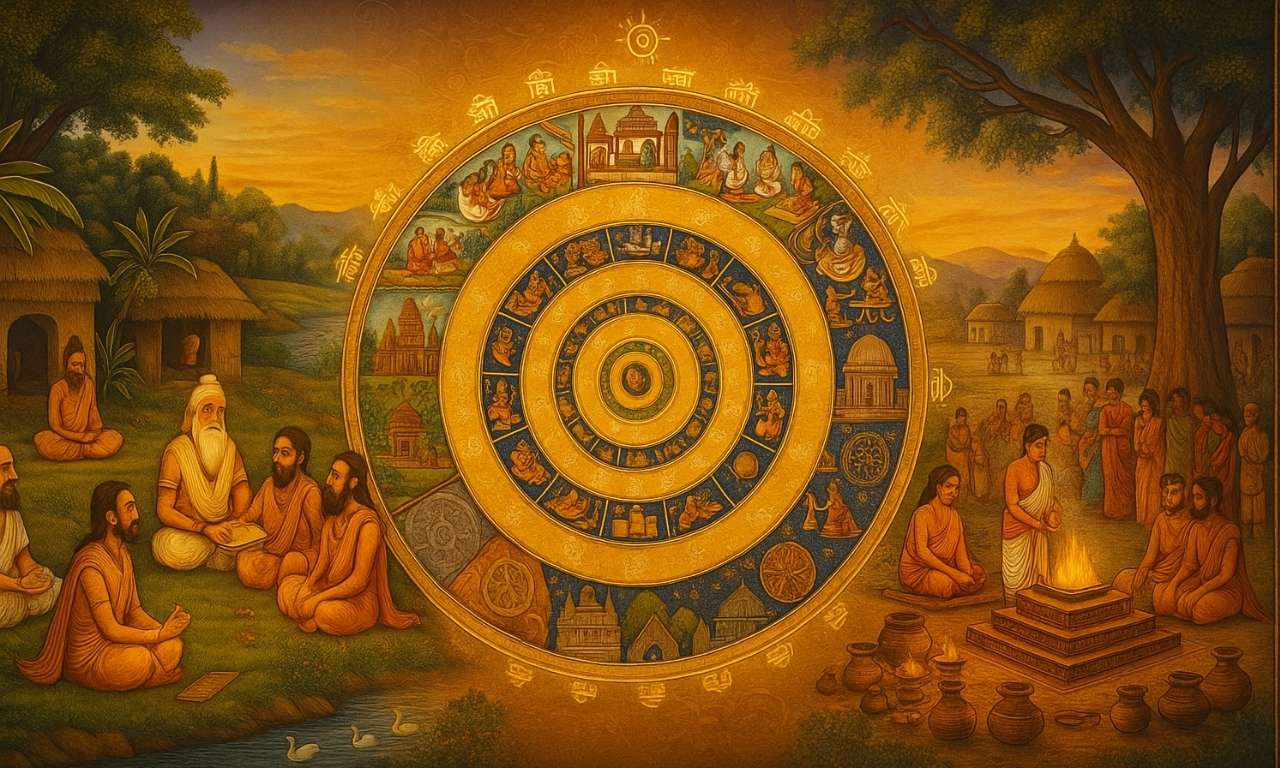
To understand this foundational concept, let's explore the theory behind the origin of Rigvedic religion.
Concept of God in the Rgvedic Religion
The following text, from a research paper on the topic, explains the 'theory of Naturalism' and how the reverence for nature formed the basis of the Vedic pantheon.
Please read the first page of this document (up to the heading 'Theories regarding the problem of Gods -'). Focus on the explanation of the 'theory of Naturalism' and how natural phenomena became objects of worship.
As you've read, the Vedic seers saw divinity in the world around them. This worship, however, was primarily for practical and material purposes. The hymns are filled with prayers for:
- Praja (progeny, especially sons)
- Pashu (cattle and horses)
- Health and long life
- Victory in battle
It was a transactional relationship: offerings were made through fire sacrifices (yajnas) in expectation of boons from the gods. This contrasts with later Indian religious thought, which would increasingly focus on spiritual liberation (moksha).
This article on Vedic gods clearly outlines the motivations behind these sacrifices and invocations.
Please read the short section titled 'Why the gods are worshipped'. This will solidify your understanding of the tangible goals of Vedic religious practice.
Navigating the Pantheon: Polytheism and Henotheism
The Rigveda invokes a large number of deities, a system known as polytheism. However, a unique characteristic of Rigvedic worship gave rise to a special term coined by the scholar Max Müller: Henotheism (or Kathenotheism).
Henotheism is the practice of worshipping one single god as the supreme and ultimate reality at a time, without denying the existence or importance of other gods. In one hymn, Indra might be lauded as the creator and sustainer of the universe; in another, the same praise might be directed at Varuna or Agni.
This approach suggests that the Vedic seers perceived a singular divine power that manifested in different forms, depending on the context of the prayer. This conceptual flexibility is a key feature of their theology.
Concept of God in the Rgvedic Religion
The research paper we looked at earlier provides an excellent analysis of these different theological concepts.
Now, read the section 'Theories regarding the problem of Gods' on the second and third pages. Focus on the definitions of Polytheism, Henotheism, and the early seeds of Monotheism found in the Rigveda.
The Principal Deities of the Rigveda
While the pantheon was vast, a few deities stand out due to the large number of hymns dedicated to them. These gods can be broadly classified into terrestrial (earthly), atmospheric (mid-air), and celestial (sky) categories.
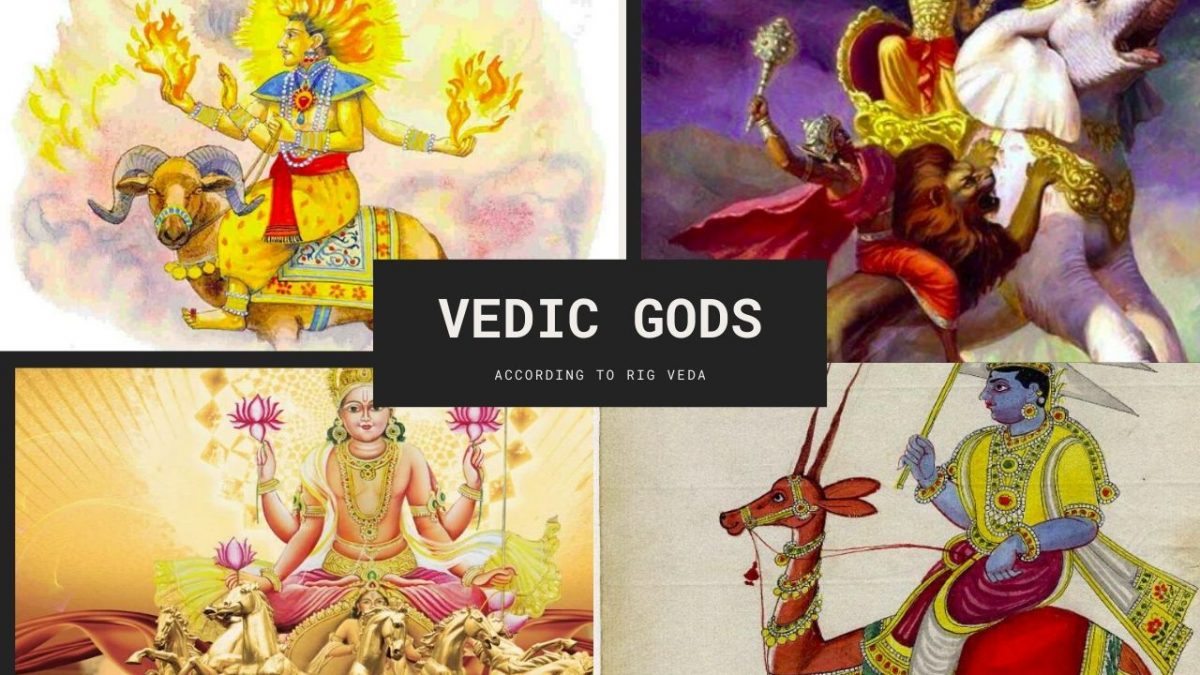
Let's begin with a quick video overview of the most prominent gods.
Early Vedic Age | Complete Ancient History Through Animation | By Aadesh Singh | StudyIQ IAS
This animated video offers a concise introduction to the main figures of the Rigvedic pantheon and their roles.
Please watch from 13:47 to 16:16. Pay attention to the descriptions of Indra, Agni, Varuna, and Soma, and their relative importance.
Now, we will take a deeper look at some of these key figures using the detailed descriptions from the "Gods and Goddess in the Vedas" article.
Please read the following sections from the article 'Gods and Goddess in the Vedas' to understand the specific attributes and significance of the most celebrated Rigvedic deities.
Read the following five sections, which you can find by their headings: Indra: The quintessential warrior-god and king of the heavens. Agni: The god of fire, acting as a crucial messenger between humans and gods. Varuna: The guardian of cosmic law (Rta) and moral order. Soma: The divine intoxicant, a plant, a drink, and a god of inspiration. Surya: The sun god, dispeller of darkness and sustainer of life.
While the pantheon was dominated by male deities, goddesses were also revered, embodying different aspects of nature and life. The most poetically praised among them is Ushas, the goddess of the dawn.
5 Forgotten Vedic Goddesses: Lost Legends of Ancient India
This beautifully animated video focuses on forgotten Vedic goddesses and opens with a compelling description of Ushas, capturing the poetic essence of the hymns dedicated to her.
Watch the segment from 01:54 to 04:02. Notice how Ushas is depicted as a gentle force of awakening, following the eternal rhythm of Rta (cosmic order).
Other important goddesses included Aditi (the boundless mother of gods), Saraswati (initially a powerful river goddess, later the goddess of wisdom), and Prithvi (the earth). Their presence, though less dominant in hymns, shows a holistic deification of the natural world.
Conclusion
The Early Vedic religious system was a direct reflection of the people's environment and lifestyle. It was a sophisticated framework for making sense of the world, engaging with its powerful forces, and seeking prosperity within it.
Key Takeaways:
- Nature Worship: The core of Rigvedic religion was the personification of natural forces (Naturalism). Deities were not abstract beings in a distant heaven but were the sun, the fire, and the storm themselves.
- Transactional Purpose: Worship was primarily conducted to secure material benefits like cattle, sons, health, and victory, not for spiritual salvation.
- Polytheism and Henotheism: While many gods existed (polytheism), the hymns often elevate one god to supreme status for the duration of the prayer (henotheism), suggesting a fluid and context-dependent theology.
- Key Deities: The most prominent gods were Indra (warrior king), Agni (fire-priest and messenger), and Varuna (upholder of cosmic order, Rta). Soma (a ritual drink and a god) and Surya (the sun) were also central.
- Goddesses: Female deities like Ushas (dawn) were revered and praised with some of the most beautiful poetry in the Rigveda.
Preview of the Next Lesson:
The religious landscape we have explored today was not static. As the Vedic people transitioned from a semi-nomadic, pastoral life to settled agriculture in the Gangetic plains, their religious practices evolved dramatically. In our next lesson, we will explain the shift to complex, ritual-centric Brahmanical traditions (yajnas) in the Later Vedic period and analyze their profound social significance, setting the stage for major philosophical and religious transformations.