Introduction
Welcome back! In our last lesson, we navigated the complex and politically charged debate surrounding the Aryan migration theory. We concluded that while the old "invasion" model is defunct, genetic and linguistic evidence points towards a migration of Indo-Aryan-speaking peoples from the Central Asian steppes into the subcontinent around 1500 BCE.
Now, we shift our focus from the origin of the Vedic people to their society. This lesson delves into the world described in their oldest and most sacred text, the Rigveda. Our goal is to describe the political and social organization of Early Vedic society, focusing on its tribal structure (jana, sabha, samiti) and pastoral economy. We will reconstruct a society that was semi-nomadic, tribal, and organized on principles very different from the urban civilization of the Harappans that preceded it.
1. The Pastoral Economy: A World Revolving Around Cattle
To understand Early Vedic society, we must first understand its economic foundation. Unlike the agriculture-centric Harappan civilization, the Rigvedic economy was predominantly pastoral. Cattle were not just livestock; they were the central measure of wealth, a medium of exchange, and the primary motive for conflict.
This economic reality permeated their language and worldview.
- A wealthy individual was called a gomat (one who possesses cows).
- The term for war was gavishti (literally, "a search for cows").
- The tribal chief was often called the gopati (protector of cows).
- Even family relations were defined through this lens: the daughter was the duhitri (one who milks the cows).
This mind map vividly illustrates how central the cow (gau) was to the Rigvedic world.

While pastoralism was dominant, it was supplemented by other activities. The Rigvedic people practiced limited agriculture, primarily cultivating barley (yava). They were also skilled craftspeople, excelling in carpentry (especially chariot-making), metalwork with copper and bronze (referred to as ayas), and weaving. Trade was conducted mainly through a barter system, with the cow as a key unit of value.
Early Vedic Age | Lecture 4: Ancient History of India Series | UPSC | GS History by Aadesh
For a concise overview of this pastoral economy, let's turn to the following video.
Please watch the segment from 11:25 to 13:42. Focus on how the importance of cows is reflected in the terminology for war and the role of priests, and note the absence of a formal revenue system.
This reliance on mobile wealth (cattle herds) rather than fixed assets (land) is fundamental to understanding the semi-nomadic and tribal nature of their social and political structures.
2. Social Organization: A Hierarchy of Kinship
Early Vedic society was not organized around territory but around kinship. A person's identity and loyalty belonged to their lineage and tribe, not to a specific piece of land. The social structure was a hierarchy of expanding kin-groups.
To understand this structure in detail, we will consult a foundational text on Vedic culture. It provides clear definitions of the key social units.
Please read the section titled 'Units of Polity in the Vedic Period' and the summary list that follows it. You will find it by searching for the heading. Pay close attention to the definitions and hierarchy of Kula, Grama, Vis, and Jana.
As you've just read, the structure can be summarized as follows:
- Kula (Family): The basic social unit. It was a large, patriarchal joint family headed by a kulapa or gṛhapati.
- Grama (Village/Kin-Group): A collection of several families. The term likely referred to a band of kinsfolk rather than a fixed territorial village. It was led by a gramani, who acted as a leader in both peace and war.
- Vis (Clan): A larger grouping of several gramas. It was the basic unit for communal activities and was headed by a vispati.
- Jana (Tribe): The highest social and political unit, comprising several clans. The jana was the source of a person's identity and was led by the rajan (the tribal chief). The Rigveda mentions several janas, such as the Bharatas, Purus, and Yadus.
The society, while patriarchal, was largely egalitarian. Occupations were not determined by birth, and the rigid, hierarchical varna system of later times had not yet emerged. Women generally held a respectable position; they could participate in some tribal assemblies and even compose hymns, and practices like child marriage and sati were absent.
Early Vedic Age | Lecture 4: Ancient History of India Series | UPSC | GS History by Aadesh
The following video segment provides a dynamic summary of this social structure, from the family unit up to the tribe.
Now watch the section from 09:30 to 11:25. Note the description of the patriarchal family, the absence of a rigid caste system, and the early, non-hereditary nature of social divisions.
3. Political Organization: Governance by Assembly
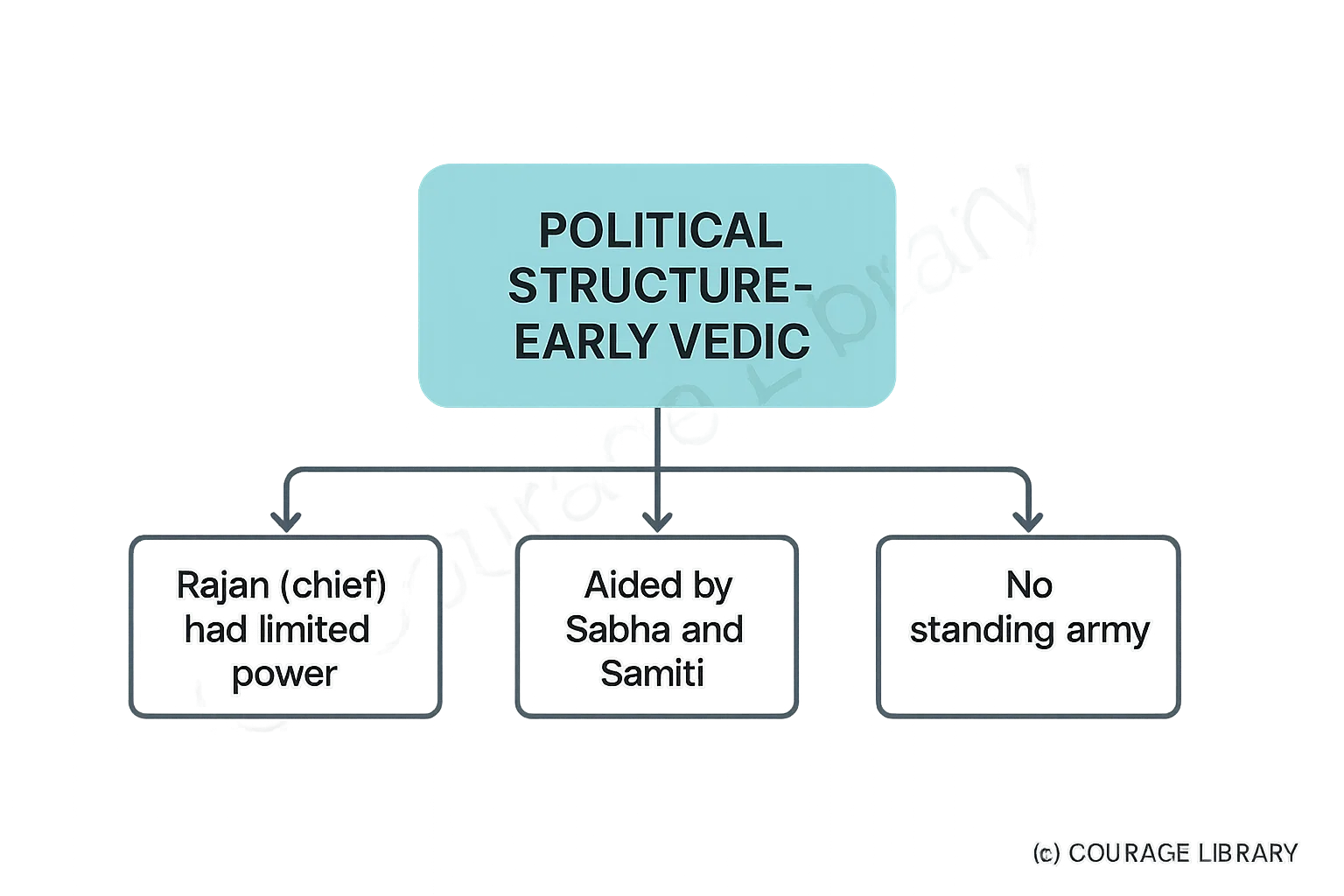
The political structure of the Early Vedic period was as tribal as its social organization. There was no concept of a "state" with a centralized bureaucracy, a standing army, or a formal system of taxation. Power was diffuse and consultative.
The Rajan: A Chief, Not a King
The head of the jana was the rajan. It is crucial to understand that the Rigvedic rajan was a tribal chief, not an absolute monarch.
- His primary duty was military leadership: protecting the tribe's people and cattle from enemies.
- His authority depended on his success in war and his ability to win the support of the tribal assemblies.
- His position was often hereditary, but the tribe, particularly the samiti, had a say in his selection and could potentially depose an unpopular leader.
- He did not collect regular taxes. The polity functioned on bali—voluntary offerings or tribute from the members of the tribe—and the distribution of spoils of war.
The Tribal Assemblies: The Voice of the People
The rajan's power was checked by popular tribal assemblies. These were the primary institutions of governance.
Sabha & Samiti - Lesson 2 - UGC NET History Series - Ancient India - Dr Veenus Jain
To appreciate the distinct roles of these assemblies, this short, focused video provides an excellent deep dive.
Please watch this video from the beginning to 02:06. Pay attention to the comparison of Sabha and Samiti to modern parliamentary houses and the specific functions of each assembly, including the Vidatha.
As the video explained, the three main assemblies were:
- Samiti: This was the main folk assembly of the entire tribe (jana). It was a large body that discussed tribal affairs and policy. Its most important function was the election or re-election of the rajan. Given your background in finance, you can think of the samiti as analogous to a general assembly of shareholders, holding the ultimate power to appoint or remove the chief executive.
- Sabha: This was a smaller, more select body, likely consisting of elders or elite members of the tribe (sabhyas). It served as an advisory council and also had judicial functions, acting as a court of justice. It can be compared to a board of directors.
- Vidatha: Mentioned frequently in the Rigveda, this appears to be the earliest and most diverse folk assembly. It handled a wide range of economic, military, social, and religious matters, including the crucial task of redistributing the spoils of war. Notably, women actively participated in the vidatha.
This system of consultative governance through popular assemblies stands in stark contrast to the autocratic monarchies that would develop later.
Conclusion
The Early Vedic period reveals a society deeply shaped by its pastoral economy and kinship-based organization. It was a world of semi-nomadic tribes where identity was tied to lineage, wealth was counted in cattle, and governance was a collaborative effort between a tribal chief and popular assemblies.
Key Takeaways:
- Pastoral Economy: The economy was primarily pastoral, with cattle being the measure of wealth and the cause of conflict (gavishti). Agriculture was a secondary activity.
- Social Structure: Society was organized along kinship lines in a hierarchy of kula (family), grama (village/kin-group), vis (clan), and jana (tribe). It was patriarchal but largely egalitarian, lacking a rigid caste system.
- Political Organization: The polity was a tribal chiefdom led by a rajan whose power was not absolute. He was primarily a war leader who ruled in consultation with powerful tribal assemblies like the samiti, sabha, and vidatha.
- Absence of a State: There was no standing army, regular taxation, or formal bureaucracy, which are the hallmarks of a state.
Preview of the Next Lesson:
This tribal, pastoral, and relatively egalitarian society was not static. In our next lesson, we will explore the profound transformations of the Later Vedic period. We will see how a shift towards settled agriculture in the Gangetic plains led to the rise of territorial kingdoms, a more complex social hierarchy with a rigid varna system, and a dramatic change in religious practices, setting the stage for the emergence of India's first cities and empires.