Introduction
Welcome to the seventh lesson in our module on the Mauryan Empire. In our previous session, we explored the magnificent art and architecture of the Mauryas, particularly under Ashoka, noting how pillars, stupas, and caves were used as sophisticated instruments of state policy to project power and disseminate the ideology of Dhamma.
As we discussed, these monumental undertakings required enormous investment in resources, labor, and logistics. This brings us to a critical question: could the very cost of projecting such imperial grandeur have contributed to the empire's undoing?
Today, we will investigate this and other possibilities as we address a central puzzle in Indian history: why did this vast, highly organized empire disintegrate so rapidly after Ashoka's death? Our learning outcome is to evaluate the various theories for the decline of the Mauryan Empire, including economic stress, administrative weakness, and Brahmanical reaction. We will move beyond a simple narrative of collapse and instead engage with the major historiographical debates surrounding this pivotal event.
The Multifaceted Nature of Imperial Decline
The fall of a subcontinent-spanning empire is rarely due to a single cause. Historians have proposed a range of interconnected factors to explain the Mauryan collapse. Let's begin with a visual overview of the different lines of argument.
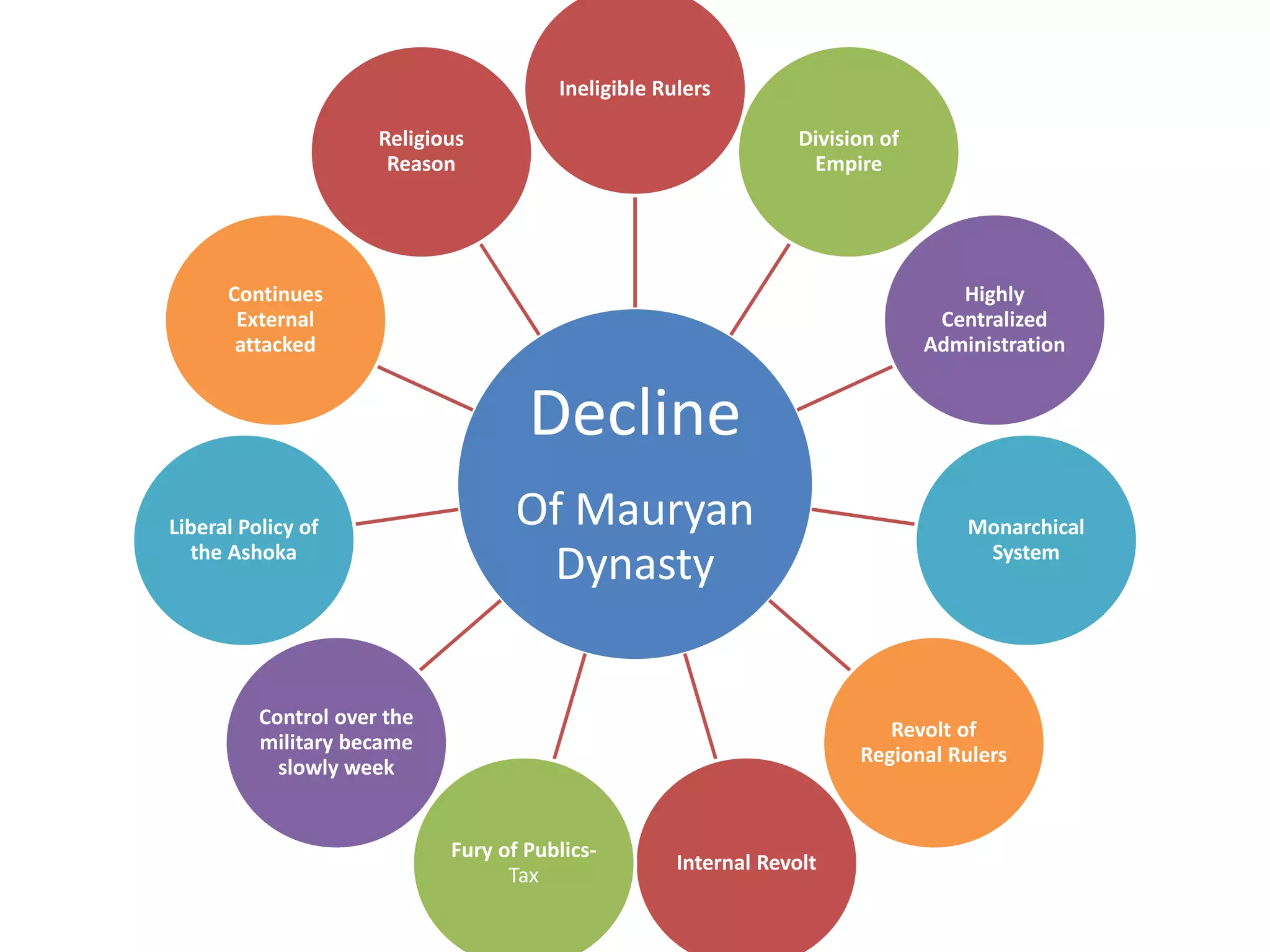
As you can see, the debate is rich and multifaceted. To structure our analysis, we will examine the most prominent theories, looking at the historians who proposed them, the evidence they used, and the critiques that have been raised.
[PDF] Decline of Mauryan Empire : A Historical Debate
To get a sense of the key players and perspectives in this scholarly debate, please start by reading this brief introductory section from the paper 'Decline of Mauryan Empire: A Historical Debate' by Satyajeet Kumar.
Read the first page of the article, stopping at the list of six different views (labeled A to F). Pay attention to how the author frames the problem and lists the key historians (Shastri, Raychaudhuri, Kosambi, etc.) associated with each major theory. This will serve as our roadmap for the lesson.
Unpacking the Theories of Decline
Now that we have a map of the debate, let's dive into the arguments themselves. We'll start with two theories that place the responsibility squarely on Ashoka's policies, though from very different angles.
Mauryan Collapse – Can we really Understand it?
The following video, 'Mauryan Collapse – Can we really Understand it?', provides a concise and critical examination of the two most famous 'Ashoka-centric' theories. It offers a balanced view by presenting both the arguments and the counter-evidence.
Please watch from 02:11 to 10:45. The video will cover two main theories: Brahmanical Reaction (02:11 - 05:15): Focus on how Hariprasad Shastri uses Ashoka's edicts on banning animal sacrifice as evidence for an anti-Brahmin policy, and how the video counters this by citing other edicts. Pacifist Policy (05:15 - 10:45): Note the argument that Ashoka's shift from military conquest (Bherighosha) to cultural conquest (Dhammaghosha) weakened the army. Pay close attention to the video's pragmatic analysis of Ashoka's edicts, especially the Kalinga edict, to challenge this view.
Let's summarize and consolidate what you've just watched and read about these two theories.
1. The Brahmanical Reaction Theory
- Proponent: Hariprasad Shastri.
- Argument: Ashoka's patronage of Buddhism and his policy of Dhamma, particularly the ban on animal sacrifices mentioned in his edicts, antagonized the Brahmin priestly class, whose livelihood and ritual status depended on such sacrifices. This resentment festered and culminated in a "Brahmanical revolution" led by the Brahmin general Pushyamitra Shunga, who assassinated the last Mauryan king, Brihadratha.
- Critique: This theory is now largely discredited. As the video and the article
Decline of Mauryan Empire : A Historical Debatepoint out, other Ashokan edicts (e.g., Major Rock Edicts 3, 4, and 11) explicitly call for showing respect and courtesy to Brahmins as well as to shramanas (ascetics). Ashoka’s policy appears to be one of general tolerance, not targeted antagonism. Furthermore, the coup occurred nearly half a century after Ashoka's death, making a direct causal link to his policies tenuous.
2. Ashoka's Pacifist Policy Theory
- Proponent: H.C. Raychaudhuri.
- Argument: After the bloody Kalinga War, Ashoka abandoned the traditional policy of military expansion ("iron and blood") in favor of non-violence (ahimsa). This pacifism, it is argued, led to a decline in the military's strength and preparedness, leaving the empire vulnerable to internal revolts and external threats (like the later Greek invasions in the northwest).
- Critique: This view is also considered an oversimplification. While Ashoka clearly had a personal revulsion to war, he was a pragmatic ruler.
- There is no evidence that he ever disbanded the army.
- In his edicts, he issues stern warnings to forest tribes, stating that while he prefers persuasion, his power to punish remains.
- Crucially, as noted in the video, the edict expressing remorse over the Kalinga slaughter was conspicuously not displayed in Kalinga itself. The edicts found there have a much sterner, administrative tone. This suggests Ashoka was crafting an image of a pacifist ruler for the wider empire while maintaining firm control where needed.
Economic and Administrative Fault Lines
While the Ashoka-centric theories are compelling narratives, many modern historians believe the roots of the decline were more structural, lying in the economic and administrative fabric of the empire. Given your background in finance and management, these arguments may seem particularly resonant.
3. Economic Stress and Fiscal Crisis
- Proponents: D.D. Kosambi, R.S. Sharma.
- Argument: The Mauryan state, for all its power, was under immense financial pressure. This economic fragility became a key factor in its decline. The sources of this stress were numerous:
- High Overhead: Maintaining a vast standing army and a complex, salaried bureaucracy as described in the Arthashastra was incredibly expensive.
- Public Expenditure: The massive cost of Ashoka's monumental art projects and the extensive tours undertaken by him and his officials drained the treasury.
- Grants: R.S. Sharma suggests that large donations to the Buddhist Sangha may have further strained state finances.
The most innovative evidence for this theory came from historian D.D. Kosambi, who combined his expertise in mathematics with history.
[PDF] Early Indian History and the Legacy of DD Kosambi
Kosambi pioneered the use of numismatics (the study of coins) to diagnose the empire's economic health. The following excerpt from a paper on his legacy explains his method and findings. This provides a fascinating example of quantitative analysis applied to ancient history.
Read the section titled 'Numismatics' (pages 562-563). Focus on how Kosambi used age-weight correlation and statistical analysis of coin hoards to establish a chronology. Understand his central argument: that the debasement of silver coins (reducing their silver content) in the late Mauryan period points to a severe fiscal crisis as the state struggled to meet its massive expenditures.
Kosambi's argument, that the debasement of currency was a symptom of a deep-seated fiscal crisis, provides a powerful economic explanation for the empire's weakening. This pressure on the treasury would have hampered the state's ability to maintain its army, pay its officials, and respond to crises.
4. Top-Heavy Administration and Weak Successors
- Proponent: Romila Thapar.
- Argument: The Mauryan administrative system was highly centralized and critically dependent on the competence of the monarch.
- Personal Loyalty: Officials were appointed by and loyal to the emperor personally, not to the abstract idea of the "state" or the "throne." Under strong rulers like Chandragupta or Ashoka, this system was effective.
- Weak Successors: After Ashoka, his successors were a series of much weaker rulers with short reigns. With a weak center, this personalized, top-heavy administration faltered. Provincial governors, no longer held in check by a powerful emperor, may have become oppressive or asserted their independence.
- Lack of Integration: Thapar also argues the empire was a patchwork of diverse regions at different stages of development. The central administration failed to create a unifying national consciousness or representative institutions that could hold the empire together once the strong hand of the emperor was gone. The loyalty of the people was local, not imperial.
The video you watched earlier briefly touched on this, noting the short reigns of later emperors and the possible division of the empire after Ashoka's death (section from 10:45), both of which support this theory of administrative failure.
Conclusion: A Cascade of Causes
So, what caused the fall of the Mauryan Empire? As we have seen, there is no single answer. The early theories blaming Ashoka's religious or pacifist policies have been largely refined or refuted. The modern consensus points towards a more complex, structural failure.
The most convincing explanation is a cascade of interconnected factors. A highly centralized administration, effective only under brilliant rulers, buckled under a series of weak successors. This administrative decay was exacerbated by severe economic stress, evidenced by currency debasement, stemming from the immense cost of maintaining the imperial machine. As the center weakened, the material culture and technologies (like iron working) that had once given the core region of Magadha a unique advantage had spread to the peripheries, empowering local chiefs to break away.
Ultimately, as the concluding part of the video 'Mauryan Collapse' suggests (from 13:47), a definitive, minute-by-minute account of the collapse is impossible due to the scarcity of sources for the post-Ashokan period. What we can do is evaluate the plausible systemic weaknesses that made the empire so fragile.
Key Takeaways:
- No Single Cause: The decline of the Mauryan Empire was not due to one factor but a combination of long-term structural weaknesses and short-term triggers.
- Beyond Ashoka-centric Theories: While Ashoka's policies had a profound impact, explanations focusing on a "Brahmanical reaction" or "pacifism" are now seen as incomplete. Evidence shows Ashoka was a pragmatic ruler, not just an idealist.
- Economic Strain was Critical: The theory of a fiscal crisis, supported by numismatic evidence of currency debasement, is a powerful explanation. The costs of the vast army, bureaucracy, and public works likely outstripped the state's revenue.
- Administrative Fragility: The empire's top-heavy, centralized structure was its strength under able rulers but its fatal weakness under incompetent ones. The lack of institutionalized loyalty or a common identity meant the empire disintegrated once the center failed.
Preview of the Next Lesson:
The final act of the Mauryan Empire was the assassination of its last ruler, Brihadratha, by his own general, Pushyamitra Shunga. This event was not just an end but also a beginning. In our next lesson, we will begin a new module on Post-Mauryan India by examining the dynasty Pushyamitra founded: the Shungas. We will explore their political and cultural significance and their patronage of both Brahmanical and Buddhist traditions, setting the stage for the next chapter of Indian history.