Introduction
Welcome to your fifth lesson in our exploration of the Mauryan Empire. In our previous session, we analyzed Ashoka's policy of Dhamma, an ambitious project in ethical governance and ideological consolidation. We saw how Ashoka used the state's administrative machinery to propagate a universal moral code. Today, we turn our attention to the material foundations of this vast empire.
A powerful administration and a far-reaching state ideology require immense resources. Where did this wealth come from? The answer lies in one of the most organized and state-controlled economic systems of the ancient world. Our objective for this lesson is to describe the Mauryan economy, focusing on state control of agriculture, mines, and trade networks with the Hellenistic world.
We will investigate how the Mauryan state, guided by the principles of Kautilya's Arthashastra, functioned not just as a tax collector, but as the primary director of the economy—owning land, monopolizing industries, and regulating trade on a continental scale.
1. The Agrarian Foundation: State Control over Land and Revenue
As with most pre-modern empires, the backbone of the Mauryan economy was agriculture. However, the Mauryan state's involvement went far beyond simply taxing farmers. It was a direct participant and a meticulous regulator.
Mauryan Economy: Agriculture, Trade, Tax System & Revenue ...
To understand the core mechanics of the Mauryan agrarian system, please read the following brief overview from the Testbook article on the Mauryan Economy.
Read the section titled 'Agricultural Economy of the Mauryan Empire'. Pay close attention to the distinction between 'Sita Lands' and 'Private Agriculture', and the roles of key taxes.
As you've just read, the state employed a two-pronged strategy to maximize agricultural revenue:
- Direct State Enterprise (Sita Lands): These were crown lands cultivated directly by the state. The Sitadhyaksha (Superintendent of Agriculture) managed these farms, using the labor of slaves, hired workers, and prisoners. The entire produce from these lands went directly to the royal treasury. You can think of this as a portfolio of state-owned agricultural enterprises.
- Taxation of Private Agriculture: The state encouraged the settlement of new lands (Janapadanivesa) and recognized private cultivation. These farmers, in turn, were subject to a systematic taxation regime. The most important taxes were:
- Bhaga: The primary land tax, typically one-sixth of the produce, though it could be as high as one-fourth in fertile regions. This was the main revenue stream from the private sector.
- Udakabhaga: A water tax levied on farmers who used state-provided irrigation facilities.
The state was not a passive tax collector; it was a strategic investor. The construction of irrigation works, like the famous Sudarshan Lake in Gujarat, was a form of capital expenditure designed to increase agricultural productivity and, by extension, the state's tax yield.
2. Strategic Monopolies: Mines, Manufacturing, and State Revenue
Beyond agriculture, the Mauryan state secured control over virtually all strategic resources, creating state monopolies that were crucial for both its wealth and its military power.
Mauryan Economy: Agriculture, Trade, Tax System & Revenue ...
The state's control extended deep into the non-agricultural sector. This section from the same article outlines these key monopolies.
Now, read the section on the 'Non-agricultural Sector of Mauryan Economy'. Focus on which industries were designated as state monopolies.
The state's primary monopolies included:
- Mining: This was perhaps the most critical monopoly. The Arthashastra considers mines the "source of the treasury." The state had exclusive control over the mining of iron (essential for weapons and tools), copper, and precious metals and stones like gold and diamonds. Important mining centers like Suvarnagiri ('Gold Mountain') in the south were under direct imperial management.
- Salt and Liquor: The production and sale of salt and liquor were also state-controlled, providing a consistent and easily taxable source of revenue.
- Armaments and Shipbuilding: The state employed its own artisans (shilpins), such as armorers and shipbuilders, who were exempt from taxes but worked exclusively for the imperial government. This ensured the military was well-equipped without relying on private contractors.
This level of state control over strategic sectors ensured that the empire's military and administrative needs were met and provided substantial revenue streams independent of agricultural cycles.
3. The Arteries of Empire: Trade, Regulation, and the Hellenistic Connection
While agriculture and mining provided the raw resources, it was a vast and tightly regulated trade network that circulated wealth throughout the empire and connected it to the wider world.
To understand the sheer complexity and systematic nature of Mauryan trade policy, we will turn to an analysis based directly on the Arthashastra.
Kautilya’s Arthashastra: The Economic Blueprint Behind Ancient India’s Wealth and Power#sangamtalks
The Sangam Talks video on 'Kautilya’s Arthashastra' provides an excellent breakdown of the Mauryan approach to trade. It reveals a system that is remarkably sophisticated in its structure and regulation.
Please watch the segment from 18:24 to 25:41. As you watch, note the following key aspects of Mauryan trade policy: The dual focus on high-risk, high-value goods and the importance of economies of scale. The rationale behind prioritizing imports over exports. The bureaucratic structure for managing trade, including the roles of the Panyadhyaksha (Superintendent of Trade), Samsthadhyaksha (Market Superintendent), and the Superintendent of Customs. The mechanisms for facilitating internal trade, such as the use of caravans and a form of transit insurance (vartani).
The Hellenistic Connection
One of the most significant aspects of Mauryan external trade was its connection with the Hellenistic world—the Greek kingdoms that emerged after Alexander the Great's conquests.
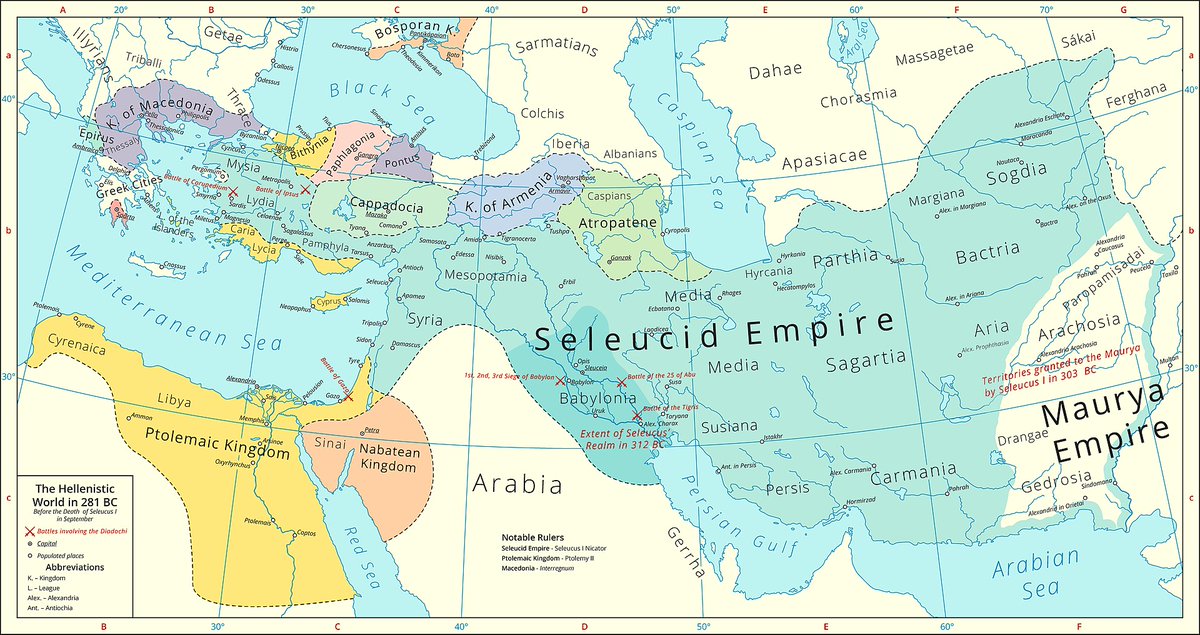
This direct contact facilitated a thriving trade network. Goods flowed along both land and sea routes.

This trade was a two-way exchange:
- Exports from India: Cotton textiles, silk, spices, ivory, pearls, and precious stones.
- Imports to India: High-quality horses (from Central Asia), gold, fine wine, and luxury goods like glass and silver vessels from the Hellenistic West.
The Mauryan state's promotion of a standardized currency, primarily silver punch-marked coins, was essential for facilitating these complex long-distance transactions, moving the economy beyond simple barter.
Conclusion
In this lesson, we have dissected the economic engine of the Mauryan Empire. It was not a laissez-faire system but a highly centralized, state-driven economy meticulously designed for resource extraction and control.
Key Takeaways:
- Agriculture as the Base: The state maximized revenue through a dual system of directly-owned crown lands (Sita) and the systematic taxation (Bhaga) of private agriculture, supported by state investment in irrigation.
- Strategic State Monopolies: The empire maintained direct control over crucial sectors like mining, salt, liquor, and armaments, securing vital resources and revenue streams for the treasury.
- Regulated Trade Networks: The Mauryan bureaucracy, with officials like the Panyadhyaksha, tightly regulated a vast trade network. This network facilitated commerce within the empire and fostered significant trade with the Hellenistic world, exchanging Indian goods for Western luxuries and strategic resources like horses.
- Systemic Approach: The entire economic apparatus, from land management to trade regulation, reflects the systematic and pragmatic principles laid out in Kautilya's Arthashastra, creating the financial foundation for one of India's greatest empires.
Preview of the Next Lesson:
We have seen how the Mauryans administered their empire, formulated its ideology, and funded it. In our next lesson, we will explore how they expressed their power and beliefs through lasting physical forms. We will describe Mauryan art and architecture as instruments of state policy, focusing on Ashokan pillars, stupas, and rock-cut caves.